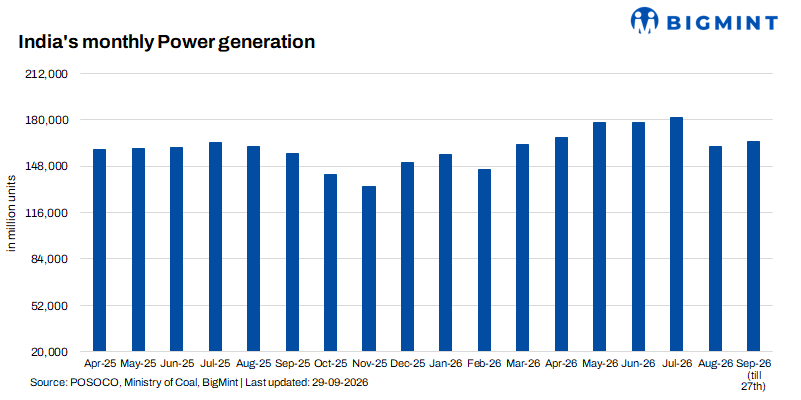
- Till date generation in Sep rises nearly 12% as hydro drops 20%
- Coal stocks fall 7.27 mnt; Section 11 measures expanded
India’s power demand remained unusually strong through much of September 2026, while an uneven monsoon constrained hydro generation. Coal filled most of the resulting gap, but the additional output came at the cost of a steep decline in power plant stocks. Demand and exchange prices eased in the final days of the month; rebuilding those stocks is now the test.
During 1-27 September, maximum demand met averaged 247.3 GW, compared with 217.6 GW in the corresponding period of 2025. It reached 269.1 GW on 10 September. Total generation rose 11.6% y-o-y to 157.01 TWh.

Hydro was the clear underperformer, producing 4.35 TWh less than a year earlier. Renewables added 5.78 TWh, and gas and nuclear output also increased. Coal nevertheless provided the largest response: its generation rose 12.21 TWh, equivalent to roughly 75% of the net increase in total generation. Coal’s share of the mix increased by 1.2 percentage points to 64.6%.
An uneven monsoon leaves a hydro shortfall
IMD data cited for 6 June’26 September show 749.2 mm of rainfall against a normal 853.4 mm, a 12% deficit. Although this remains within IMD’s broad “normal” classification, rainfall has varied sharply by region and over time. IMD’s assessment through 23 September put both east and northeast India and the south peninsula 26% below normal. Skymet had downgraded its seasonal forecast in August to 85% of the long period average; that was a forecast, rather than the final observed outcome.
For hydro plants, the national rainfall total matters less than sustained inflows into their catchments. September’s generation figures show the consequence of the uneven season. With hydro contributing a smaller share just as electricity requirements rose, coal plants had to run harder.
The southwest monsoon began withdrawing from western Rajasthan on 19 September and had retreated from much of northwest India by 23 September. IMD expects conditions to favour further withdrawal during 1-7 October and forecasts below normal rainfall nationally that week, while allowing for rain in some regions. A broad near term rebound in hydro generation therefore cannot be assumed.
WMO expects the established El Niño to strengthen and persist into early 2027. This increases uncertainty around future rainfall and temperature patterns, but it does not, by itself, establish a particular outcome for India’s winter or next summer.
IEX prices ease after a strained start
The supplied IEX series shows 4.72 TWh of final scheduled volume during 1-27 September, 9.7% above the comparable 2025 period. The simple average daily market clearing price more than doubled to INR 6,970/MWh, from INR 3,351/MWh.
The month had two distinct phases. Prices averaged INR 7,747/MWh during 1-22 September, reaching INR 8,648/MWh on 16 September. As demand eased and offered supply increased, they averaged INR 3,554/MWh during 23-27 September. Scheduled volume in those final five days rose to 1.33 TWh. The price reversal signals immediate relief in the market balance, though it does not mean that fuel inventories have recovered.
Coal stocks expose vulnerable plants
CEA reports show stocks at the covered power plants declining from 29.12 mnt on 31 August to 21.85 mnt on 27 September, a fall of 7.27 mnt, or 25%. Holdings dropped from 48% to 37% of normative requirement, and the number of plants classified as critical increased from 51 to 82.
The remaining coal is distributed unevenly. On 27 September, Rajasthan’s RRVUNL fleet held just 13% of normative stock, Haryana’s HPGCL 12%, Andhra Pradesh’s APGENCO 14%, and Maharashtra’s MAHAGENCO 22%. Among individual stations, Panipat TPS stood at 2% and Suratgarh TPS at 6%. These figures indicate vulnerability, although actual running time also depends on coal receipts and plant load.
Three measures, three different roles
The government has directed coal based captive power plants of 50 MW and above to generate to the maximum extent of their available capacity from 1 October to 31 December, offering surplus power after captive use through the exchanges. The order could add supply, but those plants must also secure enough coal to operate.
Separately, Section 11 directions for Tata Power’s imported coal based Mundra plant have been extended through 31 December. Continued output from this large station can support supply without consuming domestic coal. The verified extension is specific to Mundra; it should not be described as a new blanket order for all imported coal based plants.
A third measure — requiring domestic coal based plants to blend up to 5% imported coal — remains under consideration, rather than in force. If adopted, its effect would depend on coal availability, landed cost, delivery and suitability at individual stations.
Retreating rain may help mining and transport, while the late September decline in demand creates an opportunity to rebuild stocks. The decisive question for October is whether coal receipts can consistently exceed consumption. Until then, higher captive output and Mundra’s continued operation can support electricity supply, but the domestic coal plants with the thinnest inventories remain exposed to another demand surge.
Leave a Reply