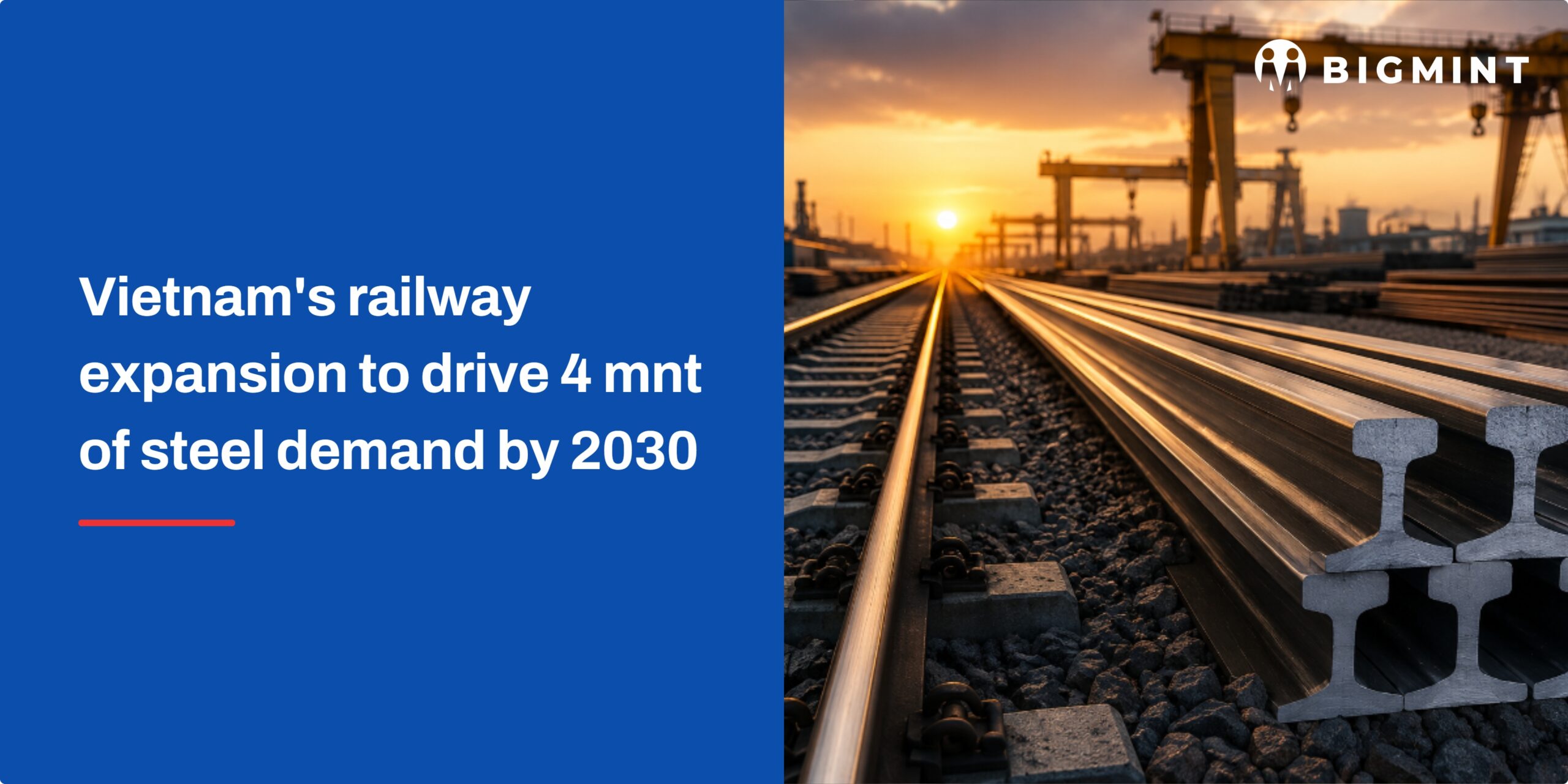
- Development of high-speed and urban railway networks driving demand
- Hoa Phat adds 700,000-t annual rail capacity; Vinmetal expands output
Vietnam is expected to require around 4 million tonnes (mnt) of railway rails between 2026 and 2030 as it accelerates the development of high-speed and urban railway networks. The growing demand has prompted domestic steelmakers to invest in dedicated rail production facilities to support upcoming infrastructure projects.
According to an MB Securities (MBS) report citing Vietnam’s Ministry of Construction, the country’s railway projects are expected to require approximately 28.7 million metres of rail, equivalent to nearly 4 mnt, over the next five years.
The North–South High-Speed Railway, Hanoi–Hai Phong–Lao Cai Railway, and Ho Chi Minh City Urban Railway projects are expected to account for the bulk of demand. MBS added that actual requirements could exceed current estimates if other planned projects, including the Hanoi–Quang Ninh Railway and Ben Thanh–Can Gio Railway, also move forward.
Domestic steelmakers ramp up investments
Vietnam’s largest steel producer, Hoa Phat Group, is constructing a railway rail and special steel plant in the Dung Quat Economic Zone in Quang Ngai Province, with an annual production capacity of 700,000 tonnes (t).
The company plans to begin commercial production of high-speed railway rails in the first quarter of 2027. Output is expected to reach around 400,000 t in 2027 before increasing to the plant’s full annual capacity of 700,000 t from 2028.
The facility will manufacture high-speed railway rails of up to 100 metres in length, along with urban railway rails, crane rails, H-beams, and I-beams. The products will comply with international standards, including EN 13674 (Europe), JIS E1120 (Japan), and TB/T 2344 (China).
While MBS estimated the project’s total investment at around VND 14 trillion, Hoa Phat has officially announced an investment of more than VND 10 trillion. According to MBS, the higher estimate includes additional costs such as working capital.
Meanwhile, Vinmetal, a steel company affiliated with Viet Phat Group, is also advancing railway rail production in cooperation with Formosa Ha Tinh Steel. The proposed integrated steel project has a design capacity of 5 mnt per year, with the first railway rail products expected by the end of 2026.
MBS forecasts Vinmetal’s railway rail production will increase from around 600,000 t in 2027 to approximately 3.5 mnt by 2030. The company is also collaborating with Primetals Technologies to develop a large-scale integrated steel complex in Ha Tinh Province that will produce billets, plate products, and railway rails.
Supply-demand gap likely before capacity expansion
Despite these investments, MBS expects Vietnam’s domestic railway rail supply to remain insufficient during 2027-2028, as newly commissioned facilities will require time to ramp up production and stabilise operations.
From 2029 onwards, however, expanding production at Hoa Phat and Vinmetal is expected to gradually narrow the supply-demand gap. MBS believes Vietnam’s large-scale railway infrastructure programme will become a key driver of domestic steel demand and a new growth engine for the country’s steel industry.
Note: This article is published as part of a content exchange agreement between SteelDaily and BigMint.
Leave a Reply