- Shipments to Manila halt after protectionist restriction
- Exporters seek alternative markets, shifts to premium grade rice
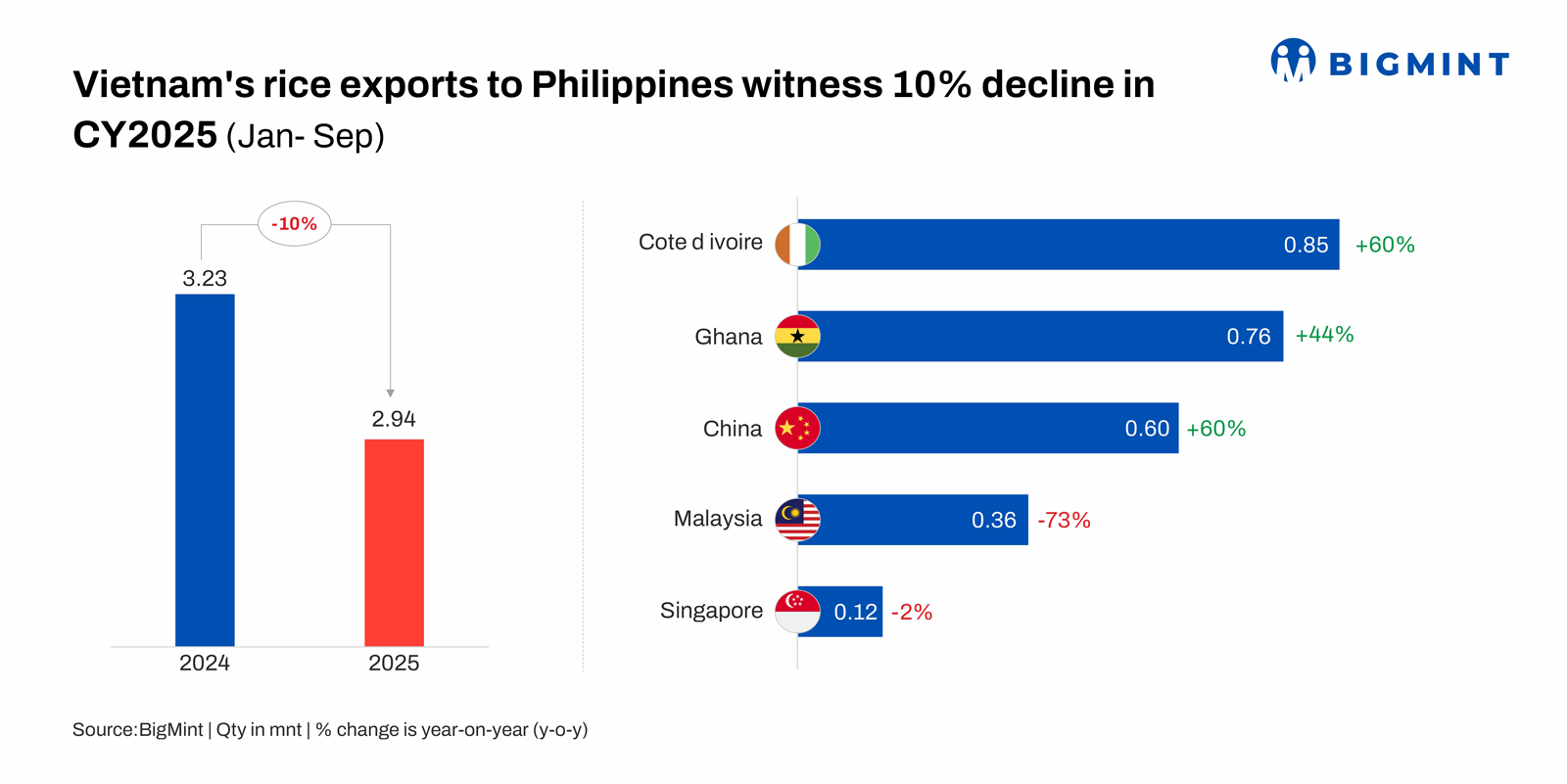
Vietnam’s biggest rice buyer, the Philippines, has stopped importing rice following the extension of an import ban on the staple grain that was introduced in September to protect local farmers from cheaper imports. Shipments to the Philippines fell 10% y-o-y in Jan–Sept to 2.94 million tonnes from 3.23 million tonnes, leaving exporters scrambling to redirect volumes. The ban has disrupted forward contracts, freight planning and allocation strategies, keeping sentiment subdued amid uncertainty over when Manila may resume purchases.
To offset the shortfall, Vietnam deliveries to other markets — China imported 5.9 million tonnes in Jan–Sept, up nearly 60% y-o-y from 2.4 million tonnes, strengthening its role as the second-largest buyer. West Africa surged as a growth engine, with Côte d’Ivoire buying 8.5 million tonnes and Ghana 7.6 million tonnes rising about 60% and 44% y-o-y respectively as the region becomes a crucial outlet for Vietnamese rice.
In contrast, demand from key ASEAN partners softened. Malaysia’s imports plunged to 3.6 million tonnes from 6.2 million tonnes a 73% y-o-y decline as the country pushes for rice self-sufficiency and explores cheaper alternatives while local output improves. Singapore edged down marginally to 1.21 million tonnes from 1.24 million tonnes, a 2% drop as per BigMint data.
Vietnam pivots to premium-grade rice
Despite the loss of its top customer, global demand for Asian rice is still strong. Vietnamese exporters are now redirecting their shipments to other markets and focusing more on premium, fragrant, and high-quality rice varieties.
According to Vietnam Food Association chairman Do Ha Nam, Vietnam faces limited competition in the high-quality rice category, which should help keep exports stable in the 8 – 9 million tonne range once the market adjusts. This is part of Vietnam’s longer-term strategy to move away from low-margin bulk white rice and earn higher returns from better-quality grain.
Policy shift and climate pressures
Over the long term, Vietnam’s rice exports may gradually decrease. Policymakers are considering reducing rice cultivation area to encourage farmers to diversify into other crops as climate risks increase.
In the Mekong Delta Vietnam’s key rice-growing region many farmers are already switching to shrimp aquaculture and higher-value crops because of problems such as salinity intrusion and erratic rainfall.
This suggests that even if global demand stays strong, Vietnam’s export volumes may structurally remain lower in the future.
Outlook
Vietnam’s rice exports are likely to drop by about 11.5% in 2025 to around 8 million metric tons. Vietnam is expected to export less rice in 2025-26, mainly because of the Philippines ban. However, the financial impact may be limited since the country is moving toward high-value rice varieties that bring better prices and higher margins.
In the longer run, shifting farm priorities and climate pressure may keep export volumes lower, but Vietnam is positioning itself to earn more per ton rather than sell the maximum quantity.
Leave a Reply