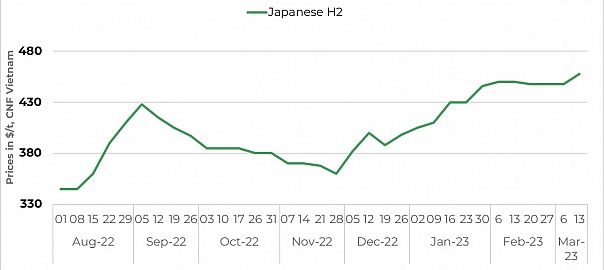
Imported scrap prices to Vietnam continued to rise w-o-w, reflecting bullish moods in the global market specifically in Turkiye and Japan Kanto scrap tender. In this context, Vietnamese steel mills increased their bids slightly. However, these are yet to match market price levels.
Japanese H2 scrap was offered at around $455-460/t CFR Vietnam last week after most suppliers increased their offers based on the Kanto tender result. Prices moved up significantly by $10-15/t w-o-w, whereas, bids hovered around $450/t PCFR.
Offers for bulk HMS 1&2 (80:20) scrap from the US, rose by $10-15/t to $475/t CFR Vietnam, while the buyers’ price idea was $20/t lower.
Market participants are cautious about scrap procurement at higher levels as the market for the finished product demand is still inadequate. The country continued to tighten its monetary policy, which has affected the construction sector, SteelMint learnt.
The Ministry of Construction (MOC)’s 2022 real estate report said that the total number of transactions was 14,600 apartments, the lowest level in the last five years, as per reports.
The market has seen an imbalance between supply and demand, with an oversupply in the high-end segment but a shortage of affordable housing construction. However, experts have urged property firms to make efforts themselves first instead of relying too much on government’s support measures.
On the other hand, Vietnam’s BF-grade billets export offers remained stable at around $630-640/t FOB during last week.
Overview of other South Asian scrap markets
- Thailand: Thailand’s scrap market continued to maintain silence, and no major deal was recorded in the last week. Shredded scrap offers were heard at $460/t and HMS 1&2 (80:20) at $425/t CFR from Caribbean-and Australian-origin.
- Indonesia: Imported scrap offers for HMS 1 were at $440-445/t CFR, whereas PNS was heard at $465/t CFR levels. However, deals mostly remained absent due to bids-offers disparity.

Leave a Reply