- US imports of zinc semis continue to outpace its exports of ore, concentrate, scrap
- New Clarksville capacity may reduce US refined zinc import dependence after 2029
The United States (US) imported 275,033 tonnes (t) of zinc across all categories during January-May 2026, up 7.34% y-o-y from 256,236 t in the corresponding period last year, according to trade data.
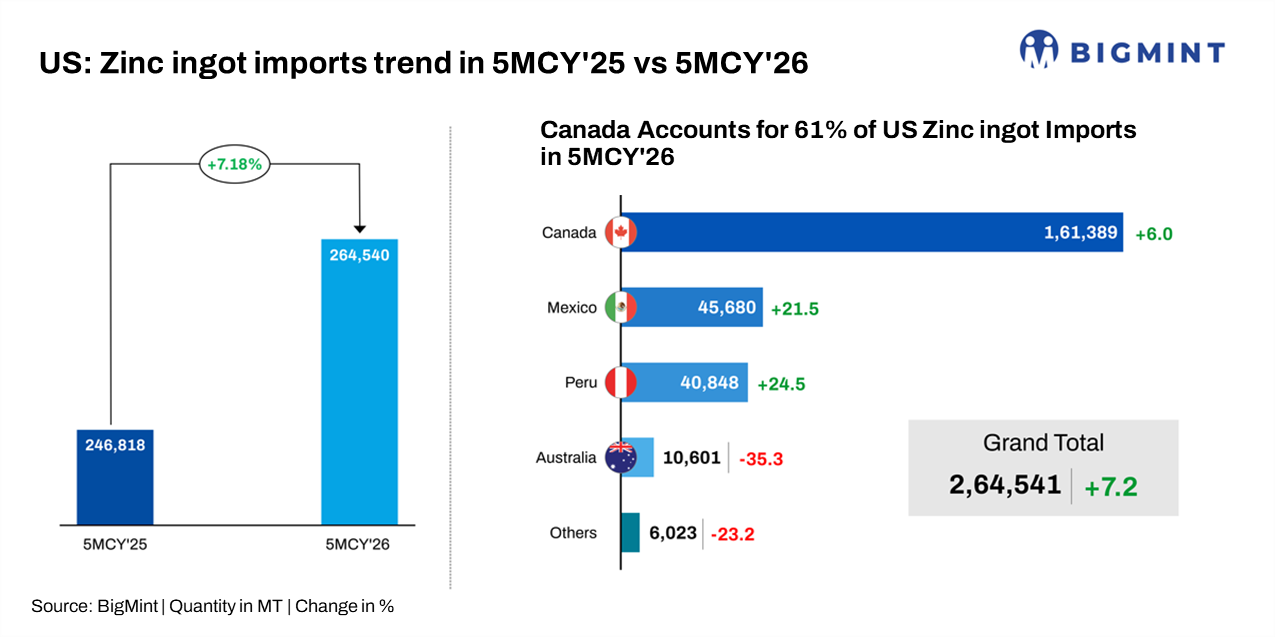
Nearly all of the increase came from semi-finished zinc ingots, which rose 7.18% y-o-y to 264,541 t and represented around 96% of total imports. The figures reinforce a defining feature of the US zinc market: despite being a significant zinc miner, the country remains structurally dependent on imported zinc ingots to meet downstream manufacturing demand.
Ingot imports continue to shape US zinc trade
Zinc ingot imports declined 7.63% m-o-m to 46,562 t in May from 50,407 t in April, pointing to softer procurement in recent months. Even so, the broader growth trend remained unchanged. During January-May, semi-finished imports reached 264,541 t, while finished long products, finished flat products and zinc scrap combined totalled just 10,492 t.
The imbalance reflects more than trade preferences. Zinc ingots are the principal feedstock for galvanising, alloy production, die-casting, and industrial fabrication, making them a direct indicator of downstream manufacturing activity. With limited domestic smelting capacity, imported refined metal continues to bridge the gap between US mine output and industrial consumption.
Although the US remains a major zinc concentrate producer — led primarily by Teck Resources’ Red Dog mine in Alaska — it exports much of that concentrate for overseas processing. Nyrstar’s Clarksville, Tennessee facility remains the country’s only operating primary zinc smelter, with capacity of roughly 120,000 t per year, leaving imports as the primary source of refined supply for downstream industries.
Flat products gain momentum
Growth within finished zinc products was uneven. Imports of pipes and tubes increased 56.15% y-o-y to 4,797 t, while rolled zinc plate imports rose 18.59% to 874 t during January-May. M-o-m, rolled plate imports climbed 305.36% in May to 227 t, albeit from a low base.
By contrast, imports of bars, rods, profiles and wire declined 14.12% y-o-y to 1,502 t. The divergence indicates stronger demand for flat zinc products than long products, suggesting procurement patterns are evolving across downstream manufacturing segments.
Why does supplier concentration matter?
US zinc imports are becoming increasingly concentrated among a handful of suppliers. Canada, Mexico, and Peru together supplied approximately 0.25 million tonnes (mnt) during January-May 2026, accounting for nearly 89% of total imports, compared with around 85% a year earlier.
Canada alone supplied roughly 0.16 mnt, supported by geographic proximity, integrated North American manufacturing networks and USMCA trade arrangements. The country accounted for 61% of US semi-finished zinc ingot imports during the period. Mexico and Peru also recorded strong y-o-y growth, while Australia’s share declined.
Greater supplier concentration improves logistical efficiency and supply-chain integration but also increases exposure to disruptions affecting a limited group of trading partners. As import dependence deepens, supplier diversification is likely to become increasingly important for downstream consumers.
Exports remain centred on raw materials
The US exported 86,505 t of zinc during January-May 2026, up 2.7% y-o-y. Ore and concentrate remained the dominant export category at 58,581 t, while zinc scrap exports rose 7.9% y-o-y to 10,796 t. Semi-finished exports also increased 4.2% y-o-y to 17,129 t, although they remained far below the volume of semi-finished zinc imported during the period.
The export mix reinforces the structural imbalance in the US zinc market: the country continues to export significant volumes of upstream material while importing much larger quantities of semi-finished zinc to meet domestic manufacturing requirements. Canada remained the largest destination for US semi-finished zinc exports, followed by South Korea, Malaysia, Mexico and Belgium.

Mirror image of China’s strategy
The US zinc trade structure contrasts sharply with China’s. While Chinese smelters have increasingly imported concentrates and converted them into higher-value refined and semi-finished products, the US continues exporting a significant share of its mined concentrate while importing the semi-finished metal required by domestic manufacturers.
This pattern is unlikely to change materially before new domestic capacity comes online. Korea Zinc began construction in 2026 on an integrated non-ferrous metals complex at Clarksville with an estimated investment of $6.6-7.4 billion. Designed to process around 1.1 mnt of raw materials annually into approximately 540,000 t of finished non-ferrous products, the project is not expected to begin phased commercial production before 2029.
Zinc trade remains largely outside Section 232 tariff regime
Unlike steel, aluminium, and more recently semi-finished copper products, zinc has largely remained outside the scope of expanded US Section 232 tariffs. That has allowed semi-finished zinc imports to continue flowing with relatively limited policy disruption, preserving established North American supply chains.
Any future extension of Section 232 measures to zinc products could reshape sourcing strategies, particularly given the country’s heavy reliance on imported semi-finished metal.
Outlook
The first five months of CY’26 reinforce the structural characteristics of the US zinc market rather than signalling a cyclical shift. Semi-finished imports continue to dominate supply, supplier concentration is increasing around North America and the Andean region, and downstream demand remains dependent on overseas refined metal.
With only one operating primary zinc smelter and major new refining capacity still several years from completion, the current trade model is unlikely to change in the near term. Until additional domestic processing capacity becomes operational, semi-finished zinc imports will remain one of the clearest indicators of the health of US downstream zinc manufacturing.

Leave a Reply