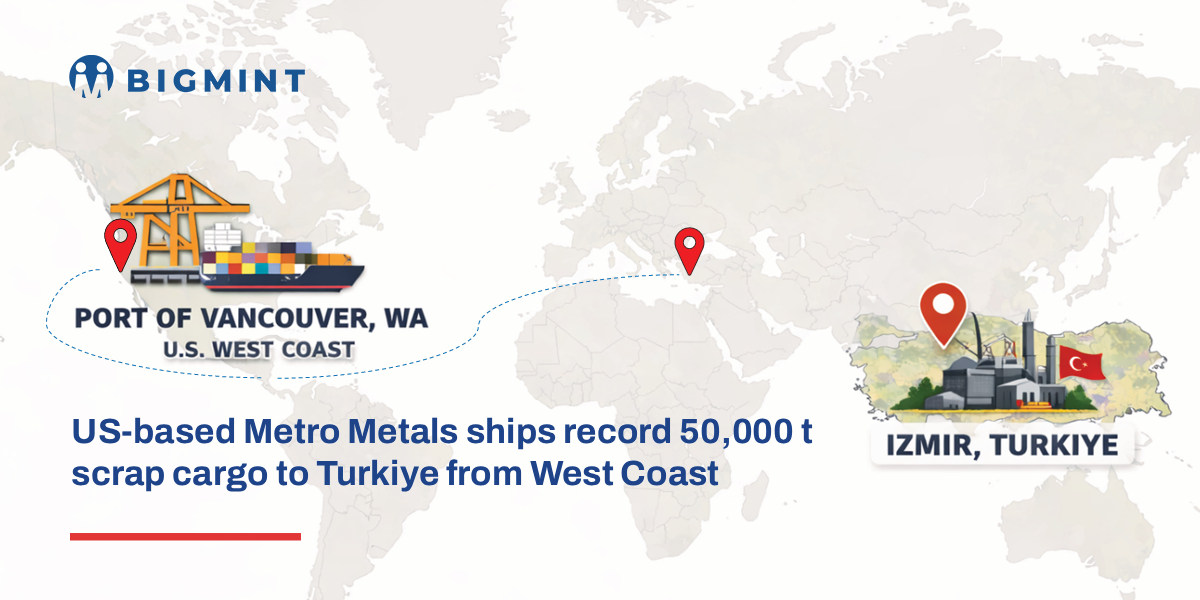
- Tightening European supply prompts shift to West Coast cargoes
- Mills seem willing to absorb extra costs to ensure supply security
Metro Metals, a US industrial-based scrap metal supplier and processor, moved a record 50,000 tonnes (t) of ferrous scrap from the Port of Vancouver, Washington, to Izmir in December — the largest scrap cargo ever shipped from the port.
Typically, US scrap flows to Turkiye are anchored on the East Coast, while West Coast cargoes surface only occasionally. Market participants interpret this shift as a sign of tightening European scrap availability and weak South Asian bulk scrap inquiries, pushing Turkish mills to widen their sourcing lens.
The deal came together through Metro Metals’ long-standing Hong Kong brokerage relationships, which helped open doors with Turkish smelters. Once buyers were comfortable with the quality, the cargo was quickly wrapped up.
The shipment reflects a practical shift for Metro Metals, as softer demand across Asia pushed the exporter to look beyond its usual markets, with Turkiye emerging as a natural alternative after a well-received first cargo.
Freight-driven premium: US West Coast scrap typically lands $30-50/t higher than East Coast cargoes into Turkiye, with the gap almost entirely explained by freight rather than FOB scrap prices.
Longer voyage, higher cost: West Coast routes run over 11,000 nautical miles and take 25-30 days, compared with 12-15 days from the East Coast, tying up mills’ working capital for longer. US West Coast scrap has therefore traditionally flowed into Asia, with Turkish shipments limited to periods when supply security outweighed freight economics.
Late-2025 shift: Market disruptions opened a narrow arbitrage window, prompting several vessels to be booked from the US West Coast into the Izmir region and signalling a gradual change in sourcing behaviour.
According to a major trading source, a handful of large Turkish mills have begun booking West Coast cargoes in 2025. Delivery delays–particularly around February–have, however, tempered near-term confidence and kept buying cautious.
Against a backdrop of tight European collections and weather-related supply disruptions, mills have shown a greater willingness to absorb higher freight costs to secure reliable volumes. Even so, most continue to rely on prompt European cargoes for immediate needs while assessing the reliability of longer-haul West Coast supply, despite additional bookings for 2025 delivery.
Asia demand softened: Prolonged monsoons, policy shifts in India, financing constraints in Bangladesh, and higher Chinese steel exports reduced regional scrap intake, leaving fewer outlets for West Coast exporters. In contrast, Turkish mills were willing to pay around $20/t premiums for shredded scrap over HMS, versus roughly $5-8/t in South Asia, helping offset higher freight and longer delivery times.
Metro Metals operates from its Portland headquarters, with additional facilities in Portland, Vancouver, and Tacoma (Washington), and Denver, Englewood, and Brighton (Colorado). Turkish buyers also noted that the supplier’s ability to deliver large, consistent parcels with dependable quality strengthened confidence in an increasingly tight global scrap market.
Leave a Reply