- European prices rise but muted Turkish demand weighs on sentiment
- Weak demand pulls down prices in Brazil but tight supply caps drop
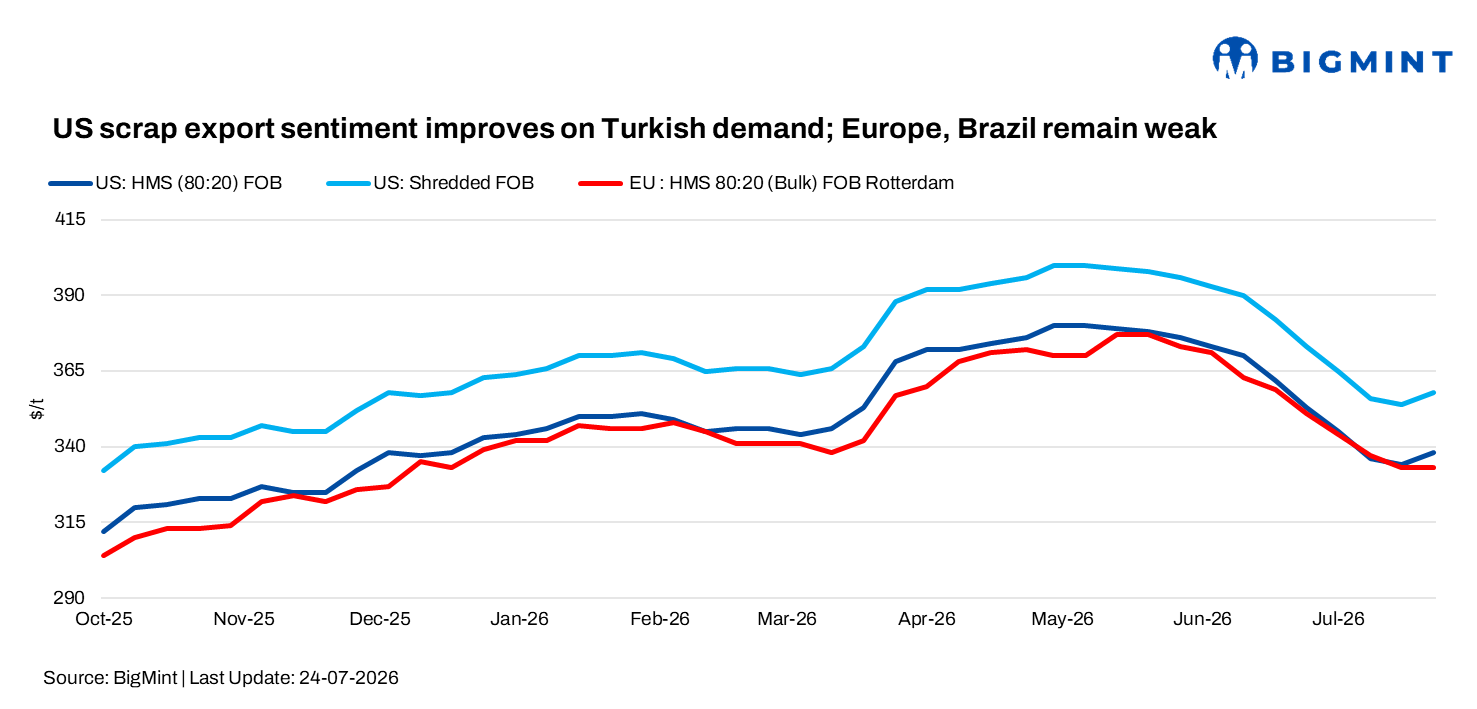
Atlantic ferrous scrap markets showed mixed trends during the week ended 24 July. Stronger deep-sea demand from Turkiye supported US export prices, while European sentiment remained pressured by seasonal demand weakness despite firmer Benelux dockside prices. In Brazil, domestic scrap prices declined amid sluggish steel demand, although limited scrap generation helped prevent steeper price drops.
US
Export sentiment improved during the week as FOB US HMS 80:20 increased to $338/t and FOB shredded scrap rose to $358/t, supported by stronger deep-sea demand, particularly from Turkiye. However, containerized export scrap prices weakened, especially on the US West Coast, amid slow demand and typical seasonal summer trading. Meanwhile, the domestic ferrous scrap market remained largely stable during the week, although market participants expect additional pressure in August as healthy scrap supply and scheduled mini-mill maintenance outages could outweigh demand.
Domestic prices for busheling, shredded, plate, and structural, and HMS remained unchanged w-o-w, while some mills are expected to seek lower prices for obsolete grades in the next buying cycle. Despite firmer finished steel prices, abundant scrap availability continued to weigh on sentiment. Participants also noted that increased pig iron restocking may partially displace prime scrap demand, although imported pig iron remains relatively expensive.

Europe
Scrap export sentiment remained under pressure during the week, although FOB Rotterdam HMS 80:20 remained stable at $333/t, while Benelux dockside HMS 80:20 increased to EUR 280-285/t ($319-325/t) DAP amid firmer collection prices. Demand across Germany weakened sharply as summer holidays and scheduled mill maintenance reduced scrap consumption.
Participants highlighted that lower EU steel import quotas, ongoing geopolitical challenges in the Middle East, and US tariffs continued to pressure Turkish steel exports, indirectly affecting European scrap demand. Additionally, low water levels on Germany’s inland waterways disrupted logistics, adding further challenges to the regional scrap trade.
Brazil
Ferrous scrap prices weakened during the week as several steelmakers reduced domestic purchase prices amid sluggish finished steel demand and adequate inventories. Market participants said mills had aligned scrap inventories with lower production levels, while weaker steel sales continued to weigh on procurement.
However, recyclers noted that scrap generation remained limited, which is expected to prevent any significant further decline in prices. HMS 80:20 was at BRL 750-800/t ($148-157/t) FOT, down BRL 50/t ($10/t) w-o-w, turnings at BRL 650-700/t ($128-138/t) FOT, and clean steel scrap at BRL 850-900/t ($167-177/t) FOT.
Meanwhile, export sentiment remained subdued due to weaker overseas demand, with FOB HMS 80:20 holding at $285-290/t and FOB shredded scrap unchanged at $310-315/t.

Leave a Reply