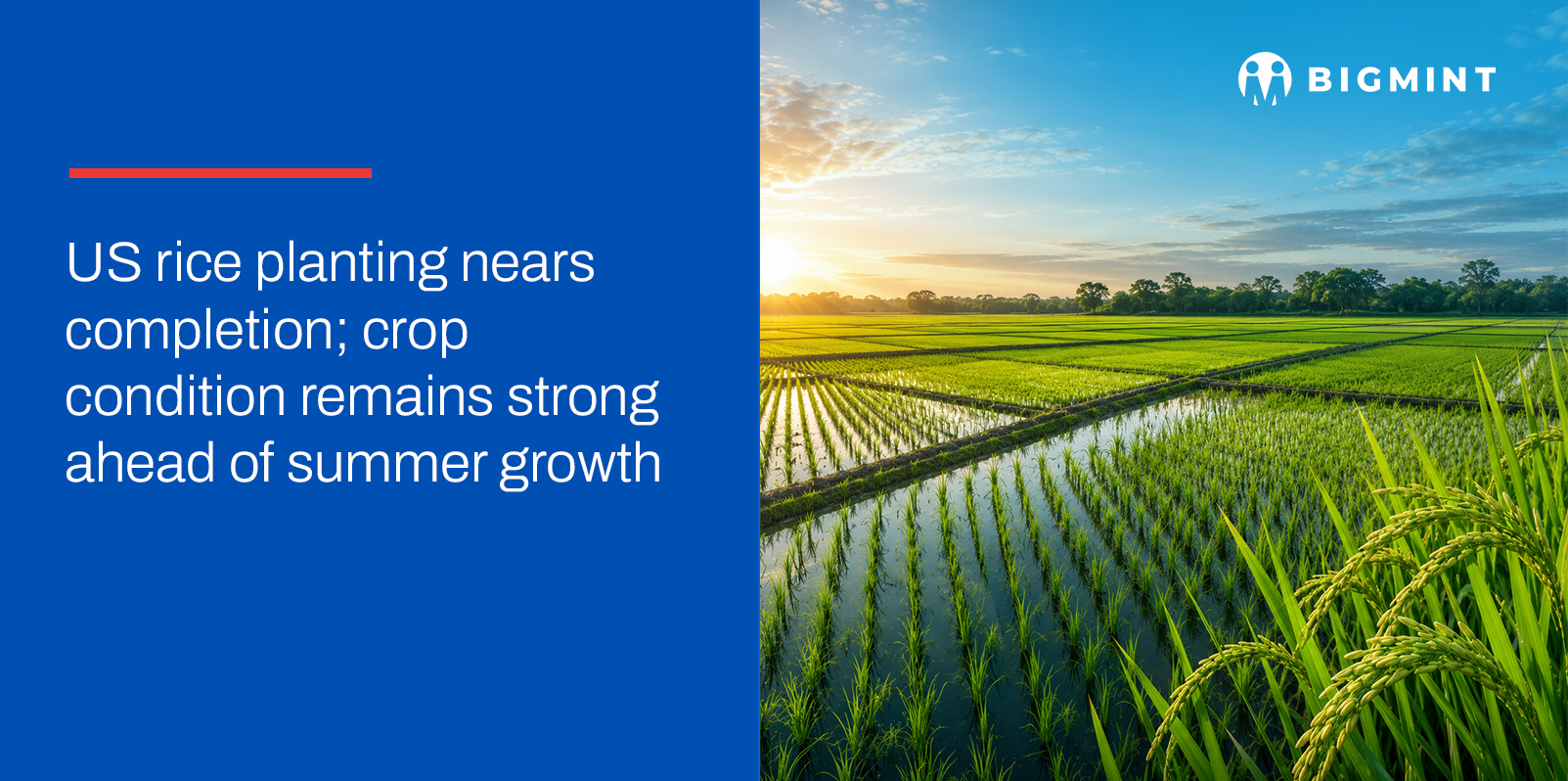
- Rice planting 98% complete as of 31 May
- Around 72% of the crop rated good-to-excellent
The US rice crop entered the summer growing season on a positive note, with planting operations nearing completion and crop conditions remaining largely favourable across major producing regions. According to the latest USDA crop progress update, rice planting reached 98% completion as of 31 May 2026, slightly ahead of both the five-year average of 97% and last year’s level of 96%, reflecting favourable field conditions and steady planting progress.
Planting nearly complete across key states
Rice planting is now virtually complete across most US producing regions, with California remaining the only major state still finishing field operations. The state reported 90% planted area, only marginally below its five-year average of 92%, a pace that remains consistent with its typical planting calendar.
California generally completes rice sowing later than southern producing states due to differences in climate, irrigation schedules and water management practices. As a result, the current planting progress is not expected to affect overall production prospects.
Crop emergence ahead of normal
Crop establishment has also progressed well, with 87% of the US rice crop emerged as of 31 May, two percentage points above the five-year average and matching the level recorded during the same period last year.
The faster emergence reflects favourable temperature and moisture conditions across key rice-growing regions, providing a solid foundation for vegetative growth as the crop moves into the critical summer development phase.
Crop condition remains encouraging
The latest USDA assessment indicates that the overall health of the US rice crop remains robust. Approximately 72% of the crop is rated good-to-excellent, while only 3% is classified as poor-to-very poor, suggesting limited production stress despite normal regional weather variations.
Although crop ratings are marginally below the exceptionally strong levels reported a year ago, they continue to indicate favourable yield potential across major producing states. Healthy crop conditions at this stage reduce the likelihood of significant production losses, provided weather conditions remain supportive through the reproductive and grain-filling stages.
Market implications
The near-completion of planting and strong early-season crop conditions reinforce expectations of stable U.S. rice production in 2026. A healthy crop outlook could improve export availability later in the marketing year, particularly for long-grain rice supplied to markets in Latin America, the Middle East and other traditional destinations.
However, market participants will closely monitor weather developments during the summer months, as excessive heat, tropical systems or prolonged dryness during heading and grain filling could still influence final yield outcomes.
Outlook
With planting almost complete, emergence progressing ahead of historical norms and nearly three-fourths of the crop rated good-to-excellent, the US rice sector enters the next stage of the growing season on a favourable footing. Unless adverse weather disrupts crop development, current field conditions point toward a stable production outlook, which could help maintain ample export supplies and moderate price volatility in the global rice market during the coming months.
Leave a Reply