- Turkiye remains largest export destination despite 4% decline in shipments
- Shipments to key Asian markets plunge amid unfavourable import economics
- Higher scrap consumption, crude steel production limit US export growth
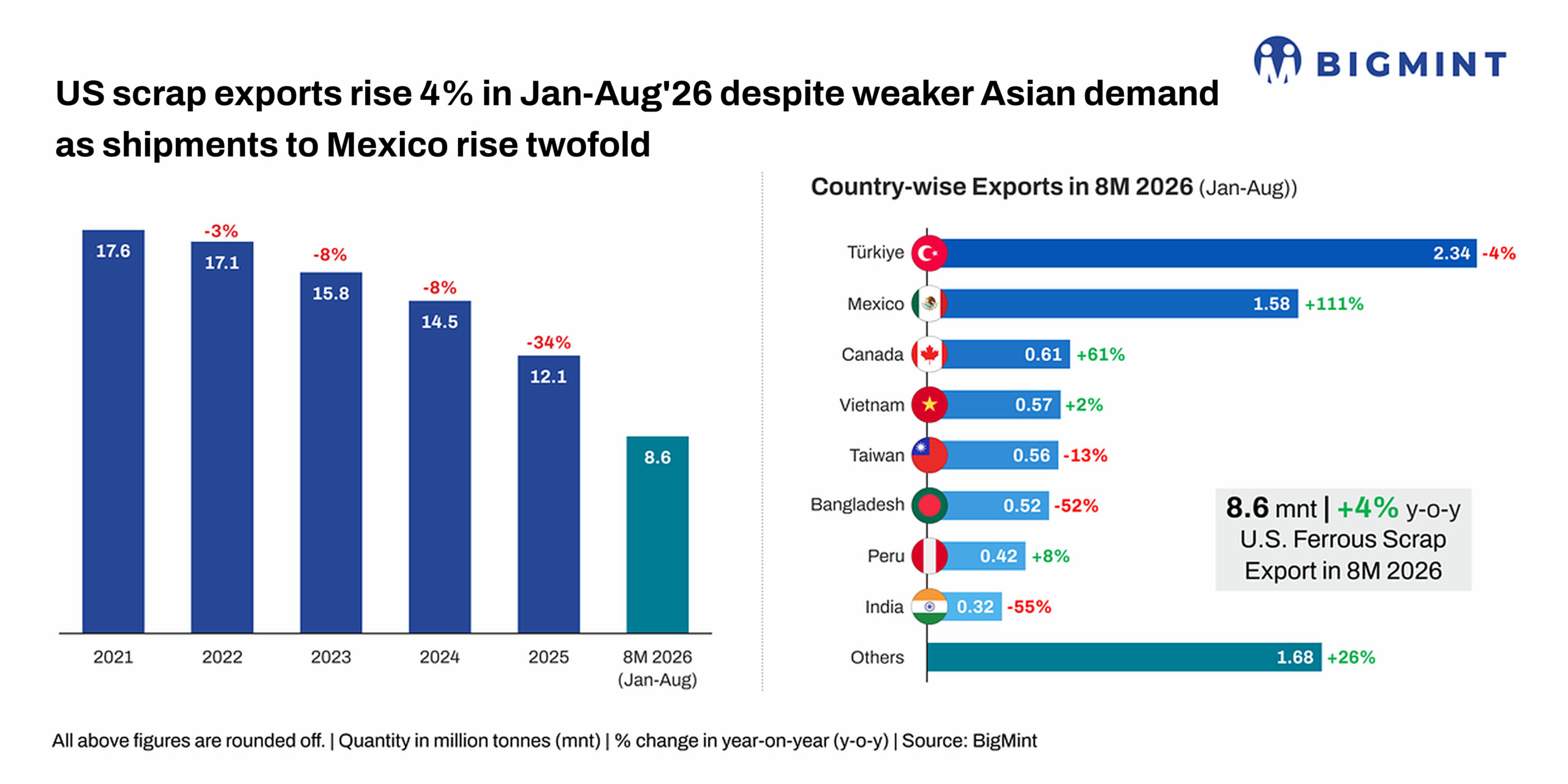
Morning Brief: US ferrous scrap exports rose 4% y-o-y to 8.60 million tonnes (mnt) during January-August 2026 (8MCY’26) from 8.29 mnt a year earlier, according to data compiled by BigMint.
The increase was driven primarily by a sharp recovery in shipments to Mexico and stronger demand from Canada, Peru, and Vietnam, which offset lower purchases from India, Bangladesh, Taiwan, and Turkiye. The shift suggests that US scrap trade flows have become more diversified, with stronger North American demand partly offsetting weaker Asian buying.
Turkiye remains largest buyer despite 4% drop
Turkiye remained the largest destination for US ferrous scrap during 8MCY’26, although shipments declined 4% y-o-y to 2.34 mnt.
Turkish buying strengthened during March and the second quarter as mills replenished inventories amid disruptions to global semi-finished steel trade following the temporary closure of the Strait of Hormuz. Reduced availability of competitively priced Asian billets improved the relative appeal of scrap-based steelmaking and supported deep-sea procurement. However, buying became more selective as finished steel demand softened and mills returned to need-based purchasing.
Turkish scrap imports fluctuated during the third quarter, rising in July before declining in August as mills reduced procurement after covering their requirements. High borrowing costs, a weakening lira, and subdued manufacturing activity constrained procurement, while collection and freight costs kept delivered scrap prices firm. Need-based procurement continued through July and August before demand improved in September.
Mexico, other North American markets drive export growth
US scrap shipments to Mexico more than doubled to 1.58 mnt during 8MCY’26, making the country the largest contributor to export growth. Stronger crude steel production and higher electric arc furnace (EAF) utilisation increased Mexico’s demand for scrap-based steelmaking inputs. The country’s crude steel production increased by 12% y-o-y to 10.2 mnt during the period.
Industry estimates put Mexico’s ferrous scrap consumption at more than 18 mnt in 2025, compared with domestic generation of around 14 mnt. This supply-demand imbalance supports the need for external sourcing, while the proximity of US suppliers offers logistical advantages.
Shipments to Canada increased 61% y-o-y to 0.61 mnt even as the country’s crude steel production fell 5% to 7.3 mnt. Established trade links allow Canadian mills to source US-origin scrap through integrated cross-border supply networks, supporting the movement of raw materials between the two markets.
Exports to Peru also increased 8% y-o-y to 0.42 mnt, adding to the gains from Mexico and Canada and helping US suppliers compensate for lower demand from several traditional destinations. The shift towards North American markets was particularly important because exports to India and Bangladesh fell by a combined 1 mnt compared with the corresponding period last year.
Asian buyers reduce US-origin scrap purchases
India and Bangladesh recorded the steepest declines among major US scrap destinations. Shipments to India fell 55% y-o-y to 0.32 mnt during 8MCY’26, from 0.71 mnt, as higher international scrap offers reduced the attractiveness of imported material for Indian mills, encouraging greater use of domestic scrap and alternative raw materials.
Exports to Bangladesh declined 52% to 0.52 mnt from 1.08 mnt. Higher freight costs and weaker price competitiveness reduced the appeal of US-origin material, prompting buyers to source more actively from alternative suppliers.
Japan emerged as Bangladesh’s largest supplier, with shipments rising 31% y-o-y to 0.77 mnt. Imports from Singapore increased 78% to 0.32 mnt, while those from Australia rose 72% to 0.31 mnt. The increase in shipments from these origins suggests that Bangladesh’s lower purchases from the US partly reflected a change in sourcing rather than a contraction in its overall scrap requirements.
The weakness across these Asian destinations reflects the cautious Asian buying environment seen during the second quarter, when elevated international scrap prices, unfavourable import economics, and subdued finished steel demand limited procurement appetite.
US steel production growth boosts domestic scrap demand
US domestic scrap consumption increased 9% y-o-y to 42.2 mnt during 8MCY’26, from 38.6 mnt, while crude steel production rose 6% to 57.5 mnt. Domestic scrap generation also increased 9% to 38.5 mnt from 35.4 mnt, reflecting higher material availability alongside stronger steelmaking activity.
The increase in consumption alongside higher output indicates sustained demand for scrap from US steelmakers, particularly EAF producers. Although rising generation added to domestic supply, higher mill consumption absorbed much of the additional material, limiting the extent of export growth.

US scrap imports rose 15% y-o-y to 3.7 mnt from 3.2 mnt, while pig iron imports declined 4% to 3.67 mnt from 3.81 mnt.
Against this backdrop, export growth was driven less by a broad increase in overseas demand than by a shift in destination markets, with Mexico and Canada providing the strongest support.
Export prices remain above year-ago levels
US ferrous scrap export prices averaged $375/t FOB US East Coast for shredded scrap during 8MCY’26, up 9% y-o-y from $345/t. HMS 80:20 prices also increased 9% to $355/t from $325/t.

Prices were supported by stronger Turkish buying during March and April, resilient US steelmaking activity, and relatively tight availability in the international scrap market. However, seasonal weakness in finished steel demand, slower construction activity, and more cautious mill procurement weighed on sentiment towards the end of the second quarter.
On the US West Coast, firm Asian demand and limited availability of US-origin scrap also supported prices. The easing of energy restrictions in Taiwan and higher Chinese and Russian billet prices narrowed buyers’ alternatives, encouraging Asian mills to pay more for US scrap.
Outlook
US ferrous scrap exports are likely to remain dependent on the balance between Turkish deep-sea demand and the recovery in North American shipments. Mexico’s rebound has been central to the increase in exports so far, but sustained growth will depend on whether cross-border demand remains firm.
Additionally, Turkish procurement may increase, given that limited availability of competitively priced Russian and Chinese billet has increased the appeal of imported scrap. However, high financing costs and subdued finished steel demand could limit the scale of buying.
Prices are also likely to strengthen in the fourth quarter as seasonal collection slows and steelmakers seek to secure feedstock amid healthy production and order books. Market participants expect potential increases of $20-50/t by year-end, although the extent of any rise will depend on scrap availability, mill purchasing, and competing metallics prices.
Leave a Reply