- Emirates Steel rolls over January rebar prices
- VAT policy to favour domestic scrap consumption
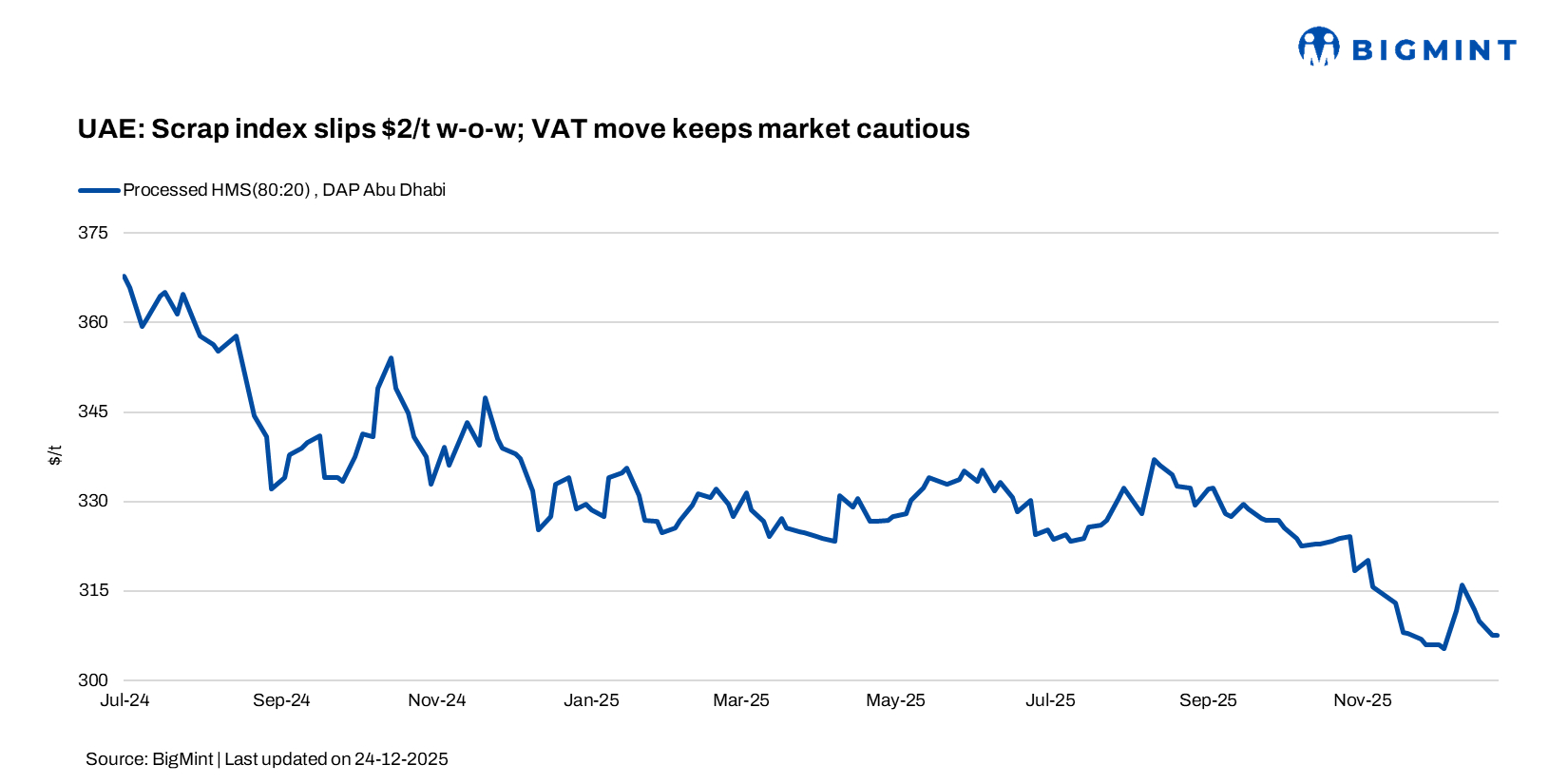
The UAE’s domestic scrap index declined by AED 9/t ($2/t) on 24 December as compared to 17 December, with processed heavy melting scrap (HMS) falling to AED 1,130/t ($308/t) as of 24 December.
A market insider noted that the last heard levels were AED 1,120-1,130/t ($305-308/t) for processed HMS, AED 1,090-1,100/t ($297-299/t) for HMS, and AED 1,150-1,170/t ($313-319/t) for shredded scrap. Some volumes were sold at lower levels to large exporters due to cash-flow constraints.
Fabrication scrap is currently quoted at AED 1,140-1,150/t ($310–313/t), while end-cut scrap is assessed slightly higher at AED 1,170-1,180/t ($319–321/t)
A representative of a major mill said current DAP levels are assessed at AED 1,135-1,140/t ($310-311/t) for processed HMS, AED 1,100-1,110/t ($299-302/t) for HMS, and AED 1,140-1,160/t ($311-316/t) for shredded scrap.
Mills remain largely stable and are adopting a wait-and-watch approach toward year-end, with no immediate urgency to revise buying levels.
Market participants are seeking clarity on the recently announced VAT reverse charge mechanism and are assessing whether it will lead to any tangible, real-time impact once implemented in the market.
UAE steel market
Emirates Steel Arkan (ESA) rolled over its Jan’26 rebar prices at AED 2,648/t ($721/t) exw-Abu Dhabi, excluding 5% VAT, marking the third consecutive month of price stability.

The offer is valid on 90-day LC terms, with an additional AED 92/t ($25/t) surcharge on 8 mm rebar. Market sentiment remains cautiously positive, supported by steady construction demand, with mills opting for selective price adjustments rather than a broad-based increase.
UAE to implement VAT reverse charge on scrap from January 2026
The UAE will introduce a VAT reverse charge mechanism on domestic scrap metal trading from 14 January 2026. The rule applies to both ferrous and non-ferrous scrap used for recycling, reprocessing, or remelting.
Under the new system, VAT shifts from scrap sellers to VAT-registered buyers, mainly steel mills and large processors. Sellers will stop charging VAT, while buyers will self-account, improving cash flow, reducing tax leakages, and enhancing transparency.

Scrap exports remain under standard VAT rules, making domestic sales more attractive and indirectly supporting scrap retention. The move is widely seen as a compliance-driven measure aligned with the UAE’s circular economy and industrial sustainability goals.
The UAE approved a record AED 92.4 billion ($25.2 billion) zero-deficit federal budget for 2026, up 29% y-o-y. For the steel sector, this signals limited federal infrastructure support, with demand driven mainly by emirate-level budgets, PPPs, and private investment, led by Dubai and Abu Dhabi.
Spending prioritises social development (37%), government affairs (29%), and financial investments (17%), while infrastructure receives just 3%.
Outlook
UAE scrap and steel markets are expected to remain muted in the near term, with mills in wait-and-watch mode and limited pricing upside as Emirates Steel Arkan rolls over January rebar prices. A clearer direction is likely only after VAT reverse charge implementation and post-year-end demand normalisation.
Leave a Reply