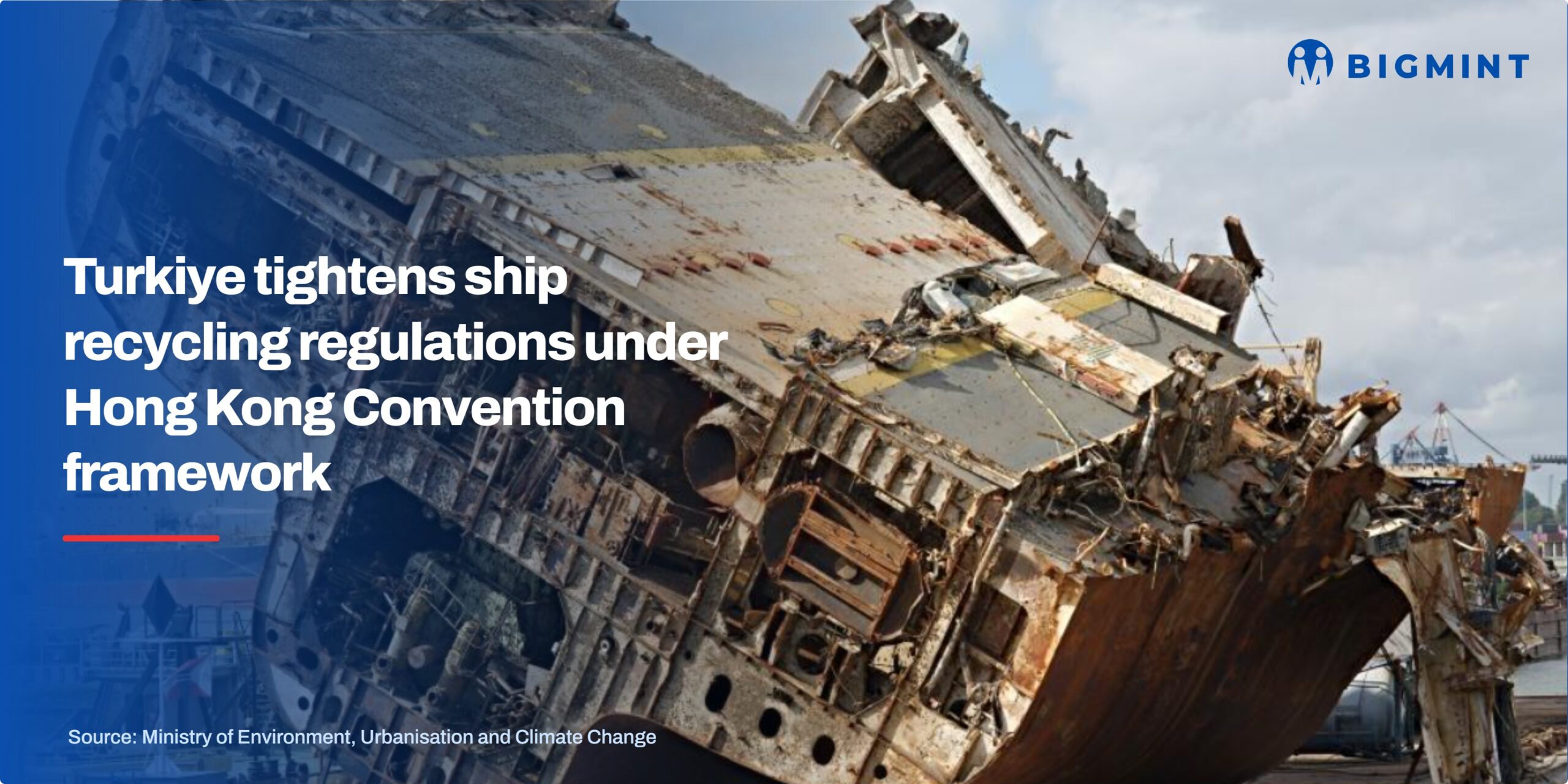
- Move comes after calls to remove Turkiye from EU’s recycling list
- Yards will receive recycling authorisation certificates valid for 5 years
SteelOrbis: Turkiye’s Ministries of Environment, Urbanisation and Climate Change and Transportation and Infrastructure have published a new regulation governing the authorisation, operation, inspection and enforcement of ship recycling facilities in line with the 2009 Hong Kong International Convention for the Safe and Environmentally Sound Recycling of Ships.
The regulation applies to ship recycling facilities operating in Turkiye and, in specific circumstances, to certain public facilities engaged in ship recycling activities outside the convention’s scope.
The move follows calls from organisations including the European Steel Association (EUROFER), Recycling Europe, and the NGO Shipbreaking Platform for stricter oversight of non-EU ship recycling facilities and the removal of Turkish shipbreaking facilities from the EU-approved recycling list until environmental and operational standards are improved.
Authorisation, operational requirements strengthened
Under the new framework, ship recycling facilities must obtain authorisation from the relevant ministry before conducting recycling activities. To receive authorisation, facilities are required to prepare a Ship Recycling Facility Plan (SRFP) outlining operational procedures and organisational structures, as well as a Ship Recycling Plan (SRP) for each vessel scheduled for dismantling. Each SRP must receive ministry approval before recycling operations can begin.
Facilities that satisfy documentation requirements and pass on-site inspections will receive a Ship Recycling Authorization Certificate valid for up to five years. The certificate is facility-specific and cannot be transferred. The regulation requires operators to establish management systems focused on environmental protection and occupational safety. Hazardous materials and waste must be handled in accordance with environmental legislation, while facilities must provide employee training, personal protective equipment, and emergency response procedures.
The regulation introduces detailed environmental monitoring requirements. Facilities must conduct annual monitoring of seawater, sediment, and marine life and submit the results to the Ministry of Environment, Urbanization, and Climate Change. Critical equipment, including lifting systems, pressure vessels, storage tanks, electrical installations, and fire protection systems, must undergo regular inspections by authorised bodies.
Inspections and recycling procedures
Inspection activities will be carried out by the ministry and the Inspection, Determination and Audit Commission (ITDK). Both scheduled and unannounced inspections may take place during the validity period of authorisation certificates.
Facilities intending to receive ships for dismantling must notify the relevant port authority in advance. Ships cannot enter recycling facilities or begin dismantling operations without an International Ready for Recycling Certificate and completion of all required notifications. After recycling operations are completed, facility operators must submit a completion report to the ministry within 14 days.
New fines, suspension mechanisms introduced
The regulation establishes a range of administrative penalties for non-compliance. Facilities operating contrary to approved recycling plans may face fines of TRY 100,000 ($2,152). Beginning recycling activities without the required notification or failing to cooperate during inspections can result in fines of TRY 500,000 ($10,761). Operating while an authorisation certificate is suspended may trigger penalties of TRY 1 million ($21,522).
Unauthorised on-site ship recycling activities are also subject to fines of TRY 1 million for the responsible parties, while individual workers involved may face penalties of TRY 100,000.
The article is published as part of a content-sharing agreement between SteelOrbis and BigMint.
Leave a Reply