- Recovery in European demand expected once uncertainty over CBAM clears
- Industry aims to raise exports to 20 mnt in 2026 from around 19 mnt in 2025
SteelOrbis: The Turkish steel industry’s growth strategy has been reshaped by the contraction in global markets, rising protectionist measures, and price pressures, according to Adnan Aslan, chairman of Turkish Steel Exporters’ Association (CIB). He stated that in the coming period, the industry will focus on nearby and neighbouring regions rather than on distant markets while emphasising that structural transformation in the product mix is essential for sustainable export growth.
Highlighting that global steel prices remain under significant pressure, driven by China’s high export volumes and global oversupply, Aslan noted that, under these conditions, growth is only possible through correct market selection and flexible export strategies.
2026 export targets – 20 mnt and $17 billion
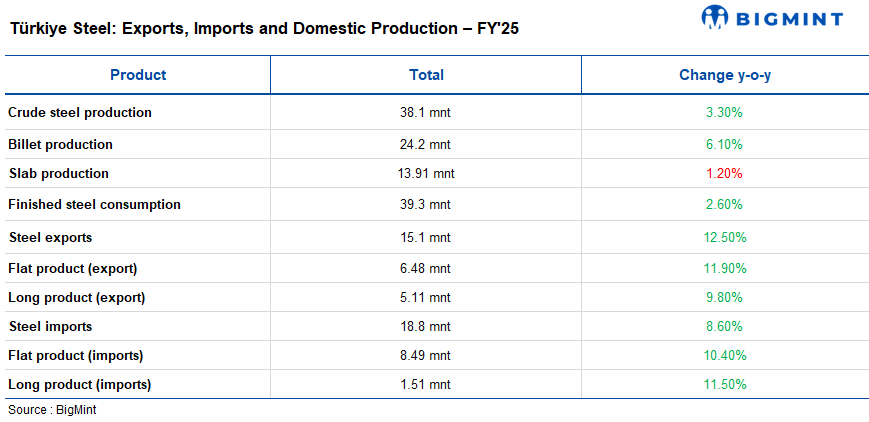
For 2026, the Turkish steel industry has set export targets of 20 mnt in volume and $17 billion in value from 19.43 mnt and $16.5 billion, respectively, in 2025.
Nearby markets at centre of strategy
Stating that the industry will prioritise geographically closer markets over overseas destinations with high logistics costs, Aslan noted that the European Union, non-EU European markets, the Balkans, eastern Europe and neighbouring countries have been identified as key target regions.
At the same time, Aslan pointed out that uncertainty surrounding the Carbon Border Adjustment Mechanism (CBAM) has been one of the main reasons behind stagnation in the European market. He added that, once the process becomes clearer, a recovery in Europe is expected, particularly from March and April onward.
Shift towards value-added products
Noting that the second pillar of the new growth strategy is a shift toward value-added products, the CIB chairman stated that long products, especially rebar, still account for a significant share of exports, emphasising that rebar has limited added value and that this structure is not sustainable. In the medium and long term, he said the Turkish steel industry aims to increase the share of higher value-added products such as cold rolled, galvanised, and pre-painted steel, as well as fasteners and stainless steel.
Through this transformation, the Turkish steel industry aims to move away from direct price competition with low-cost producers from China and India and transition to a more balanced export structure.
Note: This article has been published in accordance with a content exchange agreement between BigMint and SteelOrbis.
Leave a Reply