- Strong rebar demand supports higher mill margins
- Billet arrivals may weigh on scrap buying in coming weeks
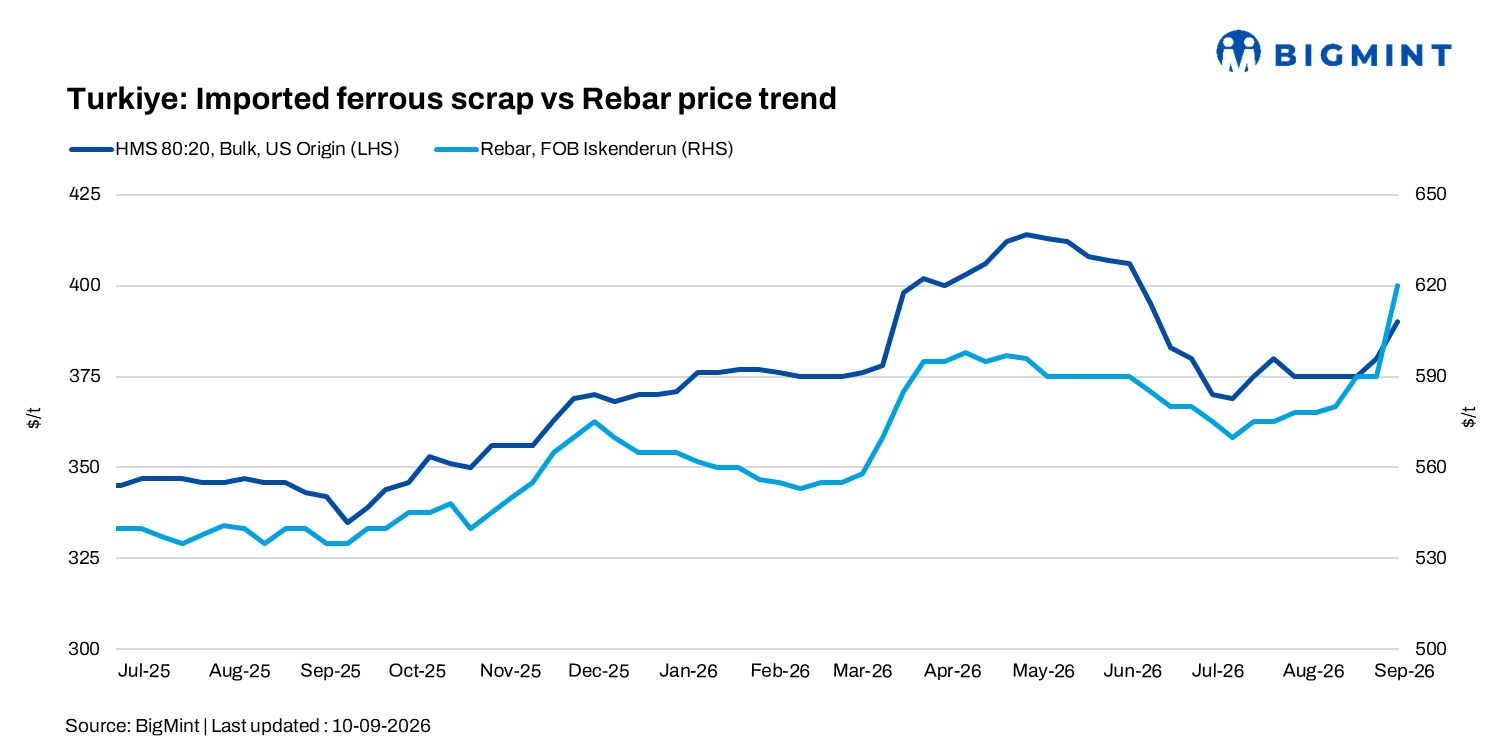
Turkiye’s imported ferrous scrap market remained firm, with US offers circulating around $390/t CFR Turkiye as strong domestic rebar demand and limited availability of alternative metallics supported mill procurement. Market participants expect scrap prices to move higher in the coming days, although buyers are attempting to resist further increases.
Price assessments
- US-origin HMS 80:20 stood at around $390/t CFR Turkiye, up by $8/t w-o-w.
- US East Coast HMS 80:20 stood at around $344/t FOB, stable w-o-w.
Market scenario
Two deals reported on Monday included Denmark-origin material sold to a West Black Sea-based mill at $382/t and another cargo sold to a Mediterranean-based mill at $383/t on an HMS 85:15 basis.
A Denmark-based supplier source said the transaction should be viewed in the context of the buyer’s location in the Black Sea region. Cargoes destined for mills in the Marmara or southern regions would incur additional freight costs for passage through the Bosporus Strait, putting equivalent prices for those destinations above the $380/t level.
The source added that the second cargo from USA, sold on an HMS 85:15 basis, was broadly equivalent to around $380/t for HMS 80:20.
Market insiders considered the level relatively low for US-origin material, although the transaction reflected effective negotiation between the buyer and seller.
The continuing Black Sea drone-attack crisis is disrupting Turkish mills’ access to Russian and Ukrainian pig iron, billet, anthracite and slab. With these alternative metallics remaining difficult to source, mills are expected to maintain their reliance on ferrous scrap, providing further support to prices, according to a Europe-based supplier source.
US suppliers are already targeting higher levels, with HMS 80:20 heard offered to a Mediterranean-region mill at around $390/t CFR Turkiye.
Strong rebar demand lifts mill margins
Domestic steel demand remains active, particularly in the rebar market. A West Black Sea-based mill sold rebar at $614-615/t on today (Thursday), up from around $590/t previously, indicating firmer domestic rebar pricing.
In the Marmara region, traders are also facing difficulty sourcing certain rebar sizes as two major mills remain closed for maintenance and new investment activities. Limited regional availability has pushed rebar prices to around $630/t exw.
Turkish mills are currently offering export rebar at around $620/t FOB, while exw domestic offers have reached approximately $630/t.
The spread between rebar and scrap has widened to around $230/t, based on $620/t FOB rebar and $390/t scrap. This is well above the approximately $200/t level generally considered necessary to cover the scrap-to-steel conversion economics.
The unusually wide spread is increasing the scope for scrap sellers to seek higher prices. Sellers are also closely monitoring mills’ finished-steel selling prices and are aware that higher rebar values have improved mill margins.
However, the duration of current domestic demand remains uncertain.
Outlook
Scrap prices are likely to face upward pressure as Turkish mills benefit from strong rebar prices, constrained alternative metallics availability and healthy domestic demand. US scrap offers are likely to hold above $395/t CFR Turkiye as sellers maintain firm price expectations.
The current $230/t scrap-to-rebar spread could narrow as scrap prices rise. However, around 300,000 t of billet booked from India, China and Malaysia is already in transit to Turkiye. These arrivals could provide mills with an alternative metallics source and limit aggressive scrap procurement in the coming weeks.
A Baltic-origin trader commented: “Turkish mills may resist higher scrap prices, citing incoming billet volumes. However, uncertainty over Black Sea vessel movements continues to disrupt pig iron, slab and billet procurement, supporting scrap demand.”
Leave a Reply