- US and Romanian scrap shipments gain momentum
- Domestic scrap generation rises faster than consumption
- Ferrous scrap prices ease from second-quarter peaks
Morning Brief: Turkiye’s ferrous scrap imports increased 4% y-o-y to 11.33 million tonnes (mnt) during January-July 2026 (7MCY26), compared with 10.86 mnt in the corresponding period last year. The increase came alongside an 8% rise in crude steel production to 23.17 mnt from 21.47 mnt, while total scrap consumption increased 4% to 18.14 mnt. Domestic scrap generation rose 5.9% to 6.97 mnt, providing much-required feedstock to Turkish mills.
Scrap consumption rises with stronger production
Turkiye’s scrap consumption increased 4% y-o-y to 18.14 mnt during 7MCY’26 from 17.44 mnt in 7MCY’25. Imports increased 4% to 11.33 mnt, while domestic scrap generation rose at a faster pace, increasing 5.9% to 6.97 mnt from 6.58 mnt.
Crude steel production reached 23.17 mnt during 7MCY’26, up 8% y-o-y from 21.47 mnt. The stronger production performance supported underlying demand for scrap, while higher domestic generation helped supplement imported feedstock.

US and Romania increase export share
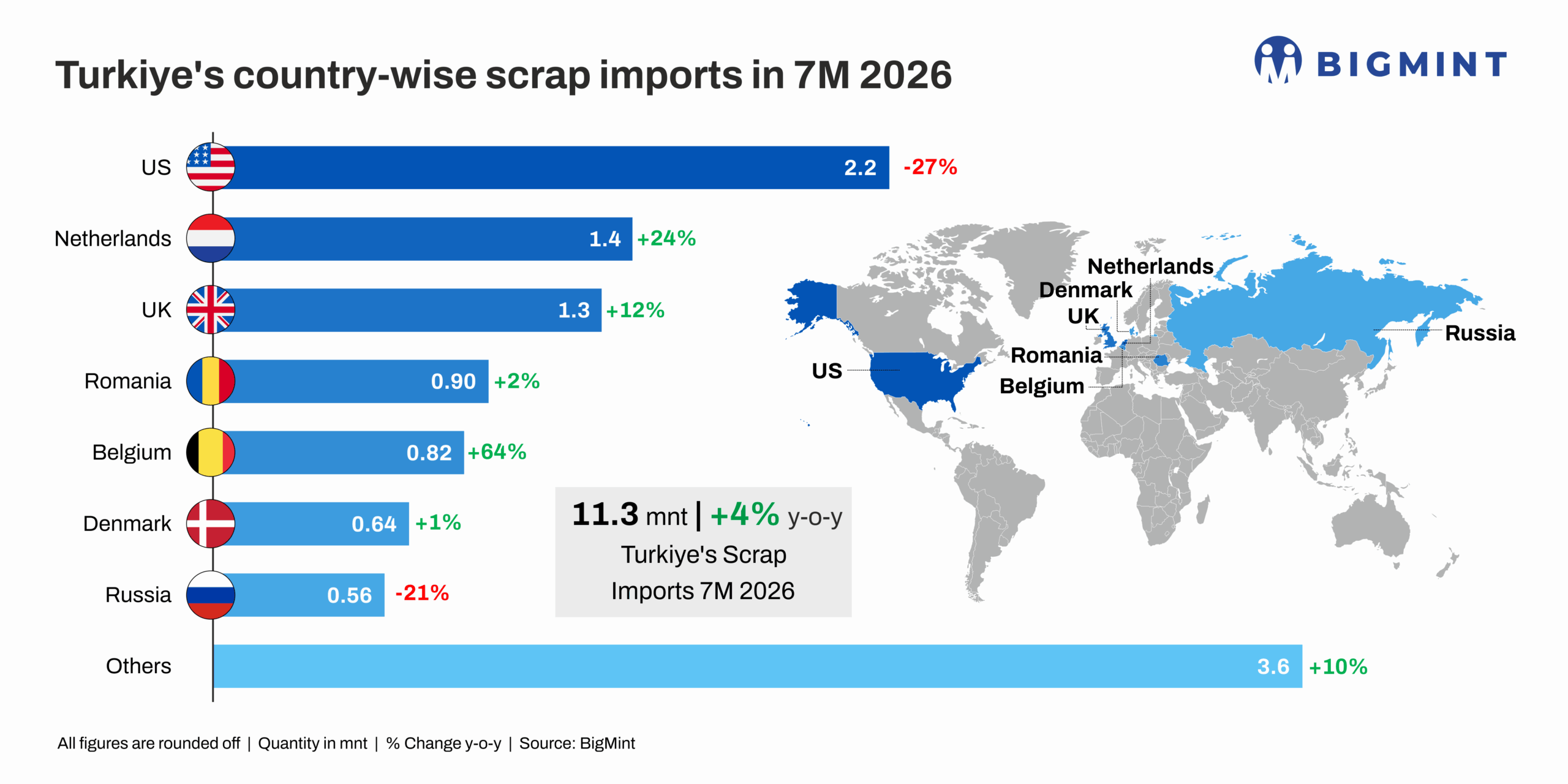
The US remained Turkiye’s largest individual supplier during 7MCY’26, with scrap shipments increasing 10% y-o-y to 2.21 mnt from 2.01 mnt. Romania recorded the strongest growth among major European suppliers, with shipments surging 64% to 0.90 mnt from 0.55 mnt.
Russia-origin shipments increased 24% to 0.56 mnt, while Denmark’s exports rose by 12% to 0.64 mnt. Belgium and the UK recorded broadly stable shipments at 0.82 mnt and 1.27 mnt, respectively.
In contrast, Netherlands-origin scrap imports by Turkiye declined 21% to 1.37 mnt from 1.74 mnt. Imports from other origins increased 2% to 3.56 mnt.
Scrap prices ease from second-quarter peaks
US-origin HMS 80:20 CFR Turkiye increased from $374/t in January to $404/t in April and peaked at $412/t in May before easing to $397/t in June, $374/t in July and $375/t in August.
US-origin HMS 80:20 FOB prices followed a similar trend, rising from $348/t in January to $379/t in May before declining to $364/t in June, $339/t in July and $342/t in August. Rotterdam-origin HMS 80:20 FOB prices rose from $345/t in January to $374/t in May before easing to $361/t in June and $337/t in July and August.
The decline from second-quarter peaks provided some relief to Turkish mills, although scrap replacement costs remained relatively elevated. Freight, regional availability and alternative metallics continued to influence procurement decisions.

Steel trade shows mixed picture
Turkiye’s steel trade remained mixed during 7MCY’26. Total steel imports declined 6% y-o-y to 10.06 mnt, with HRC imports fell by 14% to 2.32 mnt and rebar imports dropped 36% to 0.23 mnt. Billet imports remained largely stable at 4.79 mnt.
Steel exports increased 1% to 9.76 mnt of which rebar rose by 10% to 3.32 mnt, while billet increased sharply by 94% to 0.60 mnt. HRC exports, however, declined 16% to 1.94 mnt.
The increase in rebar and billet exports indicates continued activity in Turkiye’s finished and semi-finished steel trade, while stable billet imports continued to provide mills with an alternative feedstock to scrap.
Alternative metallics shape scrap demand
Pig iron imports also remained an important source of metallic feedstock, reaching 0.31 mnt in July. During 7MCY’26, pig iron imports increased to 1.66 mnt from 1.39 mnt in 7MCY’25, an increase of around 19%.
The increase in alternative metallic availability, alongside stronger domestic scrap generation, gives Turkish mills greater flexibility in managing their raw material mix. However, the 4% increase in scrap consumption and 8% rise in crude steel production indicate that overall metallic demand remained healthy.
Billet imports limit aggressive scrap buying
Despite the 8% rise in crude steel production, Turkish mills continued to balance scrap procurement against the availability and pricing of alternative feedstock. Billet imports remained broadly unchanged at 4.79 mnt during 7MCY’26, while pig iron imports were also significant, reaching 0.31 mnt in July. Imports rose by 19% in 7MCY’26 reaching to 1.66 mnt compared to 1.39 mnt in 7MCY25.
Market sources said mills stuck to a requirement-driven position when purchasing scrap, particularly when billet was available at competitive levels. The combination of elevated scrap replacement costs, alternative metallic availability and mixed finished steel demand prevented mills from aggressively chasing higher scrap prices.
However, stronger crude steel production and a 4% increase in overall scrap consumption indicate that underlying demand for metallics remained healthy. This provided a floor to scrap demand even as mills remained selective in their purchase strategies.

Outlook
Turkiye’s import scrap market is expected to remain requirement-driven in the coming months, with stronger steel production providing underlying support to scrap consumption. However, faster growth in domestic scrap generation could limit the pace of imported scrap demand. Stable billet imports and the availability of alternative metallics will also remain important considerations for mills.
US-origin material is expected to remain a key component of Turkiye’s deep-sea scrap supply, while changing availability in Europe could continue to alter the sourcing mix.
Scrap prices are likely to face upward pressure if Turkish mills continue to benefit from firm rebar prices, constrained alternative metallics availability and healthy domestic demand. The market will remain sensitive to mill buying activity, European collection levels and freight costs.
The rebar-scrap spread likely widened to around $220-230/t towards the end of Q3 2026, based on $610-630/t FOB rebar and $390/t scrap. This is well above the approximately $200/t level generally considered necessary to cover scrap-to-steel conversion economics.
The unusually wide spread is likely to give sellers greater scope to seek higher prices. Sellers are also closely monitoring mills finished-steel selling prices, as higher rebar values have improved mill margins.
However, if steel production and rebar exports remain firm, mills could maintain regular deep-sea scrap procurement. Conversely, competitive billet availability or weaker steel margins could limit their willingness to accept higher scrap offers.
Leave a Reply