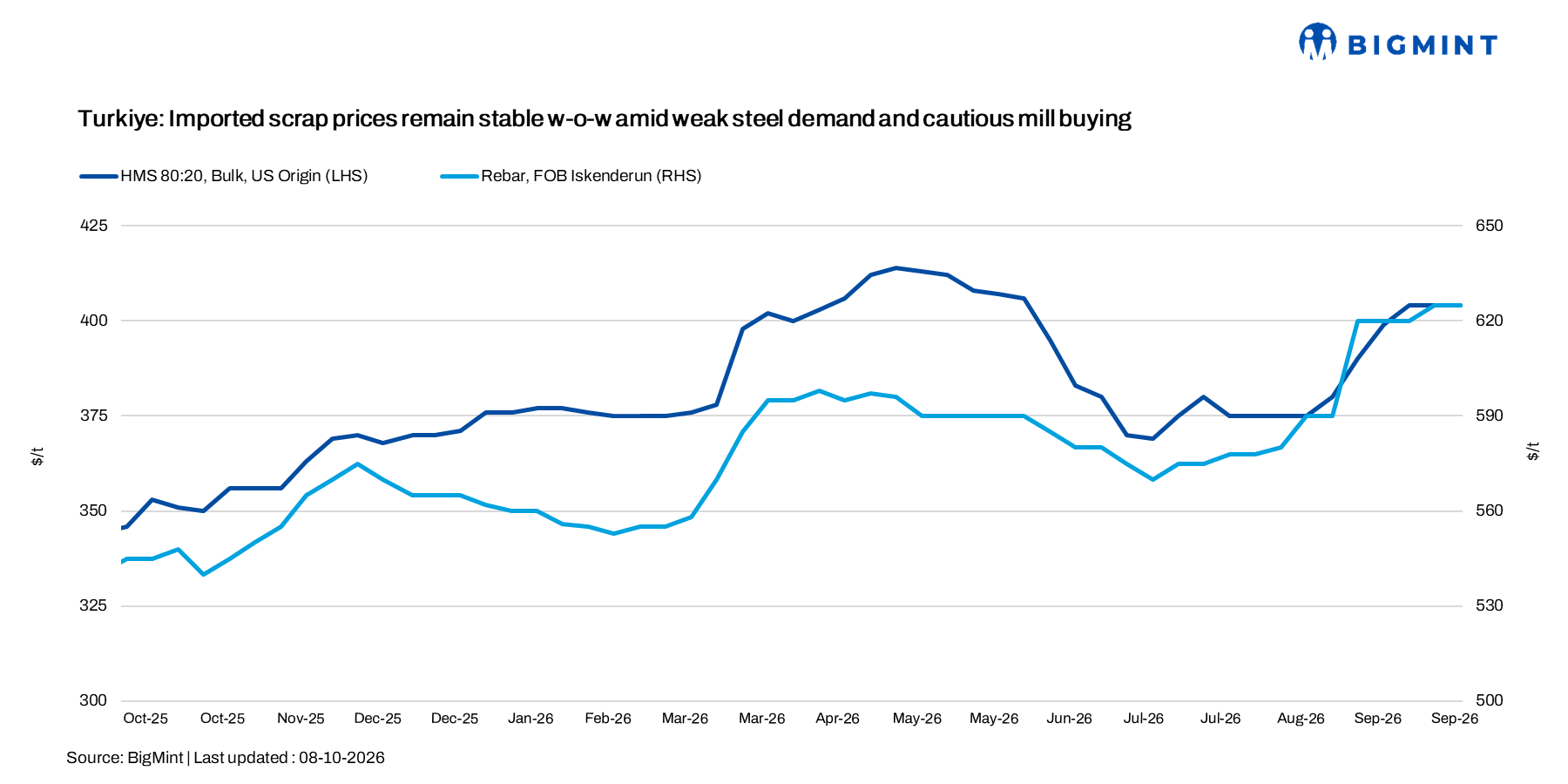
- Pressure on domestic steel market restricts demand
- US sellers resist lower scrap offers; Baltic trade levels drop
Turkiye’s imported ferrous scrap market remained largely subdued during the week ending 8 October, as weak finished steel demand and cautious mill buying kept fresh deep-sea transactions limited. Steelmakers continued to resist high scrap prices, while uncertainty in the financial sector and pressure on domestic rebar prices further reduced procurement appetite.
US suppliers remained reluctant to offer firm prices, supported by expectations of further gains in the coming weeks. Elevated ocean freight, slower scrap flows ahead of winter, and firmer US domestic scrap markets continued to underpin seller sentiment. However, weak Turkish finished-steel demand and increasing competition from European suppliers limited the scope for further price increases.
Price assessments
- US-origin HMS 80:20 stood at around $404/t CFR Turkiye, stable w-o-w.
- US East Coast HMS 80:20 stood at around $367/t FOB, up by $1/t w-o-w.
No fresh deep-sea scrap deals were reported during the week, with buyers and sellers remaining apart on price expectations. Turkish mills were heard targeting around $400/t CFR Turkiye for US-origin HMS 80:20, while tradable indications for US-origin material were heard below $400-405/t CFR. A latest Netherlands-origin HMS deal was reported at around $395/t CFR Turkiye, highlighting increasing competition from European suppliers.
Market scenario
European scrap suppliers became more competitive in the Turkish market, supported by favourable exchange-rate movements and improving water levels in Europe. The scrap collection cost was heard to be around Euro 285/t ($313/t) DAP to docks. The increased availability of European material gave Turkish mills more sourcing options and encouraged them to delay purchases.
A Baltic supplier said $390-395/t CFR is currently the maximum workable range, based on recent sales, while inquiries have declined since last week.
The US East Coast-New Jersey to Aliaga dry-bulk freight rate increased to $37-39/t, adding to delivered scrap costs. Despite elevated freight, US-origin sellers remained reluctant to lower offers, while Turkish buyers continued to seek more competitive levels. Tight scrap supply and high freight costs continued to provide support to scrap prices.
A Turkish local steel market participant said, “Mills were making selective purchases and avoiding showing strong demand to prevent further increases in scrap prices.” Meanwhile, a US recycler expected Turkish scrap prices could rise to $412-415/t CFR in the coming weeks, citing winter-related supply constraints, higher freight, and stronger US domestic prices.
Steel market
One of the SEA-based traders commented, “Across Southeast Asia (SEA), the GCC and Turkiye were awaiting the return of Chinese buyers, with China’s absence from the market contributing to limited trading activity. No major trades have been recorded so far for semi-finished commodities.
Turkish rebar prices remained under pressure amid weak downstream demand. Domestic rebar offers were heard at around $620-640/t exw, while export levels were reported at $620-630/t FOB. The scrap-rebar spread stood at roughly $215-225/t, depending on the rebar selling level. Stockists were increasingly offering material at lower prices to convert inventories into cash, putting additional pressure on mills’ margins and reducing their willingness to pay higher prices for imported scrap.
Outlook
Turkiye’s imported scrap market is expected to remain largely stable in the coming weeks, with weak finished-steel demand and cautious mill procurement limiting upside. European suppliers could face greater pressure to reduce offers if currency advantages persist. At the same time, US sellers are likely to remain firm due to elevated freight, tighter winter supply and stronger domestic scrap prices. Market activity is likely to depend on a narrowing of buyer-seller price expectations.
Leave a Reply