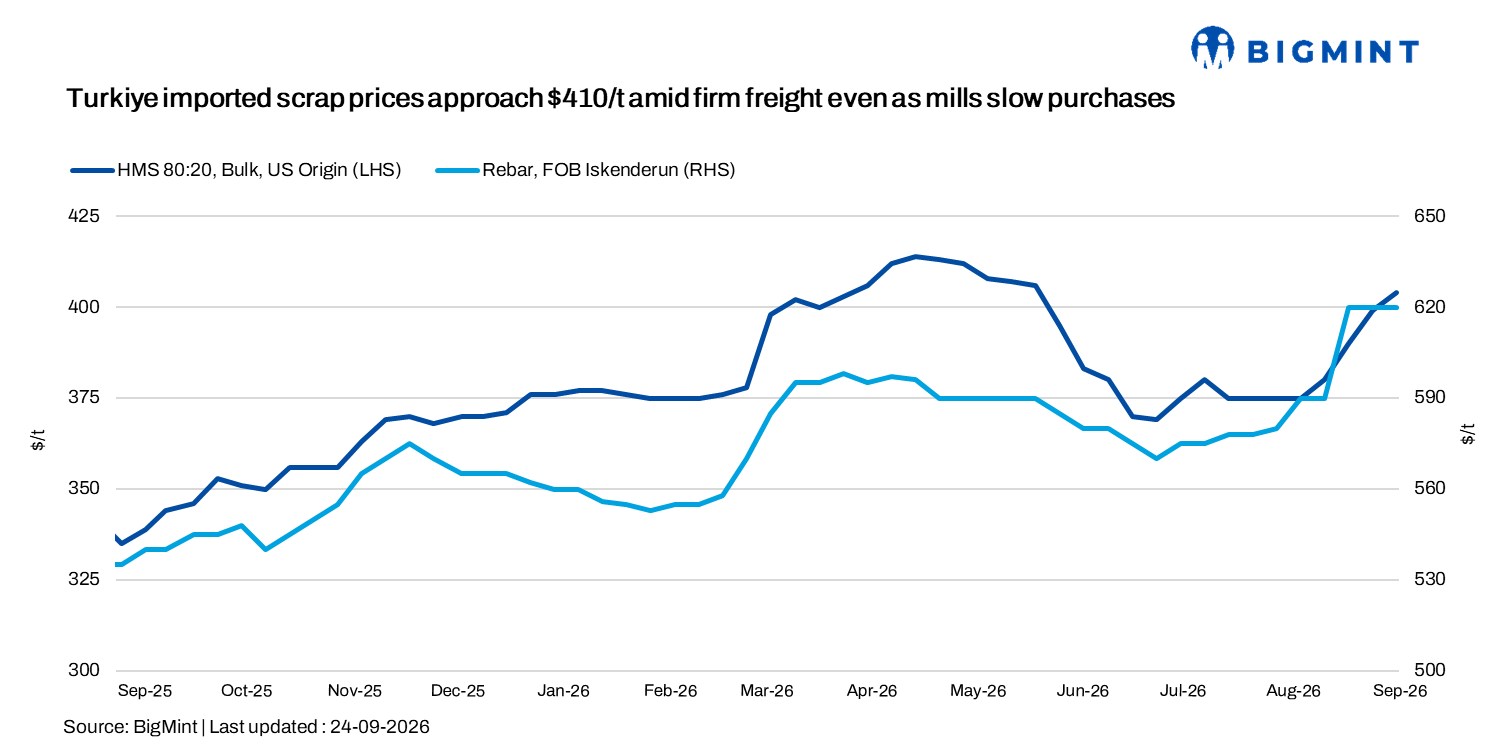
- Fresh US booking heard at $402/t CFR as mills reassess higher price levels
- Firm rebar prices and limited metallics support domestic scrap buying
Turkiye’s imported scrap market remained supported above the $400/t CFR threshold during the week ended 24 September, although buying momentum began to moderate after active procurement in recent weeks. Fresh bookings were heard at $389-402/t CFR, while US-origin offers remained around $410/t CFR and Baltic offers near $405/t CFR.
Around five to six trades were heard concluded this week, mainly from the EU at $389-395/t CFR Turkiye and the US at around $402/t CFR Turkiye.
The recent US-origin booking was reported at $402/t CFR for HMS 80:20, while higher-grade material was heard at $422/t CFR for shredded scrap and $422/t CFR for bonus.
Other transactions included West Marmara-based mills buying at $393/t CFR for 80:20 and $413/t CFR for shredded and bonus, Netherlands-origin 80:20 at $389/t CFR to a West Marmara mill, and Poland-origin 80:20 at $395/t CFR to an East Marmara mill. Another US-origin 80:20 cargo was also heard sold to an Aegean-based mill at $402/t CFR.
Following the recent round of frequent procurement, some mills have adopted a wait-and-see approach, limiting fresh negotiations, while others remain active. Meanwhile, rising European scrap collection prices and higher freight costs continue to support replacement costs and keep seller offers firm.
Price assessments
- US-origin HMS 80:20 stood at around $404/t CFR Turkiye, up by $5/t w-o-w.
- US East Coast HMS 80:20 stood at around $365/t FOB, up by $6/t w-o-w.
A Baltic-origin market insider said Turkish scrap prices are likely to cool, with limited room for further increases.” The domestic market is now well supplied, while the pace of upward price movement has slowed,” the source said.
Scrap collection prices, particularly in Europe, have continued to rise, increasing replacement costs for Turkish mills. However, higher collection prices are being partly offset by rising freight costs, which have a significant impact on delivered scrap economics, a Latvia-based supplier said.
Freight costs have increased by at least $10/t over the past 14 days, adding further pressure to CFR prices. European freight remains particularly high, with Baltic freight reportedly at a minimum of around Euro 285/t ($324/t).
The elevated freight environment is therefore an important factor in assessing the sustainability of current scrap prices, even as European collection prices continue to rise.
Meanwhile, Turkish mills have largely used their EU export quotas, with the next allocation expected in October, followed by further quotas in January 2027.
“This could encourage mills to remain cautious on raw-material purchases until there is greater clarity on export availability,” a Turkiye-based trader source said.
Limited overseas availability, higher freight and collection costs, and restricted access to alternative metallics, however, continue to support scrap prices.
Domestic rebar and scrap market
Turkish domestic scrap prices remained supported, with four Marmara-based mills raising purchase prices by TRY 300-600/t ($6-12/t) on 21 September, amid firm import scrap values, limited overseas availability, and healthy long-steel demand.
However, rebar sales have slowed, with buyers resisting further price increases. Domestic rebar prices were heard at around $655/t exw, while prices reportedly declined by around $5/t, according to a local market insider.
In the export market, rebar prices were assessed at around $620-630/t FOB, leaving the scrap-rebar spread at approximately $215-220/t. The relatively narrow margin provides limited room for mills to absorb further increases in scrap costs without putting pressure on profitability.
A Turkish steelmaker source said, “Rebar prices may be nearing a resistance point, with mills facing margin pressure if scrap costs rise further. Tighter liquidity following the collapse of highly leveraged investment funds, reportedly involving around $20 billion in assets, has also added uncertainty.”
Domestic billet prices continued to rise amid limited imported supply. Iskenderun offers increased to $565-575/t exw, from $555-560/t previously, while Aegean-origin billet was heard at $565-568/t exw. Chinese billet was offered at around $520-525/t CFR, with reported sales at $515-518/t CFR, while Russian billet was discussed at $548-550/t CFR and Iranian square billet at $490-500/t DAP.
Despite tight billet availability, slower rebar demand and limited incoming semis are keeping the market cautious. Market participants indicated that more than 200,000 t of incoming semi-finished could be required to materially affect domestic scrap demand.
Outlook
Turkiye’s scrap market is expected to remain supported in the coming days by tight overseas availability, rising European collection prices and elevated freight costs. However, softer domestic rebar demand and resistance to higher finished-steel prices are likely to limit further upside.
Market participants expect EU-origin HMS 80:20 at around $400-402/t CFR Turkiye, while US-origin material is expected to trade at $406-410/t CFR. Current Baltic and US offers are around $405/t and $410-412/t CFR, respectively. The reopening of EU export quotas in October could improve European scrap availability.
Market insiders said mills are unlikely to accept higher scrap prices from this point, as Turkish rebar prices appear to have reached their peak. This leaves mills with limited room to absorb further increases in scrap costs. If mills agree to higher scrap prices, they would have to sacrifice their margins, a trader added.
Leave a Reply