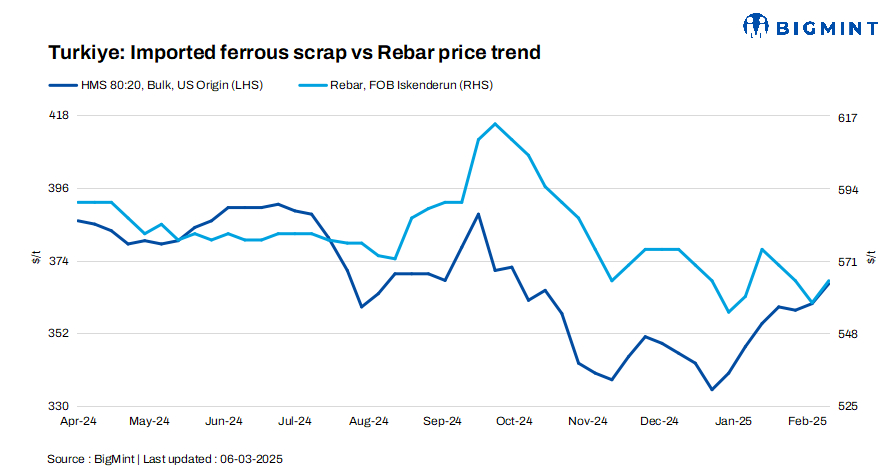
- Mills face weak rebar demand, squeezed margins
- European sellers keep targets high amid strong euro
Turkish deep-sea bulk ferrous scrap prices rose by $6/tonne (t) w-o-w, as mills struggled to resist higher offers amid limited scrap availability. Sellers remained firm, supported by improved sentiment in the US, following trade war developments.
Turkish mills sought to limit scrap price increases due to weak rebar demand during Ramadan and squeezed margins from rising costs. Meanwhile, European seller targets climbed sharply overnight, driven by the euro’s strong appreciation against the US dollar.
A mill-side participant stated that Turkiye has little leverage to resist rising EU-origin scrap prices.
According to BigMint’s bulk scrap trade tracker, 3-4 deals were concluded in the last seven days – majority from Europe and the Baltic region – at $354-365.5/t CFR Turkiye.
BigMint’s price assessments
- US-origin HMS 80:20 bulk scrap stood at $367/t CFR Turkiye, up $6/t w-o-w.
- Bulk HMS 80:20 from the US East Coast was at $345/t FOB, also up $6/t w-o-w.
Recent deals
- European-origin to Mediterranean region: 22,000 t of HMS 80:20 at $354/t.
- Belgian-origin to West Black Sea region: HMS 80:20 at $362/t and shredded and bonus at $385/t.
- Baltic-origin to West Marmara region: HMS 80:20 at $365.5/t and shredded and bonus at $385.5/t.
The Turkish scrap-to-rebar spread inched up w-o-w to $198-200/t from $195-196/t, but rising scrap costs steadily eroded mill margins.
Imported scrap market scenario
According to a source from a Turkiye-based steelmaker, mills typically operate with letter of credit (LC) terms of up to 90 days for deep-sea cargoes. “Currently, we are actively seeking April shipments and are willing to pay higher prices to secure material,” the source noted.
Current market indications are as follows:
- EU-origin HMS 80:20: over $365/t CFR
- US and Baltic-origin HMS 80:20: over $370/t CFR
According to a major trader based in Turkiye, “While the typical price is $366-367/t from Europe, recently, a deal took place at $362/t, majorly due to its inferior quality. Belgian-origin scrap is mainly considered to have high contamination, which has led Turkish mills to resist paying market rates and instead push for lower prices. For Baltic and US cargoes, prices are higher.”
According to market participants, workable prices for Baltic-origin HMS 80:20 were at $365-368/t CFR, while sellers targeted $370/t CFR or higher. Meanwhile, EU-origin HMS 80:20 was indicated at $360-365/t CFR, driven by currency fluctuations and limited export availability.
A trader noted, “Mills are reluctant to ramp up rebar production, which is adding strain to the market. The challenge lies in sourcing scrap, as strong demand in markets such as the US is limiting availability.”
Another trader observed, “Turkish mills are in a difficult position, as they cannot raise rebar prices, yet scrap supply remains tight. They are trying to secure cargoes without pushing prices up significantly, but a slight increase seems inevitable.”
Rebar market
A market participant noted that Turkish mills are struggling to sell finished steel products.
A mill side participant stated, “The highest we can secure for rebar is $560/t FOB, so we are hesitant about scrap prices reaching $370/t CFR. However, the US scrap market remains highly bullish, and they are waiting for $370/t CFR.”
Outlook
Market insiders noted that in the near term, tradable values for EU-origin HMS 80:20 could touch $364-365/t CFR. Many traders expect prices to rise soon and are holding back material from exporters, which has driven up collection costs.

Leave a Reply