- Europe-origin scrap dominates recent trades
- Mills return to market after prolonged inactivity
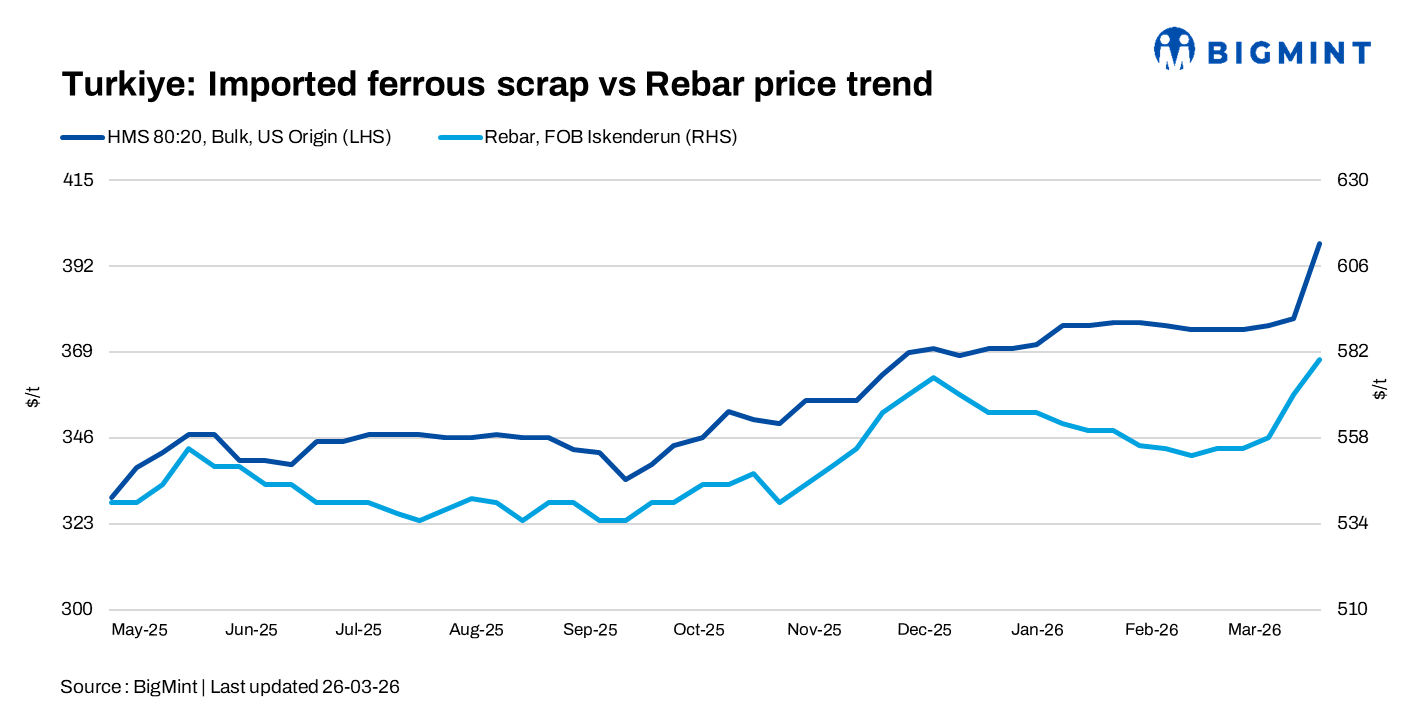
Turkish deep-sea imported scrap prices moved higher w-o-w, with HMS 80:20 assessed at around $395-398/t CFR as of 26 March. The uptrend was largely supported by firm freight rates and elevated energy costs, which continued to push up offer levels from suppliers.
Rebar export prices strengthened w-o-w, with Turkish rebar assessed at $580/t FOB, up $10/t. Post-Eid al-Fitr, mills raised offers to $585-595/t FOB for April shipments, though trading remained limited amid weak demand from key export markets.
The spread between imported scrap and exported rebar stood at around $182-185/t, with continued pressure on mill margins. While rebar trading activity improved slightly post-holiday, demand remained inconsistent, limiting mills’ ability to accept higher scrap prices.
Price assessments
- US-origin bulk HMS 80:20: $398/t CFR Turkiye, up by $18/t w-o-w.
- US East Coast HMS 80:20: $366/t FOB, up by $18/t w-o-w.
Market updates
Trading activity showed signs of recovery after a prolonged slowdown, with several deals concluded at higher price levels across Europe and the Baltic region.
Around five deals were reported mid-week, primarily for Europe-origin material. Denmark-origin HMS 80:20 was booked by a mill in East Marmara at $392/t CFR, while Netherlands-origin cargo was secured by a West Marmara-based mill at $385/t CFR.
In the Aegean region, a buyer booked Finland-origin material at $390/t CFR. Meanwhile, an East Marmara-based mill secured Poland-origin cargo at $390/t CFR. In the West Black Sea region, Swedish-origin material was booked at $394/t CFR.
Market participants stated that buying interest improved mid-week as mills returned to the market to replenish depleted inventories. Indicative workable levels for HMS 80:20 were heard at $395-396/t CFR, while suppliers were targeting as high as $400-405/t CFR.
A market participant said, “The recent pickup in activity is only mills’ urgent restocking needs after a quiet period, along with slightly improved sentiment.”
Despite the increase in deals, overall trading remained cautious. Turkish mills were heard bidding lower at $385-388/t CFR, showing resistance to higher offers due to ongoing margin pressure.
Freight and bunker fuel costs remained key supportive factors, continuing to limit aggressive buying while keeping seller sentiment firm.
Kardemir raised its domestic rebar prices by TRY 1,265/t ($26/t) to TRY 31,098/t ($584/t) exw on 25 March, based on the Central Bank reference rate (CBRT), driven by higher scrap and energy costs. The mill sold at least 20,000 t within an hour, with market estimates indicating volumes could have reached 30,000 t, indicating short-term buying interest.
Other Turkish mills also increased domestic rebar offers to $585-605/t exw, up $10/t w-o-w, while Kardemir raised wire rod prices by $20/t to $607/t exw.
However, the price uptrend comes amid weakening construction sector fundamentals — a cost-driven rally rather than a demand-led recovery.
Turkiye’s construction confidence index fell 4% m-o-m to 80.5 – 80.6 in March, the lowest level since December 2019 and well below the 100-point optimism threshold. Order books declined 2.8% and employment expectations dropped 5%, reflecting subdued forward demand. Market participants noted that while mills are pushing prices higher to offset rising costs, weak construction activity and tight financial conditions continue to cap real demand, limiting the sustainability of the price increase.
Outlook
Turkiye’s scrap prices are expected to remain firm, supported by elevated freight and energy costs, with US-origin suppliers likely to push fresh offers higher up to $405/t. However, gains may be capped by weak rebar demand and margin pressure. Recent buying remains largely restocking-driven, while weak construction activity is likely to limit sustained demand, keeping the market range-bound with cautious mill participation.

Leave a Reply