- Turkey’s steel recovery fails to lift capacity utilisation despite stronger output
- Slab production and semi-finished exports lead recovery in steel trade
- Trade protection and higher-value steel remain central to industry strategy
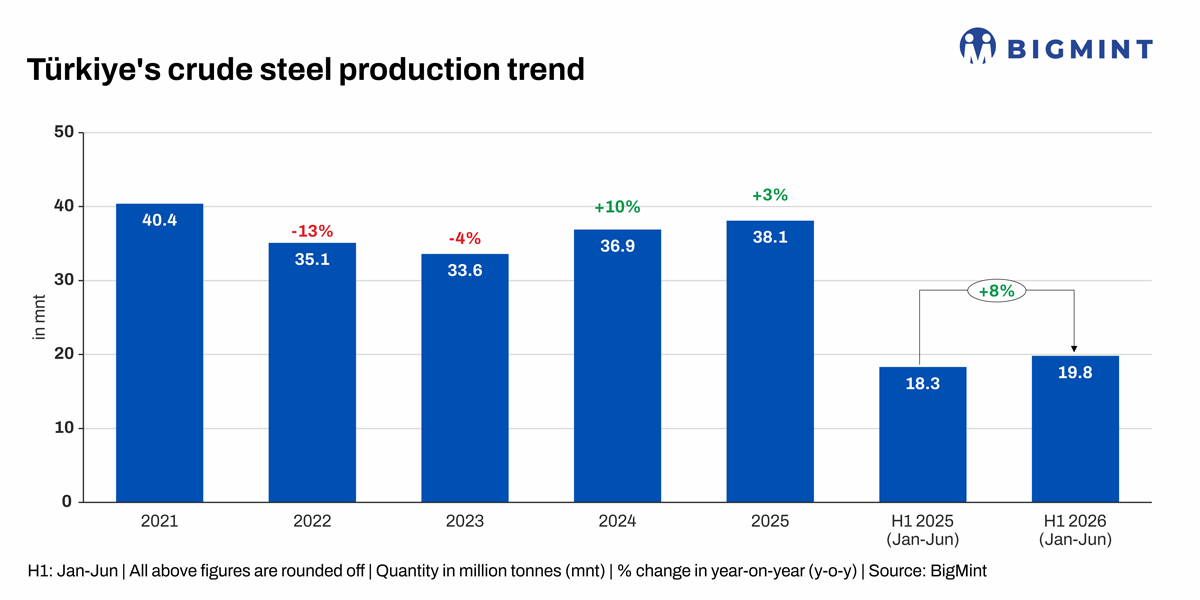
Turkey’s steel industry extended its recovery in the first half of 2026 as stronger domestic demand and improving export performance lifted crude steel production by 8.1% year on year to 19.77 million tonnes. However, the rebound has yet to resolve the sector’s structural challenge of underutilised capacity, with mills operating at only 63.9% of installed capacity despite higher output. The mismatch between recovering production and weak capacity utilisation continues to underpin industry calls for tighter import controls and measures to strengthen domestic competitiveness.
Production recovery outpaces market rebalancing
Turkey’s steel recovery has accelerated steadily since the beginning of the year. Crude steel production reached 13.04 million tonnes during January-April before rising to 19.77 million tonnes by the end of June, while capacity utilisation improved only marginally from 62.9% to 63.9%. The limited improvement suggests stronger production has not yet translated into a proportionate increase in effective demand for domestically produced steel.
The recovery has also been uneven across product segments. Slab production increased 20.9% to 8.04 million tonnes in the first half, significantly outpacing the 0.7% rise in billet production to 11.73 million tonnes. Finished steel output rose 5.6% to 21.94 million tonnes, while domestic steel consumption increased 6.6% to 19.85 million tonnes, indicating that improving demand has supported higher production but has yet to absorb available capacity.
Trade flows improve but import pressure persists
External markets have provided additional support to Turkish mills, although not enough to rebalance the domestic market. Steel exports rose 2.5% year on year to 7.84 million tonnes during January-June, while imports edged up 0.3% to 9.27 million tonnes, improving the export-to-import ratio to 82.98% from 80.03% a year earlier. Turkey nevertheless remained a net steel importer, extending a trend already evident in the first four months of the year when imports continued to outpace exports despite recovering production.
The composition of exports also shifted. Semi-finished steel exports surged 87.9% to 610,469 tonnes, far exceeding the 5.7% increase in finished steel exports to 3.15 million tonnes. Long product exports rose 2.4% to 4.08 million tonnes, suggesting overseas demand has strengthened more rapidly for intermediate steel products than finished material. The stronger growth in slab production reinforces the view that flat steel markets have recovered faster than construction-linked segments.
Recovery feeds into raw material markets
The recovery has also begun to influence upstream raw material trade. Higher steel production during the second quarter increased Turkish mills’ appetite for imported ferrous scrap, making the country one of the principal drivers of US scrap export demand during March and April as mills replenished inventories and raised electric arc furnace operating rates. Stronger Turkish buying helped offset weaker demand from several Asian markets and provided support to US export prices, highlighting Turkey’s continued importance in global ferrous scrap trade.
Policy focus shifts towards competitiveness
Against this backdrop, the Turkish Steel Producers Association (TCÜD) has maintained its call for stronger trade defence measures, particularly against imports from the Far East and Russia, while urging policies to expand domestic steel consumption and accelerate investment in higher value-added, lower-emission steel production. The association has consistently argued that improving capacity utilisation, rather than production alone, should be the priority, particularly as the EU’s Carbon Border Adjustment Mechanism (CBAM) reshapes the competitive landscape for steel exporters.
Outlook
Turkey’s steel recovery has moved beyond restoring production and is increasingly focused on restoring market balance. While stronger domestic demand, improving exports and firmer raw material purchasing point to healthier operating conditions, spare capacity remains substantial and imports continue to limit the pace of recovery. The industry’s next phase is therefore likely to be defined less by higher output than by its ability to improve capacity utilisation, strengthen export competitiveness and adapt to a more protectionist and carbon-conscious global steel market.
Leave a Reply