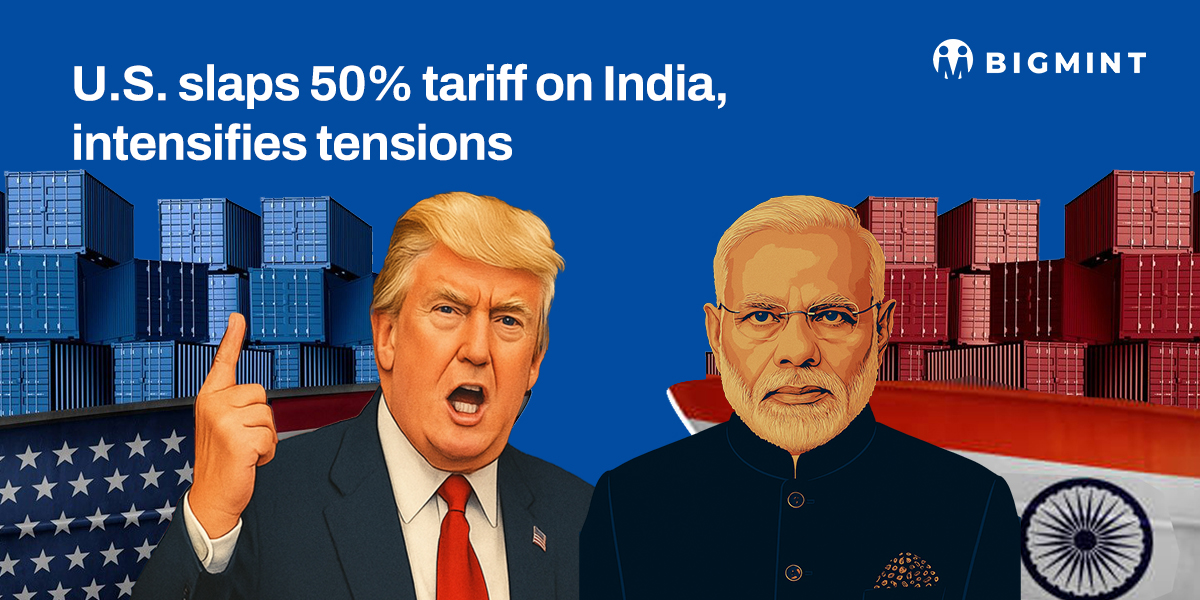
- US President’s tariffs on global imports take effect
- India rejects tariffs, vows to protect self interests
On Thursday, 7 August, President Donald Trump’s new tariffs, ranging from 10% to 50%, took effect on goods from multiple trading partners, putting his strategy of reducing the US trade deficit to the test. This move aims to minimise global supply chain disruptions, prevent significant inflation, and avoid strong retaliatory actions from other nations.
US President Donald Trump has announced increased tariffs on Indian goods in response to India’s ongoing imports of Russian oil, escalating trade tensions just ahead of another round of duties. The new 25% tariff, set to take effect in three weeks, will be added to an existing 25% duty that comes into force this Thursday–raising the total tariff to 50% on many Indian products.
However, certain items remain exempt, including goods already subject to sector-specific tariffs like steel and aluminium, as well as categories such as pharmaceuticals and semiconductors, which may face future action.
Tariff impact on Indian goods
The higher tariffs are part of Trump’s broader trade strategy aimed at reducing the U.S. trade deficit. U.S. Customs and Border Protection (CBP) began enforcing these duties at 12:01 a.m. EDT on August 7, following weeks of speculation and tense negotiations. A 25% base tariff had already been imposed on India’s imports, but Trump added an extra 25% penalty on the grounds of India’s dealings with Russia. This brings the total duty on many Indian goods, including textiles, agricultural products, and electronics, to 50%.
These tariffs are part of a wider set of duties imposed by the Trump administration on various countries, including Brazil, Switzerland, and Canada. While some countries like the European Union and Japan managed to secure reduced rates, India faces one of the highest tariff increases, reflecting the tensions over its trade ties with Russia.
India’s response
India has strongly condemned the tariffs, labeling them “unfair, unjustified, and unreasonable.” The Ministry of External Affairs (MEA) responded swiftly, asserting that India would take all necessary actions to protect its national interests. India maintains that its purchases of Russian oil were driven by market factors and the need to secure energy resources for its 1.4 billion people. This argument was echoed by Indian officials, who pointed out that US officials had previously encouraged India to source oil from Russia to stabilise the global energy market when traditional supplies were diverted to Europe.
Despite Trump’s threats, India is unlikely to yield to pressure over its defence and energy relationships with Russia. The ongoing geopolitical dynamics are likely to drive India to seek alternative markets and suppliers to mitigate the impact of these tariffs.
Potential consequences for India
The imposition of such steep tariffs will likely have a profound impact on India’s trade with the US, potentially leading to higher costs for Indian exporters. Sectors such as textiles, chemicals, and electronics, which rely heavily on the US market, will face challenges. Indian businesses may experience a slowdown in exports, affecting their competitiveness in the US market.
Furthermore, the tariffs could lead to disruptions in the supply chain. Indian companies that depend on U.S.-bound exports for growth may have to consider diversifying their markets or passing on higher costs to consumers. For instance, the tech sector, which exports semiconductors and electronic components to the US, may see a sharp rise in production costs.
The US decision to impose steep tariffs on Indian goods is expected to create short-term challenges for India’s auto component industry as well, industry body ACMA said on Thursday. Highlighting the need to boost global competitiveness and diversify export markets, ACMA emphasised the importance of strategic adaptation.
Broader global implications
Trump’s decision to impose higher tariffs on several countries, including India, could have ripple effects across global supply chains. Many industries that rely on global sourcing will face higher costs, potentially increasing inflation and reducing consumer purchasing power. In India, industries that are deeply integrated into the global supply chain, such as pharmaceuticals and technology, could also face hurdles.
Trump’s tariffs on India might also encourage India to strengthen its ties with other countries to diversify its trade relations. Countries in Asia, Europe, and even Latin America might become more critical for India as the U.S. moves to protect its own industries.
Secondary sanctions and other tariffs
Trump has also warned that secondary sanctions could be imposed on countries like China if they continue their purchases of Russian oil, following the example of India. This sets a dangerous precedent for global trade, as countries might be forced to choose between maintaining access to U.S. markets or preserving their relationships with Russia.
In addition, the tariffs will apply not only to India but also to many other countries, including Brazil and Canada. These tariffs will test how other nations respond to Trump’s “America First” trade policies, and whether they can negotiate tariff reductions or exemptions.
What’s next for India?
India’s options seem limited. While retaliatory tariffs could be one response, India’s export-dependent economy could suffer more in the long run. The government will likely seek to find diplomatic channels to ease tensions and look for strategic trade deals with other major economies like the European Union, Japan, or ASEAN countries. Additionally, India may intensify efforts to develop domestic industries to reduce reliance on exports to the U.S.
Indian officials have indicated that the country will not back down on its energy security needs, particularly regarding oil imports from Russia. At the same time, the U.S. decision could hasten India’s efforts to reduce its dependence on U.S. markets by diversifying its trade partnerships.
Conclusion
The implementation of Trump’s sweeping new tariffs is another chapter in the evolving global trade landscape. For India, it signals a challenging road ahead, both diplomatically and economically. How India navigates this new trade reality will define its relationship with the U.S. in the coming years, but it may also encourage India to recalibrate its international trade strategy to protect its broader economic interests.
Leave a Reply