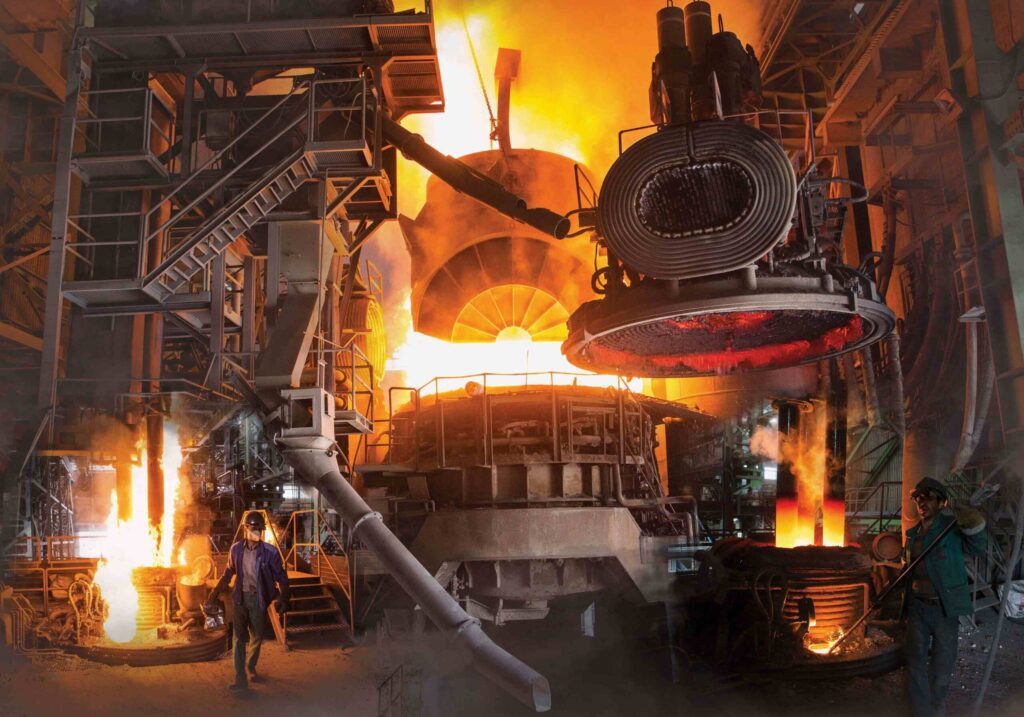
- Blast furnaces no longer refractory vessels but controlled thermal reactors
- Adoption of freeze lining raises campaign life to 15-20 years from 5-7 years
The blast furnace has undergone a silent revolution over the last four decades. Most people still imagine a blast furnace as a refractory lined vessel where iron ore and coke are charged from the top and hot metal comes from the bottom. That description belongs to the 1970s. The modern blast furnace is fundamentally different in design, cooling, and refractory philosophy and energy integration.
The biggest single change is the shift from refractory protection to freeze lining protection.
Freeze lining — the most important development in blast furnace design
Earlier blast furnaces relied on thick refractory linings to resist heat and chemical attack. Refractory erosion determined furnace campaign life. This would typically be around 5-7 years, after which relining was required.
Modern blast furnaces follow a completely different philosophy. Instead of trying to prevent slag and metal from touching the wall, modern furnaces deliberately freeze a thin layer of slag and metal on the furnace wall. This is called the freeze lining or frozen slag layer concept.
The wall structure in a modern blast furnace is effectively a steel shell, cooling system, carbon or graphite refractory, frozen slag layer, and furnace interior.
The frozen slag layer becomes the real protective layer. The refractory is no longer the primary protection. The refractory only supports the frozen layer and transfers heat to the cooling system.
Consequently, blast furnace campaign life has increased dramatically to 15-20 years and, in some furnaces, even 25-30 years.
Graphite, carbon refractories — change in refractory philosophy
Older furnaces used different refractories in different zones: fireclay bricks in stack, high alumina bricks in belly, silicon carbide in bosh, and carbon blocks in hearth.
Modern furnaces increasingly use carbon bricks, graphite bricks, semi graphite blocks, and microporous carbon blocks in critical regions, especially bosh and hearth.
Graphite and carbon are used because of their very high thermal conductivity, ability to transfer heat quickly to cooling system, facilitation of freeze lining formation, low wettability with iron and slag, high resistance to chemical attack, better resistance to thermal shock, and longer campaign life.
The philosophy has changed from an insulating refractory to a heat-conducting refractory. The earlier design tried to keep heat inside the furnace, while modern technology tries to remove heat through the wall and freeze slag.
Copper stave coolers — backbone of modern cooling
The cooling system is the most critical part of modern blast furnace design.
Older furnaces used cast iron coolers, plate coolers, and spray cooling. Now, copper stave coolers are used.
Copper stave coolers provide very high thermal conductivity and enable uniform cooling across furnace wall, formation of stable freeze lining, prevention of refractory erosion, reduction of hot spots, longer furnace life, and stable furnace operation.
Modern blast furnace wall structure includes a steel shell, copper stave coolers, a carbon/graphite refractory, a frozen slag layer, and a furnace interior.
Copper staves, a graphite refractory, and freeze lining together enable longer-campaign furnaces.
Blast furnace zones
A blast furnace is divided into different zones: throat — charging zone, stack — indirect reduction zone, belly — transition zone, bosh — softening and melting zone, raceway — combustion zone, and hearth — liquid iron and slag.
The bosh and hearth are the most severe zones in terms of temperature and chemical attack. That is why carbon and graphite refractories and intensive cooling are most important in these regions.
Bell-less top charging, burden distribution control
Modern blast furnaces use bell-less top charging with rotating chute burden distribution. This allows precise control of coke distribution, ore distribution, layer thickness, gas flow distribution, burden permeability, reduction efficiency, coke rate, and furnace productivity.
Burden distribution is now one of the most critical control parameters in blast furnace operation. The blast furnace is now operated using mathematical models, gas flow models, and burden descent models, not just operator experience.
Pulverised coal injection (PCI), tuyere injection
Modern blast furnaces reduce coke consumption by injecting pulverised coal, oil, and natural gas. Hydrogen usage in the future can also contribute.
PCI reduces coke rate significantly and improves economics.
The tuyere zone is now used not only for hot blasts but also for multiple injection streams, making the blast furnace a multi-fuel reactor.
Top pressure recovery turbine (TRT) — blast furnace as power plant
Blast furnace gas exits the furnace at high pressure and large volume. Instead of wasting this energy, modern furnaces install a top-pressure recovery turbine (TRT).
A TRT converts the top gas pressure into electricity. Large blast furnaces can generate significant power from a TRT alone. This effectively turns the blast furnace into a power generation unit in addition to an ironmaking unit.
Waste heat recovery, energy integration
Modern blast furnaces recover energy from hot blast stove flue gas, blast furnace gas, slag heat, cooling water heat, cast house fumes, and waste gas streams.
The modern blast furnace is, therefore, an ironmaking reactor, gas generator, power generator, heat recovery system, and carbon management platform.
Key technology elements
The blast furnace has, therefore, evolved into a high-temperature counter current reactor integrated with energy recovery and gas management systems. Its components typically include —
-
Bell-less top charging
-
Rotating chute burden distribution
-
Burden distribution model
-
Copper stave cooling system
-
Graphite/carbon refractory lining
-
Freeze lining protection
-
PCI
-
Advanced hot blast stoves
-
Gas cleaning plant
-
Top Pressure Recovery Turbine
-
Waste heat recovery
-
Mud gun and tap hole drilling machine
-
Cast house automation
-
Digital blast furnace model
-
Tuyere injection systems
-
Gas recycling systems
-
CO₂ capture integration (future)
-
Hydrogen injection (future)
Earlier blast furnaces were designed to protect refractories from heat, but modern ones are designed to remove heat and freeze slag on the wall.
That single change, the freeze lining concept, has increased furnace campaign life, reduced relining frequency, improved stability, and fundamentally changed blast furnace engineering.
The modern blast furnace should, therefore, be viewed not as a refractory vessel but as a controlled thermal reactor with engineered cooling, frozen protective layers, gas management, and energy recovery systems. That is the real evolution of blast furnace technology.
This article is published by BigMint in collaboration with author Mr. R.V. Sridhar, Senior Advisor, McKinsey, ex-CEO (Downstream), Jindal Steel; and ex-CEO (Downstream), AMNS.
Leave a Reply