- Africa emerges as largest destination, accounting for 41% of Jul exports
- Low rainfall raises concerns regarding next rice crop
Thailand’s rice export market has shown signs of recovery, with bulk shipments rising to roughly 0.48 million tonnes (mnt) over 1-28 July 2026 compared to 0.41 mnt in 29 June-26 July 2026, with African and Southeast Asian buyers emerging as key sources of demand and helping offset a sharp decline in shipments to Iraq. Export activity remained firm through July, supported by steady orders from Malaysia and the Philippines, while earlier El Nino-related stockpiling continued to support forward sales.
African, ASEAN demand supports exports
Africa emerged as the largest destination for Thai rice exports, accounting for around 41% of total shipments. South Africa led African demand with around 43,000 tonnes (t), while Malaysia and the Philippines anchored the recovery in Southeast Asia with 24,000 t and 21,000 t, respectively. The increase in demand from these markets has helped compensate for weaker shipments to Iraq, traditionally Thailand’s largest single market with annual imports of around 1 mnt. Iraqi imports stood at only 90,000 t during January-May 2026, significantly below the usual pace. White rice remained the dominant category, accounting for 45% of export volumes, followed by Hom Mali rice at 26% and parboiled rice at 19%.
Export prices recover after mid-July decline
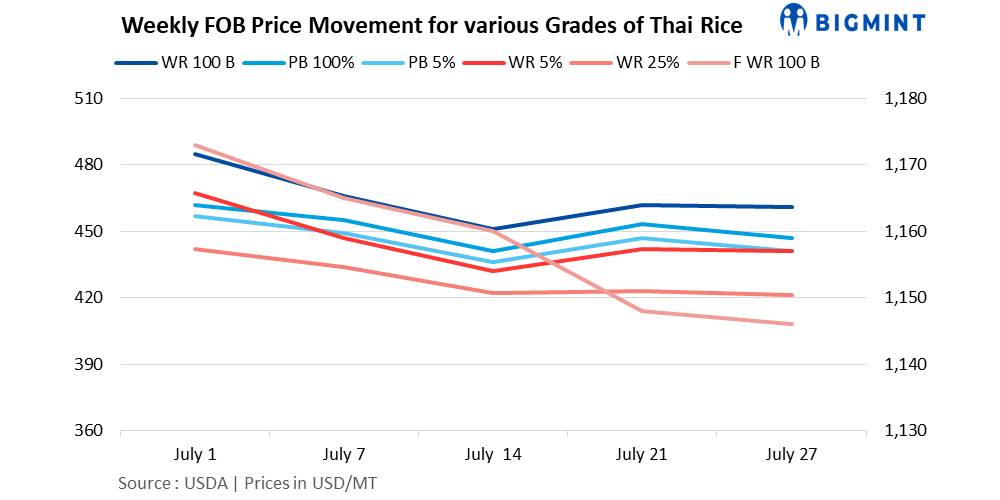
Thai rice prices softened through mid-July before recovering across most grades. Thai 5% white rice prices declined from $467/t at the end of June to $441/t by July 27, following a mid-July trough and subsequent partial recovery. Parboiled rice followed a similar trend. However, WR 25% remained under pressure, declining steadily to around $421/t without a subsequent recovery, reflecting continued competition from lower-priced Indian rice in the lower-grade segment. Export volumes moderated toward the end of July, suggesting that the market may be moving towards a more stable pace after the stronger buying seen during May-June.
Water availability emerges as key supply risk
On the supply side, below-normal rainfall and lower reservoir levels are raising concerns over Thailand’s upcoming rice crop. The Royal Irrigation Department (RID), in its 31 July assessment, identified water availability as a key risk for next year’s rice production. Nationwide rainfall between 1 January-26 July was reported at 10% below normal, with larger deficits recorded in the central region (-19%), east (-18%), and northeast (-10%). These regions collectively account for a significant share of Thailand’s main-crop rice production. The RID has also warned of potential dry-spell conditions and is prioritising available water for human consumption and urban requirements ahead of agricultural irrigation, which could add uncertainty to crop development if dry conditions persist.

Outlook
Thailand’s rice export market is likely to remain supported by African and ASEAN demand in the near term, while weaker Iraqi buying remains a key drag. On the supply side, rainfall, reservoir levels and water allocation will remain critical for the next crop. Further strengthening of El Nino could increase production uncertainty, while continued competition from India is likely to keep pressure on lower-grade Thai rice prices.
Leave a Reply