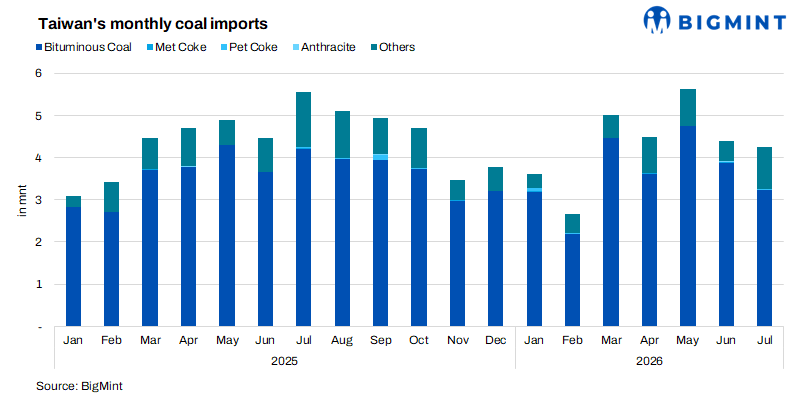
- Bituminous coal continues to dominate import mix
- Jul’26 weakness driven by smaller fuel categories
Taiwan’s coal imports remained broadly stable during the first seven months of 2026 despite a modest decline in July arrivals. Total coal imports reached 30.07 mnt during January-July, down just 1.7% from the corresponding period of 2025, while July imports eased 2.9% y-o-y to 4.26 mnt.
The data indicate that Taiwan’s thermal coal demand remains resilient. Bituminous coal, which accounts for more than four-fifths of total imports, increased marginally during the first seven months of the year, offsetting weaker arrivals of metallurgical coke and anthracite.

Thermal coal demand remains stable
Bituminous coal continued to underpin Taiwan’s import programme, accounting for approximately 84% of total coal imports during January-July 2026. While July arrivals declined from the unusually strong level recorded a year earlier, cumulative bituminous coal imports edged 0.7% higher, indicating that utility procurement remained broadly unchanged.
The data suggest Taiwan’s power sector continues to rely on imported thermal coal despite the country’s gradual expansion of alternative energy sources.
Jul’26 decline driven by smaller import categories
The modest fall in July imports was concentrated outside the thermal coal market.
Met coke imports declined 68.2% y-o-y, while anthracite imports fell 49.9%. By contrast, pet coke imports more than doubled from a year earlier, albeit from a low base, while the “Others” category also recorded strong growth during the month.
These movements indicate that July’s weaker imports reflected changes in smaller fuel categories rather than a broad deterioration in Taiwan’s coal demand.
The latest figures suggest Taiwan’s utilities continue to maintain steady thermal coal procurement, with fluctuations largely confined to smaller products such as metallurgical coke, anthracite and pet coke. For the seaborne thermal coal market, Taiwan therefore remains one of Asia’s more consistent sources of import demand, providing stability even as other regional buyers adjust procurement in response to changing market conditions.

Leave a Reply