- Steel price forecasting faces challenges due to market volatility
- Combining ML with real-world data enhances forecasting accuracy
- Strong supplier relationships crucial for cost control, efficiency
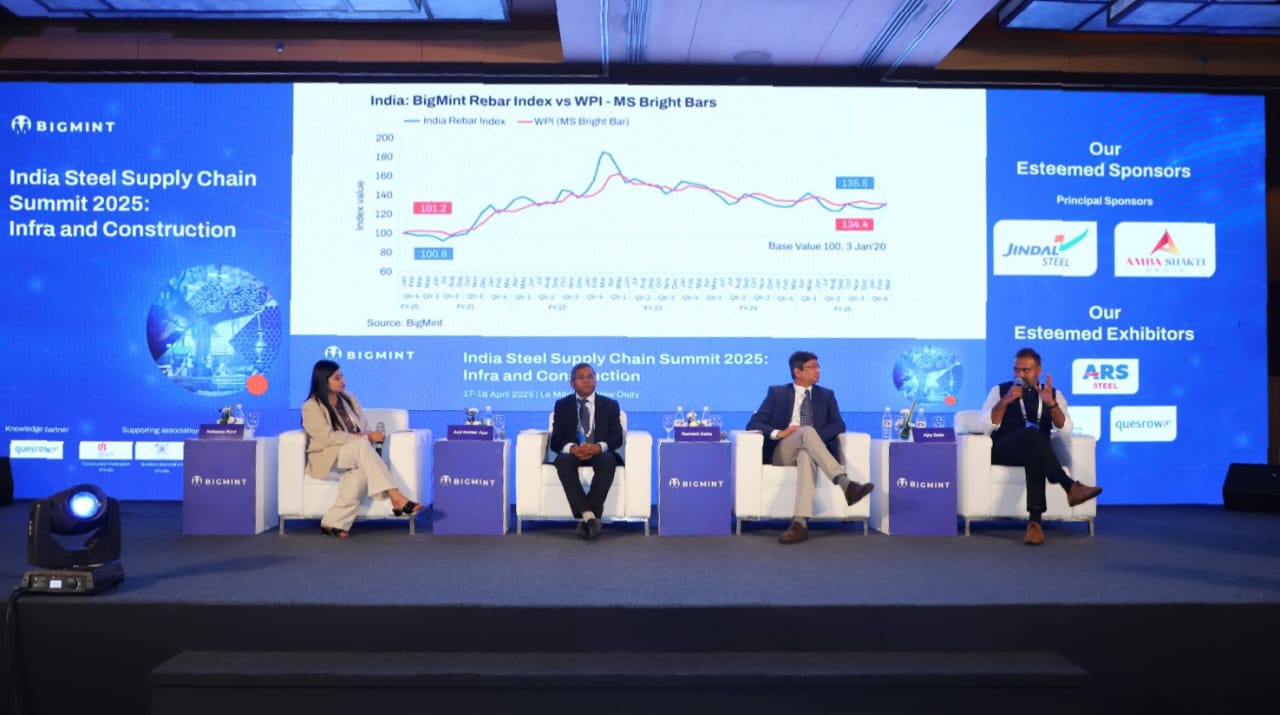
The India Steel Supply Chain Summit 2025 (ISSCS 2025), held on 17-18 April and organised by BigMint in partnership with Quesrow, brought together industry leaders to address the evolving dynamics of India’s steel sector.
A key session, “Navigating Steel Market Volatility with Excellence in Price Forecasting, Strategic Pricing, and Indexing,” focused on how price forecasting helps manage market fluctuations and support smarter decision-making. It highlighted the role of strategic pricing and indexing in shaping contracts, guiding negotiations, and supporting audits. The session also covered global best practices and strategies to handle supply-demand gaps during economic and geopolitical uncertainty.
Key takeaways
1) Forecasting challenges in steel industry
Difficulty of forecasting: Predicting steel prices is highly challenging due to the industry’s susceptibility to unforeseen events such as pandemics, wars, and terrorism, which can invalidate even short-term forecasts.
Limitations of traditional methods: Relying on past data or traditional forecasting models is often ineffective in the steel market, as these models cannot account for sudden, impactful events.
Varied forecasting objectives: The goals of forecasting in the steel industry differ, including establishing long-term agreements with suppliers, determining prices for project bids spanning many years, and making informed decisions on budgeting and procurement models.
2) Strategies for managing price volatility
Risk mitigation strategies: Companies employ various tactics to manage price volatility, such as using flexible contracts with suppliers, leveraging indexing mechanisms, securing prices through international insurance, utilising hedging instruments, and negotiating long-term agreements that include financial security.
Advanced forecasting models: There has been a move towards combining machine learning (ML) models with real-world data collection (e.g., from markets and associations) and statistical correction factors to enhance the accuracy of price forecasts.
Balancing fixed, variable pricing: To manage cost impacts, buyers may choose to fix the price for a portion of their steel requirements while leaving a certain quantity open to pricing based on market fluctuations.
3) Role of indexing, transparency
Limited applicability of indexing: While indexing supports pricing transparency and audit compliance, its effectiveness in the steel sector is limited due to the distinct dynamics of primary and secondary markets and the influence of regional factors on pricing.
Infrastructure for robust futures: Globally, reliable steel futures exist only for select products (e.g., billets, HRCs on Shanghai Futures Exchange). India lacks robust trading platforms and physical infrastructure, hindering dependable indexing development.
Transparency in pricing dynamics: While buyers seek transparency in pricing, the level of transparency can vary; it is influenced by market conditions and the specifics of the relationship between buyers and sellers.
5) Strategic pricing practices
Balanced procurement: Companies can mitigate price risks through a mix of fixed-price and market-linked contracts, supported by international insurance and hedging tools for flexibility amid volatility.
Supplier collaboration: Long-term contracts with financial security, combined with demand visibility and credible forecasting, help stabilise procurement. Digital platforms also support transparent pricing and audit compliance.
6) Best practices for procurement strategies
Strategic procurement in emerging sectors: In sectors such as hydrogen, procurement strategies focus on minimising capex to achieve quicker break-even points.
Core procurement practices: Effective procurement relies on careful purchase planning, material and design standardisation, demand visibility across the organisation, and volume consolidation to strengthen negotiation power.
Supplier relationship management: Robust supplier onboarding, transparent digital communication, and timely payments are key to building reliable partnerships and securing favourable terms.
Conclusion
Indexing and pricing in the steel industry remain complex due to market volatility and the limited applicability of traditional models. Companies are adopting mixed pricing strategies, leveraging indexing for transparency and audit compliance, while exploring advanced forecasting tools. However, infrastructure gaps in India limit the development of robust indices and futures, requiring a balanced approach to procurement and risk management.
Leave a Reply