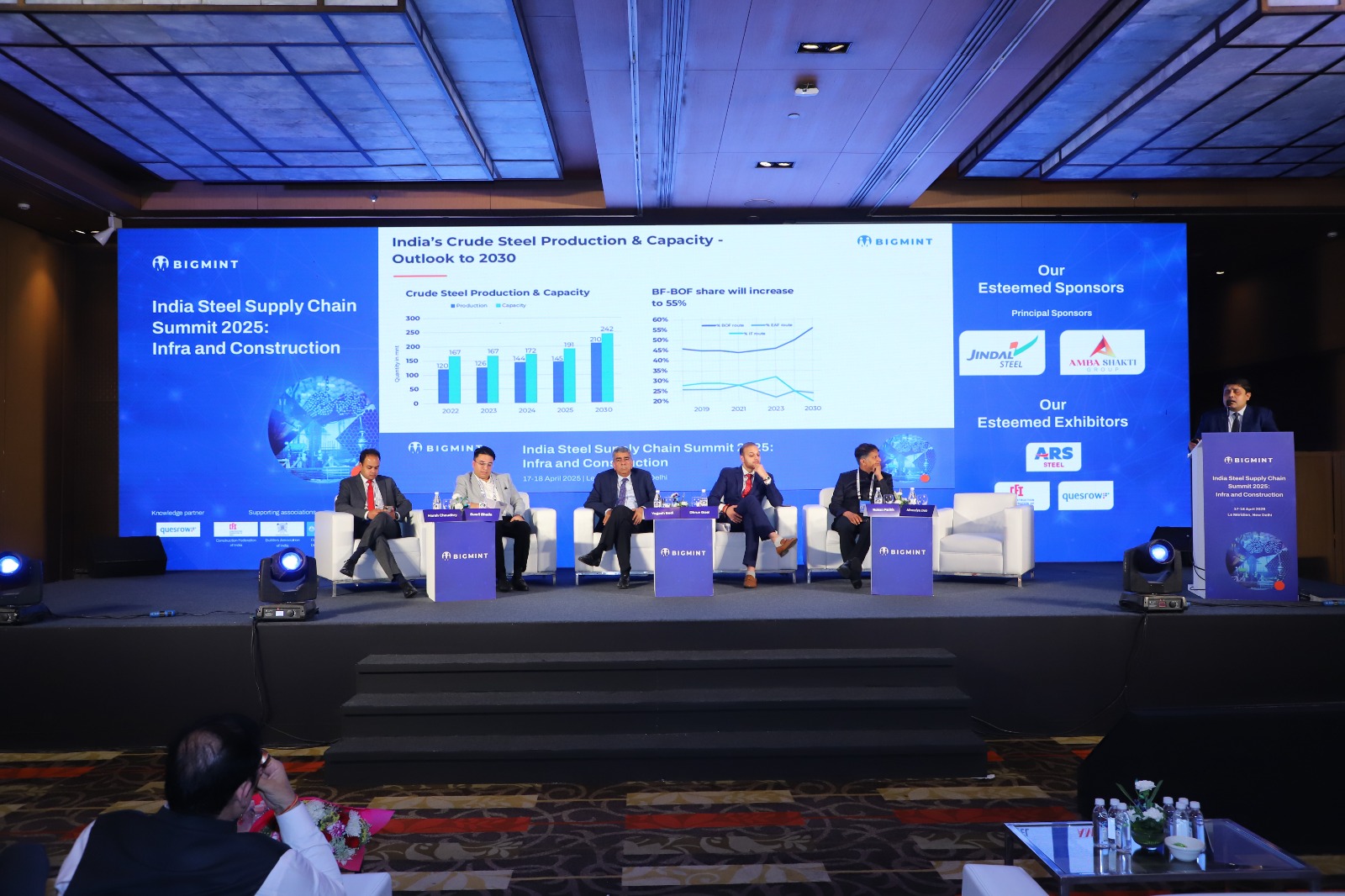
- Steel capacity to reach 245mnt by 2030; BF-BOF share rising.
- Emissions 30% above global average; target set at 2.2 t CO2/ton.
- Decarbonization via EAF, hydrogen, and CCUS under way.
The India Steel Supply Chain Summit 2025 (ISSCS 2025), held on April 17-18 and organized by BigMint in partnership with Quesrow, brought together industry leaders to address the evolving dynamics of India’s steel sector.
A key session, “Green Steel Premiums & Quality Standards,” centred on the challenge of scaling up to a 300 mnt production capacity, its implications for regional supply chains, exports, and competitive positioning, with valuable insights drawn from global supply trends, particularly from China and other key markets.
Key takeaways
1) India’s steel capacity and production
India’s steel industry is growing, with capacity projected to reach 240-245 million tonnes (mnt) and production to 210 mnt by 2030. Currently, 45% of steel is produced via the blast furnace-basic oxygen furnace (BF-BOF) route and 55% via electric processes. By 2030, BF-BOF’s share is expected to rise to 55%, while the electric route will decline.
2) Carbon emissions and green steel
India’s steel emissions are 2.55 tonnes of Carbon Dioxide (CO2) per tonne -30% above the global average of 1.9 tonnes. With global temperatures already up 1.2 degree celsius, efforts aim to limit the rise to 1.5 degree celsius. India has introduced a green steel taxonomy with a star rating to classify steel by emissions, targeting a reduction to 2.2 t CO2 per t by 2030.
3) Decarbonization pathways and costs
Decarbonization options include scrap-based electric arc furnaces (EAF), green hydrogen, and carbon capture, utilization, and storage (CCUS). EAF is currently the most cost-effective. Green steel may increase car costs by ~2% and house costs by ~4%.
4) Pressures on steel manufacturers and mitigation strategies
Manufacturers face pressure from customers, regulators, and capital markets to decarbonize. Key strategies include measuring, reducing, and monetizing emissions-through CO2 tax avoidance and green steel premiums.
5) Carbon footprinting and certification
Footprinting types include corporate carbon footprint, product carbon footprint, lifecycle assessment (LCA), and environmental product declaration (EPD).
Conclusion
India’s steel capacity is set to reach 245 mnt by 2030, with a shift toward blast furnace production. Emissions remain high at 2.55 tonnes CO2/tonne prompting green steel initiatives and a star-rating taxonomy. Decarbonization strategies like EAF, hydrogen, and CCUS are key, amid rising pressure from stakeholders. Green steel may raise product costs sharply.

Leave a Reply