- Sponge iron prices rise on firm pellet, coal costs
- Billet gains up to INR 1,000/t w-o-w in Chennai
South India’s long steel prices remained firm during the week ended 31 July, supported by higher raw material costs, tighter merchant availability, and sustained infrastructure-led demand. Sponge iron prices increased sharply during the early part of the week before losing momentum towards the weekend as buying shifted to need-based procurement. Billet and rebar prices also moved higher, supported by improved downstream buying and supply-side constraints.
Sponge iron and melting scrap
Bellary sponge iron prices increased sharply by around INR 700-800/t during the early part of the week before losing momentum towards the weekend. The initial uptrend was primarily driven by higher raw material costs, particularly iron ore pellets and imported coal, coupled with tight merchant market availability. Limited material availability, as several major producers prioritised captive consumption and kiln maintenance, further supported domestic sponge iron prices.
As of 31 July, pellet-based sponge iron (PDRI) prices in the Bellary cluster were assessed at around INR 26,000/t ex-Bellary. However, buying activity turned largely need-based during the latter half of the week, resulting in a slowdown in price momentum despite continued support from elevated input costs.
In addition, merchant market availability remained constrained as a major supplier refrained from offering material due to scheduled kiln maintenance and higher captive consumption, resulting in temporary supply tightness.
Imported RB2 coal prices increased by around INR 200-250/t w-o-w to approximately INR 10,600/t ex-Gangavaram port as of 31 July. The price rise was mainly attributed to higher freight costs. However, trading activity remained subdued, with buyers limiting purchases to immediate requirements. Several sponge iron manufacturers have also increased the use of lower-cost RB3 coal in an effort to reduce production costs, which has capped overall demand for RB2 coal.
Iron ore pellet prices increased by around INR 100-150/t w-o-w to approximately INR 9,700/t ex-Bellary as of 31 July. The price increase was driven by firm market sentiment and continued supply tightness, adding further cost pressure on sponge iron producers.
Meanwhile, domestic melting scrap prices remained stable at around INR 30,800/t ex-Chennai w-o-w, supported by consistent procurement from steelmakers. Imported scrap continued to remain commercially unviable due to elevated costs and longer delivery lead times, encouraging buyers to rely on domestic material. Australian-origin HMS (80:20) scrap was quoted at around $325–330/t CFR Chennai as of 31 July 2026.

Billet :
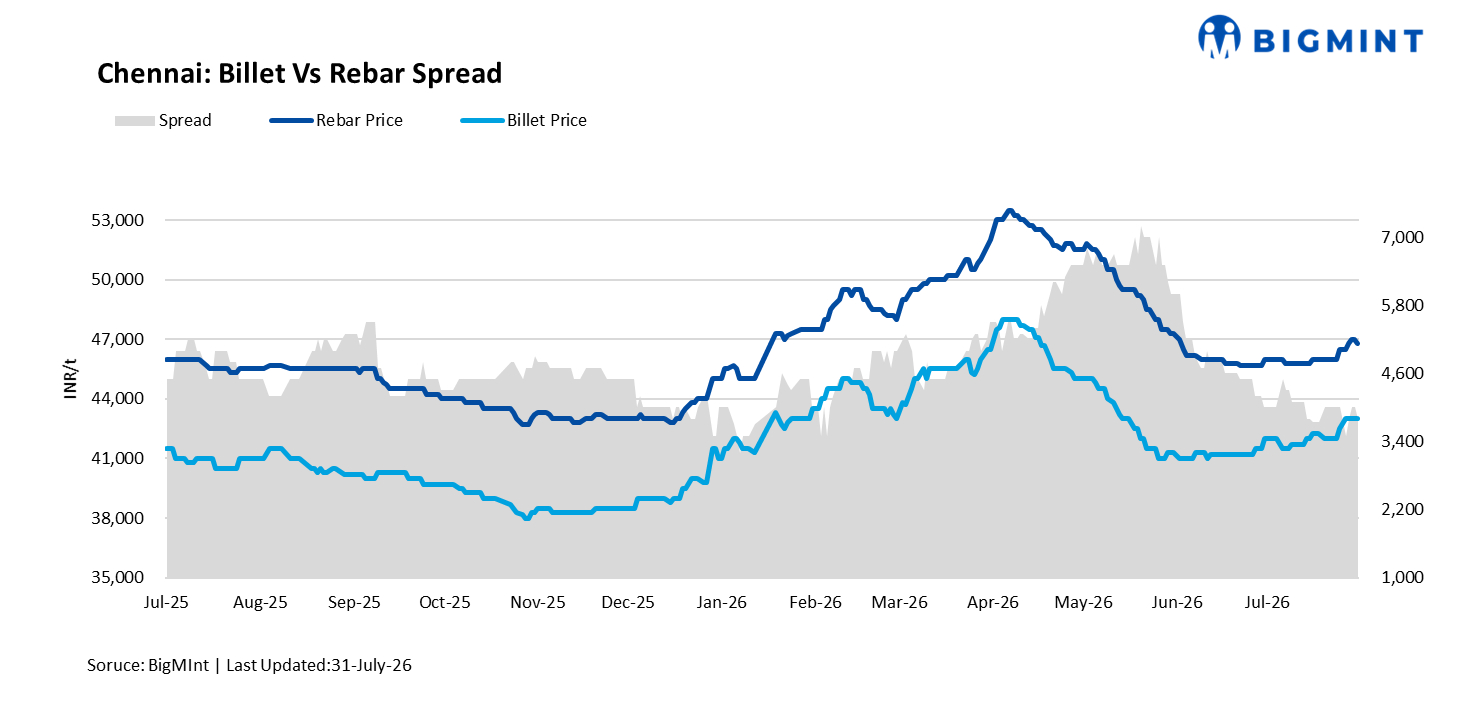
Billet prices across the southern region increased by around INR 500-1,000/t w-o-w, supported by higher raw material costs and improved procurement from re-rolling mills. Among the major markets, Chennai recorded the sharpest increase of around INR 1,000/t, primarily driven by the conclusion of a few import billet deals by merchant suppliers, which provided support to domestic price sentiment.
As of 31 July, billet prices in Hyderabad were assessed at around INR 40,500/t ex-works, while Chennai billet prices were hovering at approximately INR 43,000/t DAP. Market participants reported steady buying interest from downstream re-rollers, although procurement largely remained requirement-based.
The conversion spread between imported HMS (80:20) melting scrap and 100 mm billet in the Chennai market improved to around INR 12,200/t, up by nearly 9% w-o-w. The widening spread was mainly attributed to the increase in billet prices while domestic scrap prices remained largely stable, resulting in improved conversion margins for induction furnace-based billet manufacturers.
Rebar :
Finished steel prices, particularly rebar, moved upward across the southern markets during the week, supported by an improvement in demand compared to previous weeks. Better procurement from dealers, distributors, and re-rolling mills, coupled with higher raw material costs, lent support to domestic prices. As of 31 July, induction route rebar prices were assessed at around INR 44,500/t ex-works.
Blast furnace (BF) route rebar prices also witnessed a positive trend during the week. The price increase was mainly attributed to tighter supply in the merchant market, as several integrated steel producers undertook scheduled maintenance shutdowns, resulting in lower market availability. The reduced supply enabled primary steelmakers to maintain firmer price levels despite moderate buying activity.
Demand for finished steel continued to be supported by ongoing infrastructure and construction activities across south India. Steel manufacturers are actively supplying material to several key projects, including Chennai Metro Phase II, Hyderabad Metro Phase II, Amaravati Capital City Development in Andhra Pradesh, and the Outer Ring Road project in Telangana. In addition, steady demand from residential, commercial, and affordable housing projects across the southern states has further supported steel consumption.
Overall, the southern long steel market remained on a firm footing during the week, with higher input costs, tighter supply, and sustained infrastructure-led demand underpinning rebar prices.

Outlook :
Steel prices are expected to remain largely stable or witness a slight correction in the near term. Most bulk traders and intermediaries have already completed adequate procurement during the current week, which is likely to reduce trading activity in the merchant market over the coming days. As buying interest eases and procurement shifts to need-based purchases, market prices may come under mild downward pressure despite continued support from raw material costs.
Leave a Reply