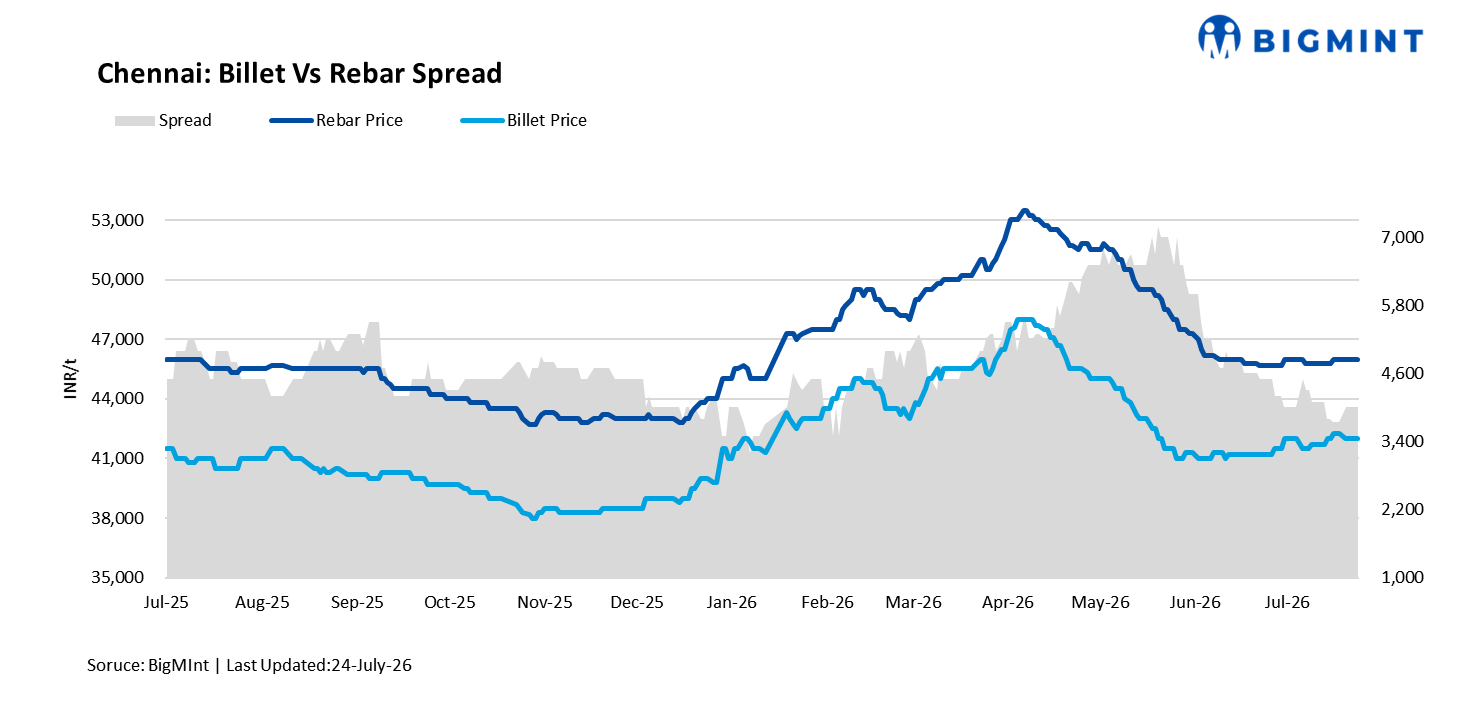
- Restocking by re-rollers lifts billet prices by INR 500/t w-o-w
- Rebar gains on higher production costs, improved buying
Southern India’s secondary steel market strengthened during the week ended 24 July 2026, supported by tighter sponge iron availability and improved procurement from re-rolling mills. Limited merchant sponge iron supply pushed up raw material costs, enabling billet and induction-route rebar producers to increase offers despite seasonally moderate demand.
Sponge iron and melting scrap
Bellary sponge iron prices increased by around INR 500/t w-o-w to INR 25,800/t ex-works as of 24 July. The increase was primarily driven by limited merchant market availability, as several sponge iron producers continued operating at reduced capacity amid weak steelmaking margins. The lower output tightened supply, offsetting the impact of subdued monsoon-season demand.
Iron ore pellet (Fe 63%) prices remained stable at around INR 9,600/t, with procurement supported by healthy demand during the monsoon, as buyers continued to prefer pellets over lump ore for better operational efficiency in wet conditions. Producers maintained firm offers, while transactions continued at prevailing levels.
RB2 coal prices were also unchanged at around INR 10,400/t ex-Gangavaram port, keeping sponge iron production costs broadly stable.
Meanwhile, the domestic ferrous scrap market remained steady, with HMS 80:20 melting scrap assessed at around INR 30,800/t delivered Chennai. Adequate domestic scrap availability and commercially unviable imported scrap due to higher landed costs encouraged steelmakers to continue sourcing locally available metallics.

Billet
Hyderabad billet prices increased by around INR 500/t w-o-w, supported by higher sponge iron prices that lifted production costs for induction furnace producers. Buying activity from re-rolling mills improved compared with the previous week as mills replenished inventories to meet regular production requirements. Firmer raw material prices and improved procurement enabled billet manufacturers to maintain higher offers.
The scrap-to-billet conversion margin for Chennai-based induction furnace producers was assessed at around INR 11,200/t, indicating that operating margins remained broadly stable despite the rise in billet prices. Stable scrap costs continued to support profitability for merchant billet producers.
Rebar
Hyderabad induction-route rebar prices increased by around INR 1,000-1,500/t w-o-w, supported by higher sponge iron prices and rising production costs for secondary steelmakers. Demand from construction and infrastructure projects improved during the week, allowing mills to pass on higher raw material costs. Market participants reported relatively better buying interest, particularly from project-based consumers.
Rebar inventories remained comfortable at around 10-15 days, depending on individual mill production levels. Manufacturers maintained balanced production and dispatches, while procurement activity remained steady. However, fresh retail demand continued to be constrained by ongoing monsoon conditions.
In contrast, blast furnace-route rebar prices declined by around INR 500-600/t w-o-w to approximately INR 48,600/t, reflecting comparatively weaker demand in the primary steel segment. Consequently, the price gap between blast furnace-route and induction-route rebar narrowed to around INR 4,000/t in the Chennai market, with secondary-route rebar continuing to receive support from tighter sponge iron availability and higher raw material costs.

Outlook
Southern steel prices are expected to remain largely stable over the coming weeks. Peak monsoon activity and the ongoing Adhik Maas period are likely to delay the commencement of new construction projects, limiting demand recovery. However, constrained sponge iron availability is expected to continue supporting secondary steel prices. Any sustained upward movement will depend on stronger downstream construction activity following the monsoon season.
Leave a Reply