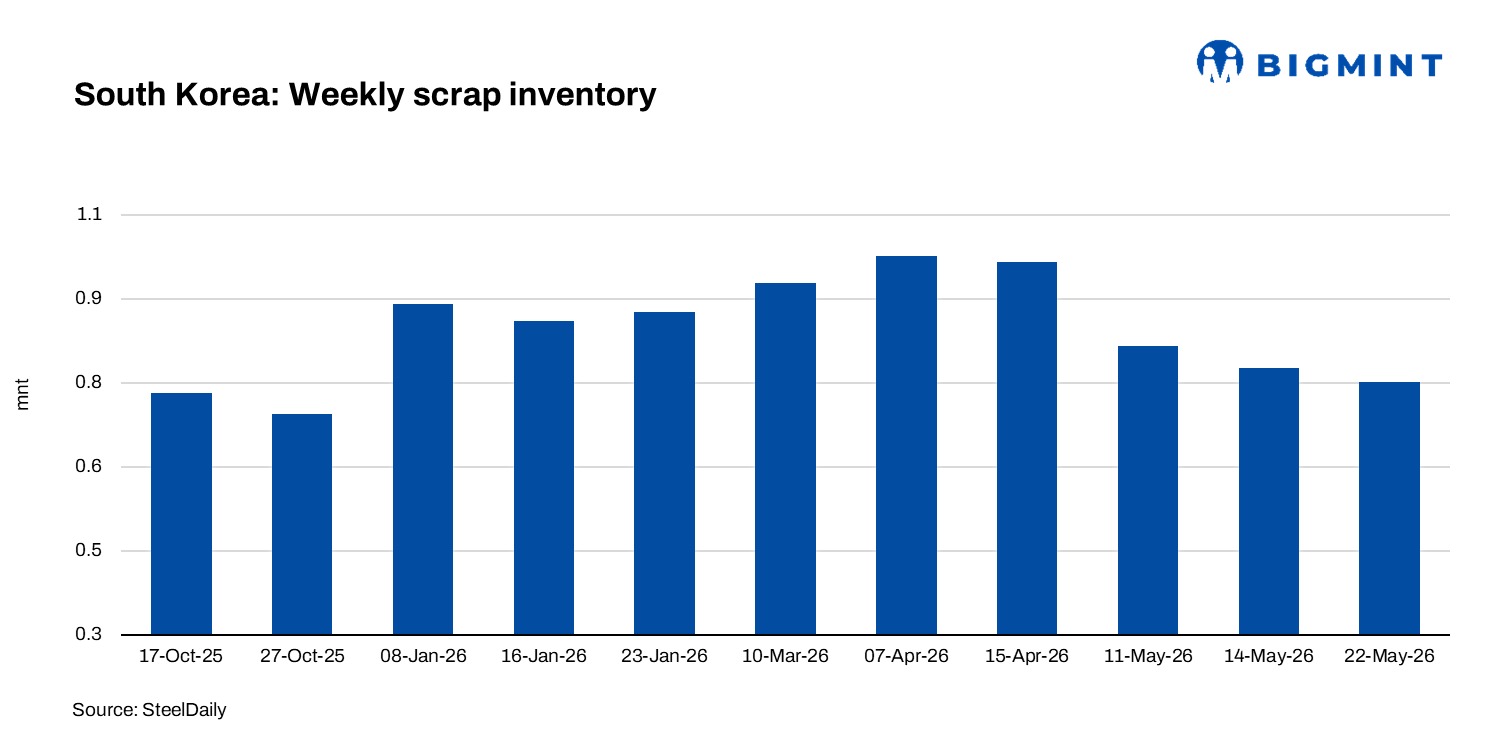
- South Korean mills scrap inventories extend decline amid tight supply
- Strong mill consumption continues to pressure domestic scrap availability
SteelDaily: Scrap inventories at 11 major South Korean steelmakers continued to decline this week, falling by 26,000 t (3.2%) w-o-w to around 782,000 t. Although the pace of decline slowed compared to the previous week, inventories remained under pressure amid continued strong scrap consumption and insufficient market inflows. Mills’ aggressive procurement efforts, including price hikes and special purchases, failed to significantly rebuild stock levels.
Region-wise inventory levels
Incheon region: Inventories at Hyundai Steel and Dongkuk Steel declined by 11,000 t (6%) w-o-w to 172,000 t due to continued scrap consumption and tight supply inflows.
Central region: Stocks remained stable at 256,000 t as declines at Hyundai Steel were offset by inventory increases at SeAH Besteel.
Pohang region: Inventories fell by 7,000 t (3.9%) w-o-w to 171,000 t, reflecting ongoing consumption at mills in the region.
Busan & Gyeongnam region: Stocks decreased by 3,000 t (3.1%) to 95,000 t amid continued inventory drawdowns across southern mills.
Product-group-wise trends
Inventories at bar and shape steelmakers, including Hyundai Steel, declined sharply by 25,000 t (4.5%) w-o-w to 527,000 t, indicating stronger consumption and tighter scrap availability in the long steel segment. Meanwhile, inventories at plate and specialty steelmakers edged down marginally by 1,000 t (0.4%) to 255,000 t.
Company-wise trends
Among the 11 surveyed steelmakers, six companies recorded inventory declines, three companies maintained inventories at levels similar to the previous week, while only SeAH Besteel reported an increase in stock levels. Most major mills continued to face difficulties in replenishing inventories despite active procurement efforts.
Market participants noted that electric furnace steelmakers raised official scrap purchase prices and conducted large-scale special buying programs exceeding KRW 30,000/t last week to secure additional supplies. However, scrap inflows remained insufficient to offset strong consumption levels, highlighting ongoing supply tightness in the domestic market and supporting firm market sentiment.
Note: This article has been written in accordance with a content exchange agreement between SteelDaily and BigMint.
Leave a Reply