- Distributors delay shipments expecting higher prices
- Weak scrap generation limits market inflows further
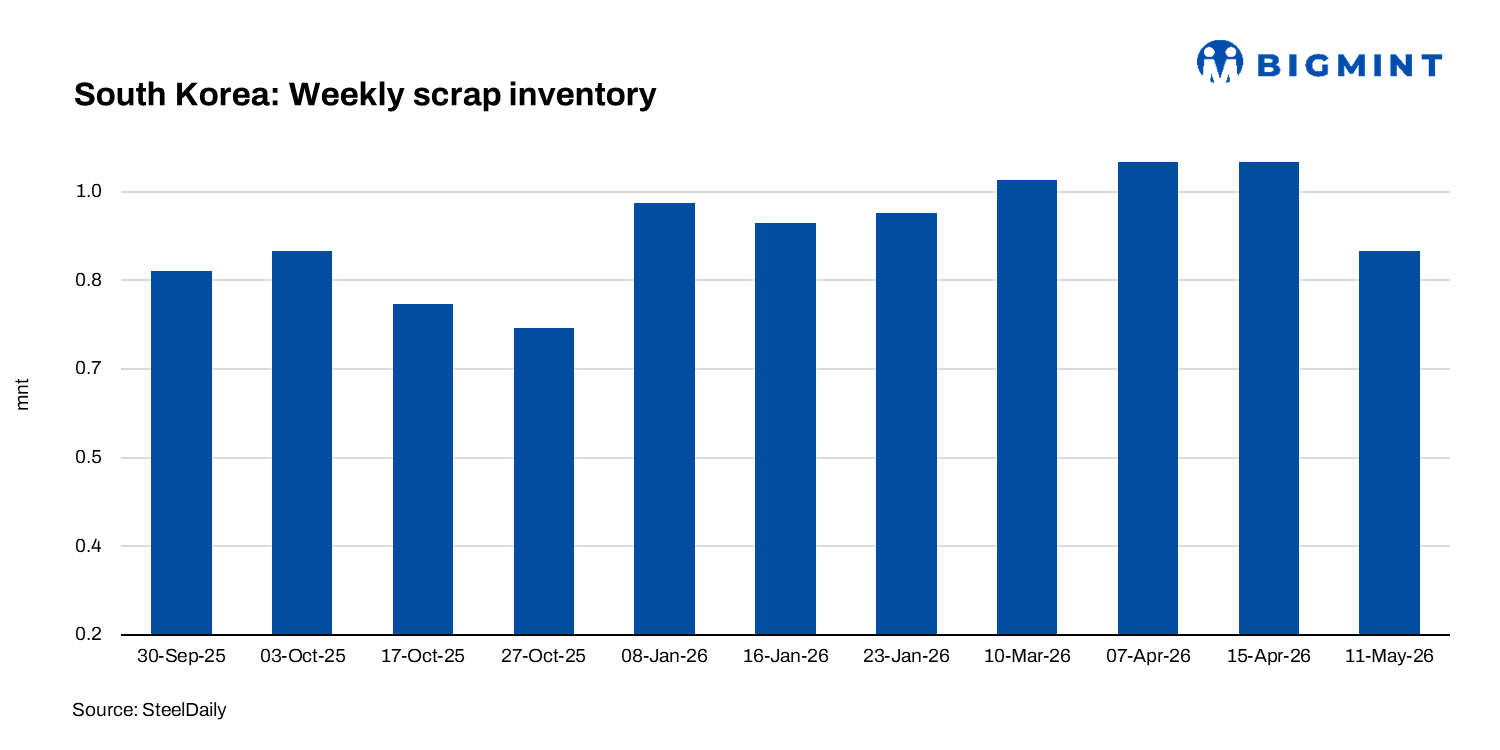
SteelDaily: Scrap inventories at 11 major South Korean steelmakers declined sharply during the week to around 851,000 t, down by 64,000 t (7%) w-o-w. The decline was mainly driven by strong mill consumption, sluggish scrap generation, and reduced shipments from distributors holding back material in anticipation of further price increases. Inventory levels at some mills reportedly fell close to operationally critical levels.
Region-wise inventory levels
Incheon region: Inventories declined by 11,000 t (5.4%) w-o-w to 193,000 t, mainly due to lower stocks at Hyundai Steel and Dongkuk Steel.
Central region: Stocks recorded the sharpest decline, falling by 29,000 t (9.4%) to 278,000 t amid strong consumption at Hyundai Steel’s Dangjin plant, SeAH Besteel, and Hwanyoung Steel.
Pohang region: Inventories decreased by 4,000 t (2.2%) w-o-w to 178,000 t due to continued high operating rates and steady scrap usage.
Busan & Gyeongnam region: Stocks fell by 3,000 t (2.7%) to 108,000 t, reflecting ongoing inventory drawdowns.
Inventories at bar and shape steelmakers, including Hyundai Steel, declined by 49,000 t (7.8%) w-o-w to 582,000 t, the lowest level since early February. Meanwhile, plate and specialty steelmakers’ inventories dropped by 15,000 t (5.3%) to 269,000 t.
Company-wise trends
Most major mills recorded inventory declines during the week, with some rebar-focused steelmakers reporting stock reductions of up to 23.5%. While a few southern-region mills saw slight increases, the overall market trend remained sharply downward.
Market participants noted that despite successive scrap price hikes by major steelmakers, inflows remained sluggish as distributors delayed shipments expecting further price increases. Some mills were also heard operating with critically low usable inventories, raising concerns over potential supply tightness in the near term.
Note: This article has been written in accordance with a content exchange agreement between SteelDaily and BigMint.
Leave a Reply