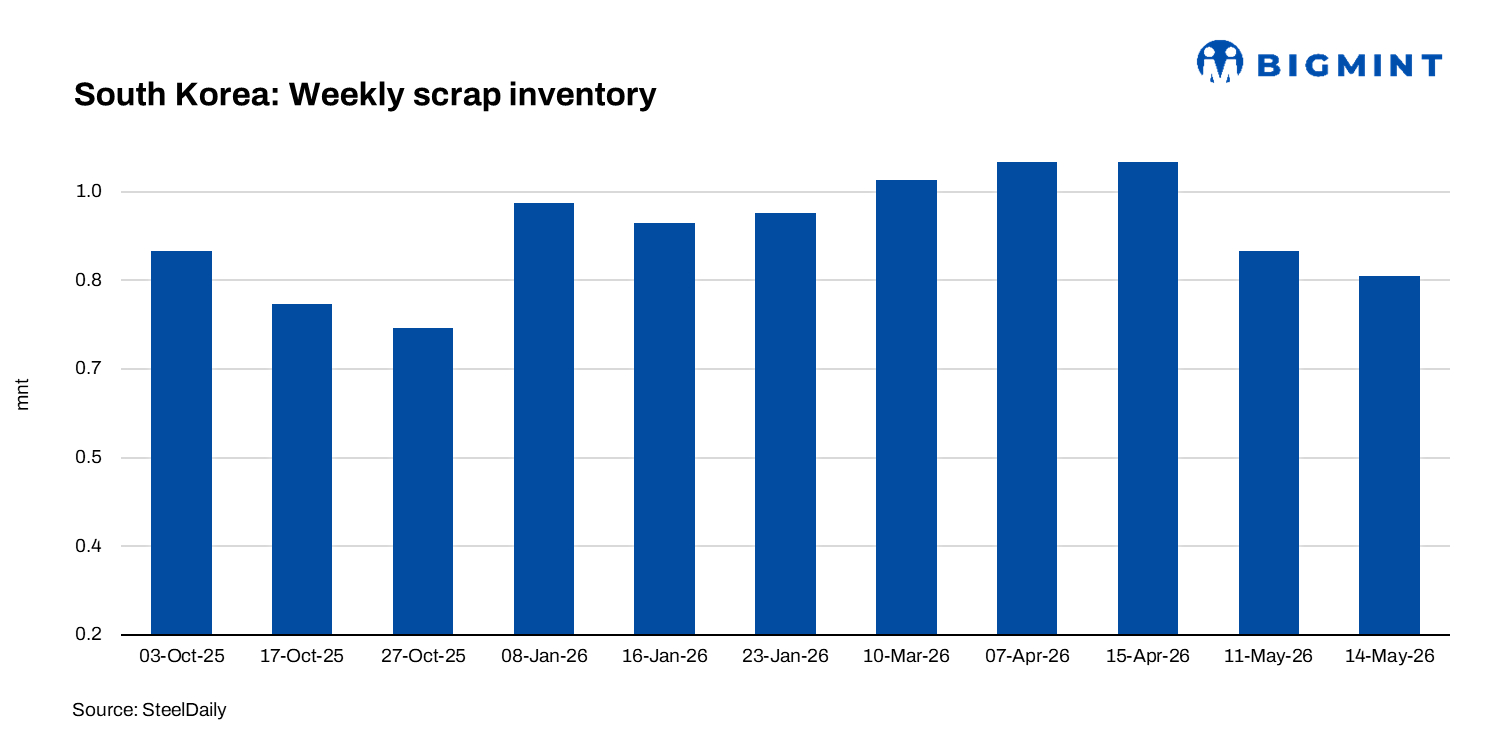
- South Korean mills’ scrap inventories fall for sixth straight week
- Strong mill consumption continues to tighten domestic scrap availability
SteelDaily: Scrap inventories at 11 major South Korean steelmakers continued to decline for the sixth consecutive week, falling by 43,000 t (5.1%) w-o-w to around 808,000 t. Compared to the short-term peak recorded on 1 April, inventories have dropped by nearly 213,000 t. The decline came despite aggressive scrap purchasing and multiple price hikes by electric furnace steelmakers, reflecting continued supply tightness and sluggish scrap inflows into the market.
Region-wise inventory levels
Incheon region: Inventories at two steelmakers declined by 10,000 t (5.2%) w-o-w to 183,000 t amid continued scrap consumption and limited inflows.
Central region: Stocks at three steelmakers recorded the steepest decline, falling by 22,000 t (8%) to 256,000 t, driven by strong operating rates and higher scrap usage.
Pohang region: Inventories remained unchanged w-o-w at 178,000 t, indicating relatively balanced scrap inflows and consumption levels.
Busan & Gyeongnam region: Stocks dropped by 10,000 t (9.3%) to 98,000 t, reflecting continued inventory drawdowns across southern mills.
Product-group-wise trends
Inventories at plate and specialty steelmakers declined by 13,000 t (4.8%) w-o-w to 256,000 t. Meanwhile, inventories at bar and shape steelmakers, including Hyundai Steel, fell more sharply by 30,000 t (5.2%) to 671,000 t, highlighting stronger consumption and tighter scrap availability in the long steel segment.
Company-wise trends
Most steelmakers reported inventory declines during the week, with some mills recording stock reductions of up to 16% w-o-w, while three companies maintained inventories at levels similar to the previous week. Mills that aggressively raised scrap purchase prices were heard maintaining relatively stable stock positions compared to others.
Market participants noted that despite successive buying price hikes by electric furnace mills, scrap inflows remained insufficient to offset consumption levels. The continued decline in inventories indicates ongoing supply tightness, particularly among bar and shape steel producers, while concerns over near-term scrap availability continue to support bullish market sentiment.
Leave a Reply