- Imports help relieve tight domestic supply
- Gwangyang sees slower unloading, congestion
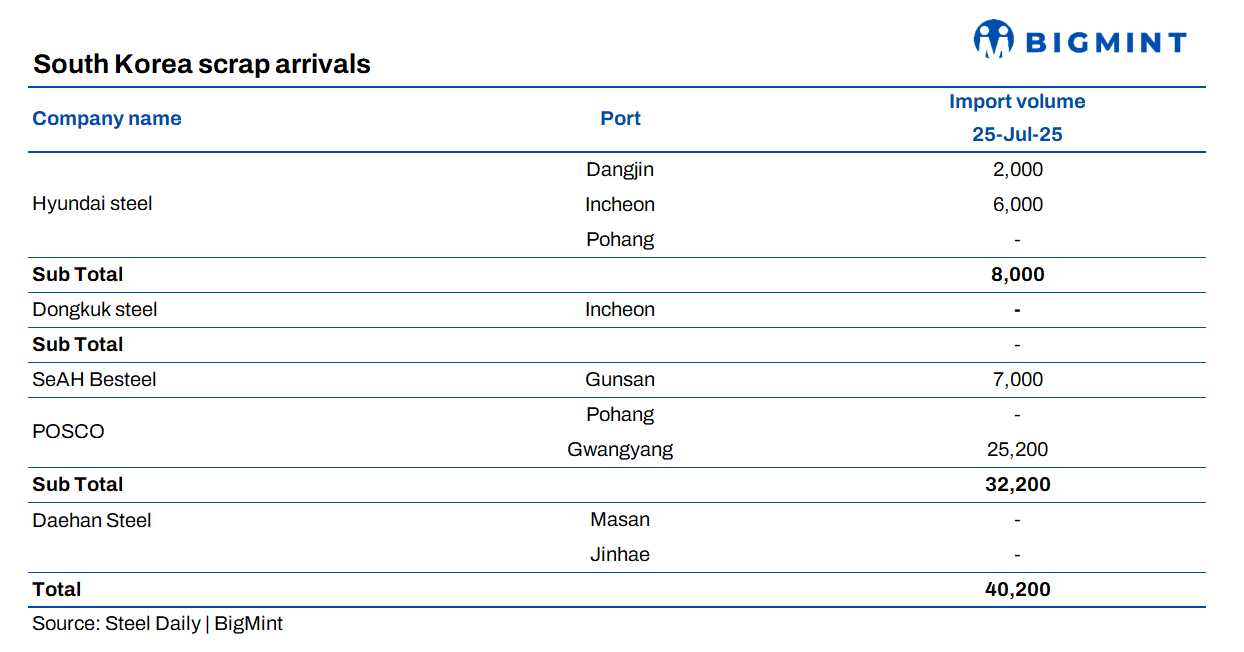
SteelDaily: South Korea’s major ports recorded around 40,200 tonnes (t) of imported scrap arrivals in the fourth week of July, as imports continued to partially bridge the gap left by stagnant domestic scrap generation.
While domestic scrap supply remains constrained, ports such as Incheon and Gunsan maintained steady import flows. However, Gwangyang Port showed signs of congestion, with slower unloading despite a large volume of incoming cargo.
Port-wise arrivals
- Incheon: Incheon is set to receive around 6,000 t of Japanese-origin scrap.
- Gwangyang: This port received the largest share of imports, 25,200 t, over half of the total volume. However, only 8,100 t were newly added during this week. The remaining 17,000 t had already been reported earlier in July and are yet to be cleared, indicating slower processing or port congestion.
- Gunsan: Approximately 7,000 t of shredded and Shindachi scrap were expected.
- Dangjin: A smaller volume of 2,000 t was confirmed for the first time in a long time.
In contrast, southern ports such as Pohang, Masan, Jinhae, and Busan reported no recent scrap arrivals.
Market updates
Some cargoes expected in mid-July are yet to arrive, suggesting delays tied to changes in the cargo owner’s storage or delivery plans.
Despite limited volumes, imports are helping to alleviate some of the supply strain in the domestic market, which remains unstable due to weak local scrap generation.
Adding to the activity, a domestic steelmaker has reportedly signed a contract for Russian A3 scrap at a CFR price of $310-315/t, which translates to approximately KRW 425,000/t. This deal underscores the growing interest in alternative supply sources amid tight market conditions.
Note: This article has been published in accordance with a content exchange agreement between SteelDaily and BigMint.
Leave a Reply