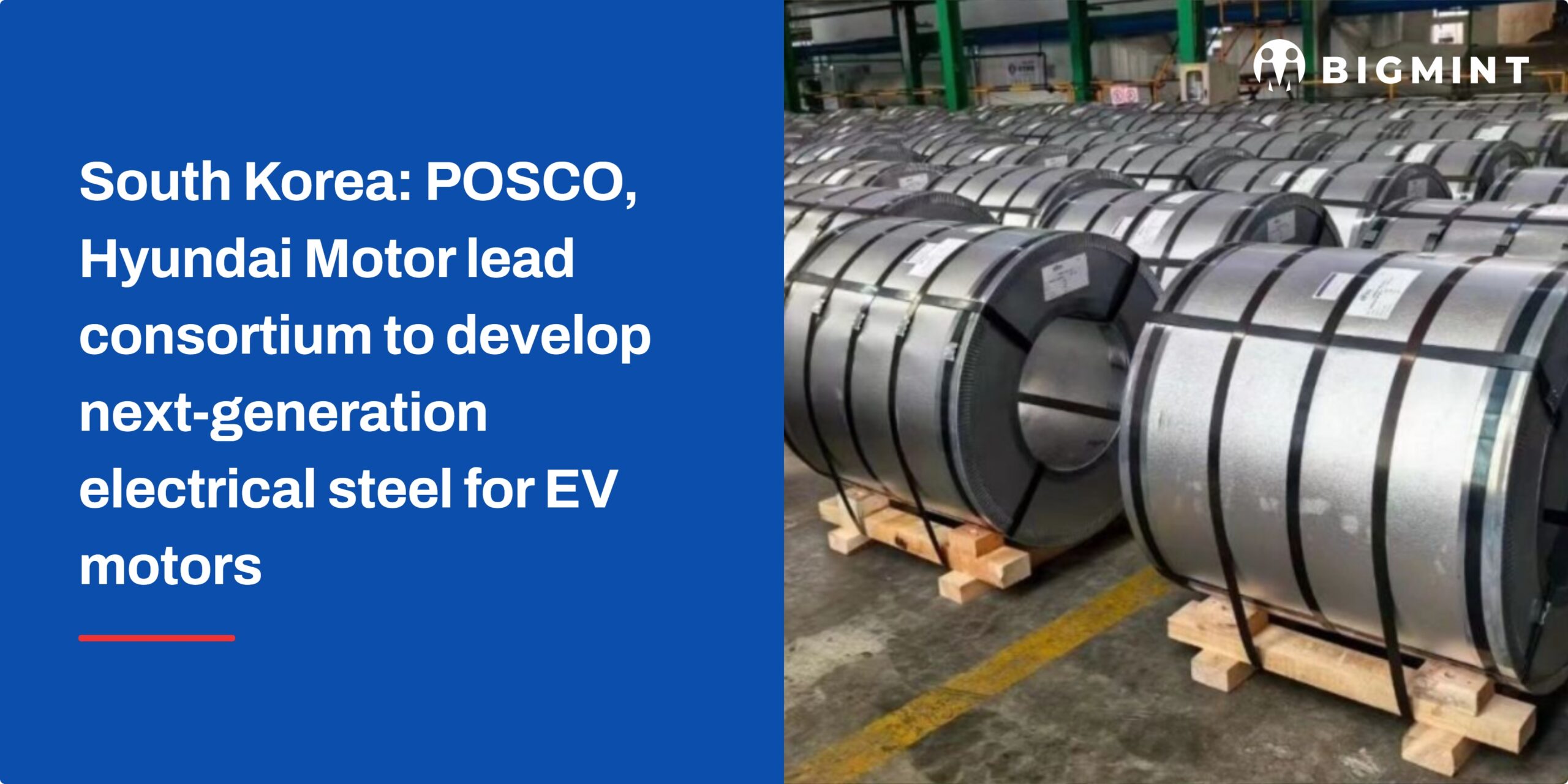
- Consortium targets mass production of 6.5% silicon electrical steel for EVs
- Project spans steelmaking, motor production, vehicle performance validation
South Korean steelmaker POSCO has joined hands with Hyundai Motor and eight industry, academic, and research partners to develop next-generation high-silicon electrical steel sheets for electric vehicle (EV) drive motors, as the country seeks to strengthen its position in the market for high-value automotive materials.
The consortium, backed by South Korea’s Ministry of Trade, Industry and Energy and managed by the Korea Evaluation Institute of Industrial Technology (KEIT), aims to develop technologies for manufacturing 6.5% silicon non-oriented wide-length electrical steel sheets for EV motors. The project will cover the entire value chain, from steelmaking and motor core production to drive motor manufacturing and vehicle-level performance validation.
Besides POSCO and Hyundai Motor, the consortium includes SL Corporation, Polepair Electric, the Research Institute of Industrial Science & Technology (RIST), the Korea Institute of Industrial Technology (KITECH), the Korea Automotive Technology Institute (KATECH), the University of Ulsan, Pukyong National University, and the Korea Metal Materials Research Association (KOMERA).
Why high-silicon electrical steel matters
Electrical steel is a critical material used in electric motors. Raising silicon content significantly reduces iron losses generated during high-speed motor operation, allowing motors to operate more efficiently while consuming less electricity. Developing commercially viable high-silicon electrical steel has, therefore, become a priority for automakers and steelmakers seeking to improve EV performance.
Conventional non-oriented electrical steel typically contains around 1-3.5% silicon. The consortium aims to develop commercial-scale production of 6.5% silicon electrical steel, which offers superior magnetic performance and lower energy losses. However, the higher silicon content also makes the material considerably more brittle, making it difficult to roll into thin, wide sheets suitable for mass production.
As a result, developing a commercially viable process to mass-produce wide sheets of high-silicon electrical steel remains a key technological challenge for steelmakers worldwide. The project will, therefore, focus on both production technology and validating the material’s performance in commercial EV motors.
EV efficiency becomes next battleground
The initiative comes as global automakers increasingly look beyond battery technology to improve EV performance. While advances in battery chemistry remain important, improving drivetrain efficiency has become another key route to extending vehicle range and reducing electricity consumption.
For POSCO, the project supports its strategy of expanding its portfolio of premium automotive steels as competition in conventional flat steel intensifies.
Successful commercialisation would strengthen POSCO’s position in the growing EV materials market while supporting South Korea’s efforts to build a more competitive domestic supply chain for electric mobility.
Leave a Reply