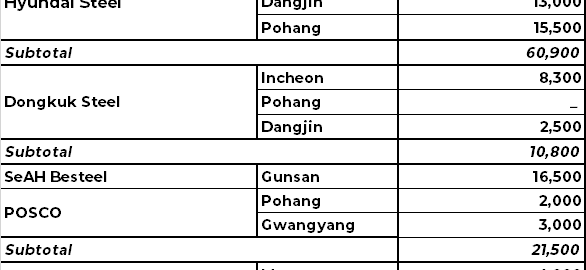
Imported scrap arrivals into South Korea fell precipitously this week after rising consistently since the beginning of the year. This week, major ports in this country announced a total inventory of 107,200 tonnes (t), a 39% or 68,062 t reduction over the previous week as of February 27, 2023. The main reason for this is a fall in the number of reported arrivals at Dongkuk Steel, which received a high volume of scrap imports earlier in February.
Company-wise imports:
Hyundai Steel: At Incheon, Dangjin, and Pohang, Hyundai Steel reported a total of 60,900 t of scrap received. Incheon received 32,400 t, Pohang 13,000 t, and Dangjin 15,500 t. This is an increase of about 3,000 tonnes from last week.
Dongkuk Steel: Dongkuk Steel brought 10,800 t of steel to Incheon and Dangjin. Incheon received 8,300 t, while Dangjin received 2,500 t. Dongkuk Steel reported more than 100,000 t of entry in the first week of February, followed by a large amount of imported scrap throughout February, but imports were significantly lower this week.
POSCO: POSCO only registered 5,000 t of scrap for Pohang and Gwangyang.
SeAH Steel & Daehan Steel: SeAH Besteel brought in 16,500 t to Gunsan — a drop of about 6,000 t from last week but has maintained steady imports this year. Masan Port received 4,000 t of imported scrap for Korea Iron & Steel, 4,000 t for Daehan Steel, and 6,000 t arrived at Busan Port for unidentified buyers.
Grade-wise arrivals:
HMS imports were at 26,400 t this week, accounting for 24.6% of the total, and comprised a cargo from New Zealand brought into Incheon by Hyundai Steel. The volume of port arrival declarations is similar to that of the previous week, but the proportion has risen significantly as the total volume has decreased.
Shredded was at 8,500 t, or 7.9% of the total; Sindachi was at 10,000 t ( 9.3%), HS at 6,000 t (5.6%), and H2 was at 2,000 t (1.9%). The slowdown in imports, which had greatly increased since the beginning of the year, is expected to affect steelmakers’ inventory accumulation.
Outlook: With the peak season approaching in March, there is fear about a supply shortfall as the number of imported ports drops.
Note: This article has been published in accordance with an article exchange agreement between SteelDaily and SteelMint.
Leave a Reply