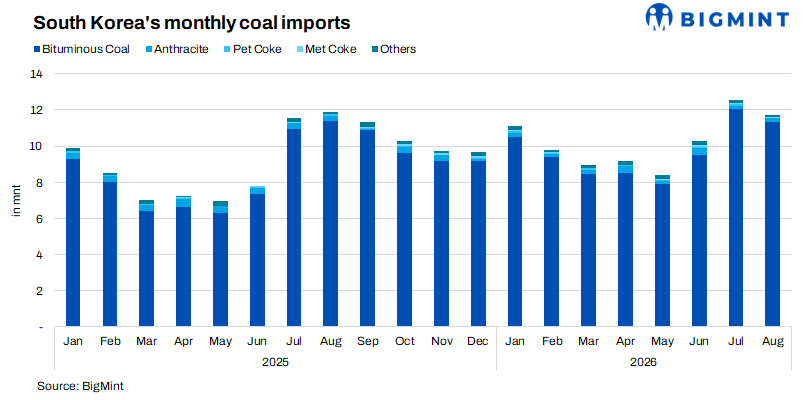
- Aug’26 coal imports fall 6% m-o-m amid lower bituminous arrivals
- Bituminous coal accounts for virtually all incremental import demand
South Korea’s coal imports eased in August 2026 from the previous month’s elevated levels, but cumulative trade data point to a substantially stronger import requirement this year, led overwhelmingly by bituminous coal.
Total coal imports stood at 11.73 mnt in August, down 6.4% m-o-m from 12.54 mnt in July. However, imports during January-August 2026 reached 81.93 mnt, up a sizeable 15.7% y-o-y, or around 11.13 mnt, from 70.80 mnt in the corresponding period of 2025.
The composition of that increase is particularly significant for the seaborne coal market.
Bituminous coal drives the increase
Bituminous coal imports stood at 11.36 mnt in August, down 5.6% from 12.04 mnt in July, but remained by far the dominant component of South Korean coal purchases.
During January-August, bituminous imports surged to 77.66 mnt, up 17.1% y-o-y from 66.35 mnt.
This represents an increase of approximately 11.31 mnt — actually slightly greater than the 11.13 mnt increase in South Korea’s overall coal imports.

Bituminous coal consequently accounted for around 97% of August coal imports and nearly 95% of January-August volumes.
This also means the headline 15.7% increase is not the result of a broad-based rise across coal categories. Instead, declining anthracite and pet coke purchases have partly offset the much larger increase in bituminous volumes.
Anthracite imports continue to contract
Anthracite imports fell to 178,876 t in August, down 12.5% m-o-m. January-August imports were substantially weaker at 2.00 mnt, down 26.5% y-o-y from 2.72 mnt.
Pet coke followed a similar pattern, falling 27.3% m-o-m to just 44,111 t in August, while cumulative imports declined 15.7% to 328,016 t.
Met coke moved in the opposite direction on a cumulative basis. Imports reached 485,470 t during January-August, up 168% y-o-y. However, August receipts collapsed to just 6,048 t from nearly 80,000 t in July, highlighting the relatively volatile nature of this trade.
Aug decline should be seen in context
The 6.4% m-o-m decline in August therefore does not yet point to a reversal in South Korea’s stronger 2026 coal import trend.
Average coal imports during the first eight months of 2026 were approximately 10.24 mnt/month, compared with 8.85 mnt/month during the same period last year. At 11.73 mnt, August remained well above that 2026 average despite declining from July.
The accompanying iron ore data present an interesting contrast. South Korea’s iron ore imports fell sharply by 21.4% m-o-m to 5.38 mnt in August, although January-August volumes remained 4% higher y-o-y at 46.42 mnt.
This suggests August’s lower coal number should not simply be interpreted as evidence of weakening overall coal demand.
BigMint assessment
South Korea has emerged as a materially stronger coal importer in 2026, with an additional 11.1 mnt entering the market during January-August compared with last year.
More importantly, the increase is concentrated almost entirely in bituminous coal. This makes South Korea’s buying an important component of incremental seaborne demand and potentially relevant for suppliers competing for Northeast Asian business.
August indicates some sequential cooling after July’s strong imports, but not yet a change in the broader trend. With cumulative bituminous purchases still running 17% above last year, the key question for the remainder of 2026 will be whether this elevated buying persists into the autumn and winter period.
Leave a Reply