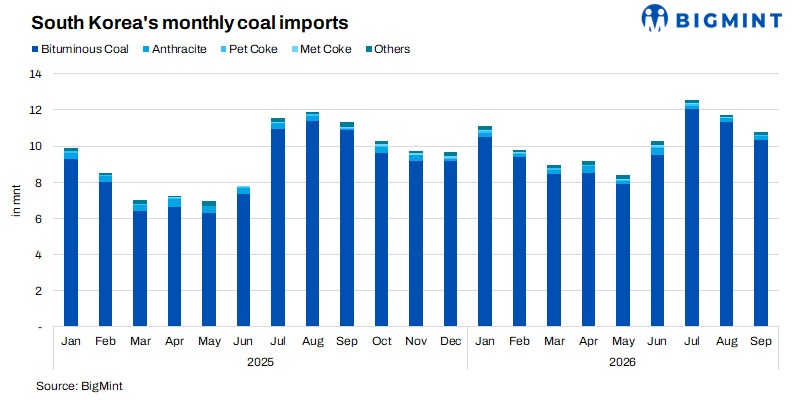
- Bituminous coal drives almost all incremental import growth in Jan-Sep
- Anthracite contracts sharply; met coke imports more than double in 9MCY’26
South Korea’s coal and solid-fuel imports declined 8.2% m-o-m to 10.77 mnt in September 2026, with lower bituminous coal purchases outweighing increases in petcoke, metallurgical coke and anthracite.
Despite the monthly retreat, January-September imports increased 12.9% y-o-y to 92.70 mnt. Growth was overwhelmingly concentrated in bituminous coal, while anthracite imports fell substantially.
The figures point to a larger import market over the first nine months, alongside considerable differences between fuel categories. September’s decline alone does not establish a sustained weakening in demand.

Sep decline follows strong Aug
Total imports fell by approximately 0.96 mnt from August. Bituminous coal purchases declined by 1.01 mnt, accounting for more than the entire net reduction, as increases in other fuels provided a partial offset.
However, September’s 10.77 mnt remained approximately 4.6% above the January-September monthly average of 10.30 mnt.
It also exceeded the January-August monthly average of approximately 10.24 mnt by 5.2%. August was therefore a particularly strong comparison month.
After adjusting for September’s shorter calendar, average daily imports declined approximately 5.1%, compared with the 8.2% reduction in monthly tonnage.
These comparisons suggest moderation from an elevated August level. Establishing whether underlying consumption weakened would require generation, industrial activity and inventory data.
Bituminous coal dominates nine-month growth
January-September bituminous coal imports increased by 10.79 mnt to 88.02 mnt.
That increase slightly exceeded the 10.60 mnt rise in total coal and solid-fuel imports, because the anthracite contraction offset part of the growth elsewhere.
Bituminous coal’s share of the total increased from approximately 94.1% in January-September 2025 to 94.9% in 2026. In September alone, it accounted for approximately 96.1% of imports.
For exporters, this is the principal commercial signal: South Korea’s additional import requirement is concentrated in its largest coal category rather than spread evenly across solid fuels.
However, “Bituminous coal” should not be treated as synonymous with thermal coal. The category can include both steam coal and metallurgical coal. The supplied data do not separate these uses, so the increase cannot be attributed entirely to power generation or steelmaking.
Anthracite loses ground despite Sep improvement
Anthracite imports increased 7.8% m-o-m to approximately 193,000 t in September, but remained well below the pace recorded over the first nine months as a whole.
January-September purchases fell by approximately 621,000 t, or 22.1%, to 2.19 mnt. Their share of total imports declined from approximately 3.4% to 2.4%.
September volumes were also around 21% below the 2026 nine-month monthly average.
The contraction is therefore more persistent than the latest monthly increase suggests. Nevertheless, the figures do not establish whether it reflects weaker consumption, inventory adjustment or substitution by other materials.
In particular, rising bituminous imports alongside falling anthracite purchases do not prove direct replacement: the fuels have different properties and applications.
Met coke doubles, but Sep remains subdued
Metallurgical coke imports more than doubled year-on-year to approximately 498,000 t during January-September, adding around 250,000 t.
September purchases rose sharply from August, but reached only 12,663 t — approximately 77% below the nine-month monthly average.
Around 97.5% of the cumulative volume had therefore arrived before September.
This contrast suggests that the year-to-date expansion was concentrated earlier in the year. September’s percentage rebound reflects a low August base and should not be read as a return to the earlier import rate.
Without domestic coke production, steel output and inventory information, higher cumulative imports cannot be attributed conclusively to stronger steelmaking demand or reduced domestic supply.
Petcoke records a monthly rebound
Petcoke imports nearly doubled m-o-m to approximately 86,800 t in September.
The month accounted for approximately 21% of January-September purchases and was almost twice the preceding eight-month average.
Nevertheless, cumulative imports increased only 4.1% y-o-y to approximately 415,000 t. The strong September arrival therefore contrasts with comparatively modest growth across the year.
The dataset does not distinguish fuel-grade from other petcoke applications. It consequently cannot establish whether the increase was driven by cement, other industrial fuel demand or non-fuel uses.
BigMint assessment
South Korea’s September retreat should be viewed against August’s elevated arrivals and a substantially larger nine-month import market.
Bituminous coal accounts for virtually all incremental growth, while anthracite is contracting and met coke’s expansion is concentrated earlier in the year.
For suppliers, South Korea remains an important source of additional buying volume. However, the next analytical step is to separate thermal and metallurgical bituminous coal and examine origins, inventories and consuming-sector activity. Those details will determine whether the higher imports represent sustained consumption, replenishment or changes in sourcing.
Leave a Reply