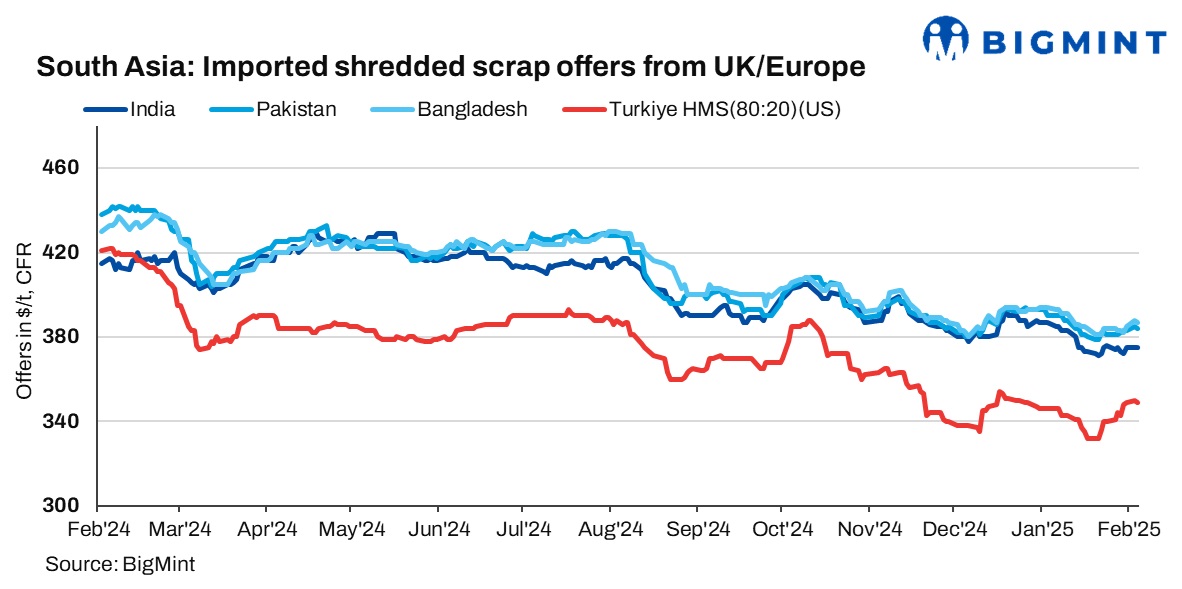
- India affected by currency fluctuations, weak steel demand
- Turkiye’s market stable despite US tariff uncertainties
South Asia’s imported scrap markets showcased mixed sentiments, influenced by currency fluctuations, regional demand shifts, and global trade dynamics. In India, a stronger US dollar and weak downstream steel demand dampened import activities, while suppliers favoured neighbouring markets like Pakistan.
Pakistan’s market remained stable despite sluggish construction activity and cash flow constraints, with sellers adjusting prices to sustain momentum. Bangladesh saw limited, need-based buying driven by pre-Ramadan restocking, keeping sentiment cautiously optimistic.
Meanwhile, Turkiye’s market stayed rangebound as participants navigated uncertainties surrounding US tariffs, with mills eyeing potential gains in rebar exports. Price movements across the region were modest, reflecting cautious trading strategies.
Overview
India: India’s imported scrap market remained subdued as the strengthening of the US dollar against the Indian rupee made imports unfeasible. Weak demand from the downstream steel sector further dampened consumption. Suppliers showed little interest in offering material to Indian buyers, favouring markets like Pakistan for better realisations and focusing on strong domestic demand in the US.
A trader remarked, “The market is quiet. Dollar appreciation and an uninspiring Budget for Indian steel players have hurt sentiments. US imports are off the table as FAS prices are much stronger than CFR.”
A seller stated, “Shredded is being heard at around $375/t and HMS 80:20 at $355-360/t, but no deals have materialised. At these price levels, even I am not prepared to sell.”
Pakistan: Pakistan’s imported scrap market remained stable, though slow steel demand and cash flow issues limited activity. UK-origin shredded was offered at $385/t CFR Qasim, with buyers quoting $380/t, while UAE-origin HMS stood at $365/t CFR.
Local scrap traded between PKR 142,000-147,000/t, and rebar prices ranged from PKR 240,000-250,000/t based on payment terms.
A sluggish construction sector and absence of new government projects kept demand weak, forcing sellers to consider discounts to maintain sales momentum.
Bangladesh: In Bangladesh, buying activities are limited and driven by need-based requirements, primarily due to restocking demand ahead of Ramadan. Indicative offers for UK/Europe-origin shredded scrap were heard at $385-390/t CFR Chattogram, while HMS (80:20) stood at $365-370/t CFR. Mills are selectively assessing offers, focusing on cost-effective, near-shore materials. While market sentiment remains cautiously optimistic, prices have stayed mostly stable with slight adjustments. The durability of this trend beyond the festive season remains uncertain.
Turkiye: Turkiye’s imported scrap market remained rangebound as participants assessed the potential impact of US tariffs on Canada, Mexico, and China. US origin bulk HMS (80:20) was assessed at $349/t CFR, slightly down by 1/t, with recent Baltic-origin deals at $349/t CFR and EU-origin at $344-345/t CFR.
Despite the euro’s weakness, price expectations stayed flat due to market uncertainty. While Turkish mills showed caution amid fluctuating currency trends, they anticipate gaining a competitive edge in US rebar exports following new tariffs. Overall, sentiment remained steady with limited price movement expected in the near term.

Price assessments
India: UK-origin shredded indicatives were assessed at $375/t CFR Nhava Sheva, unchanged d-o-d.
Pakistan: UK-origin shredded indicatives were at $384/t CFR Qasim, down $1/t d-o-d.
Bangladesh: UK-origin shredded was assessed at $387/t CFR Chattogram, down by $1/t.
Turkiye: US-origin HMS (80:20) bulk scrap edged down by $1/t d-o-d to $349/t CFR Turkiye.
Leave a Reply