- Hormuz vessel sinking raises concerns over Pakistan’s scrap supply
- Turkish scrap prices soften as mills delay fresh purchases
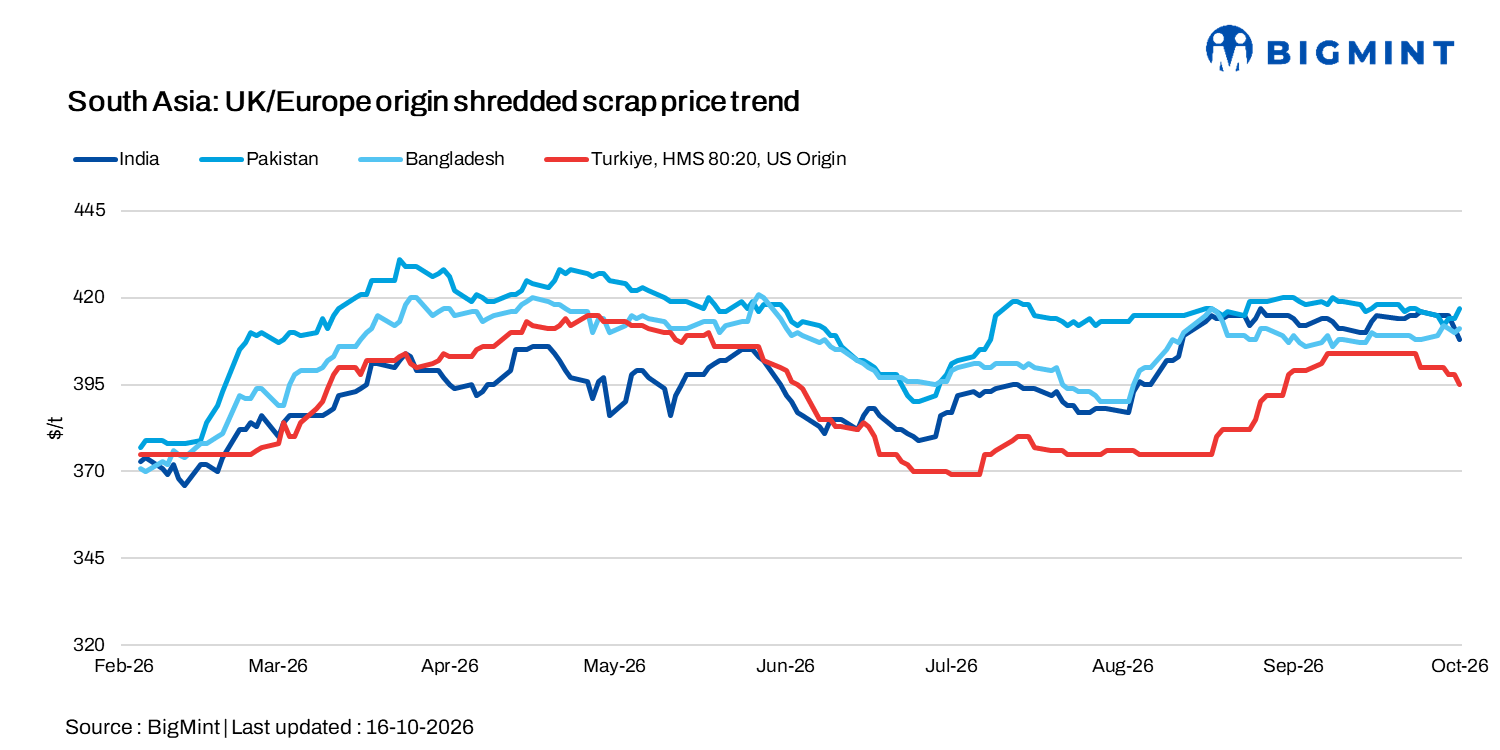
South Asian ferrous scrap markets remained under pressure d-o-d on 16 October 2026 amid weak steel demand, cautious mill procurement and cheaper domestic alternatives. Indian buyers stayed largely on the sidelines, while Bangladeshi mills resisted higher offers. In Pakistan, reports of a vessel sinking in the Strait of Hormuz raised concerns over potential supply disruptions. Meanwhile, subdued trading and falling rebar prices weighed on scrap market sentiment in Turkiye.
India: The imported containerised shredded scrap market remained subdued as increased availability of domestic scrap and direct-reduced iron (DRI) reduced import demand. Market participants indicated that bids would need to fall below $400/t CFR to attract fresh buying interest.
Imported containerised shredded scrap was heard at $395/t CFR Nhava Sheva. Offers stood at $405-410/t CFR, while indicative bids were reported at $380-385/t CFR, reflecting a wide gap between buyer and seller expectations.
A market participant said buying interest had virtually disappeared. Rising container freight costs limited sellers’ ability to lower offers, while buyers continued to favour cheaper domestic alternatives. Fresh bookings are likely to remain limited until prices decline.
Meanwhile, a UK-origin cargo of 750 t of turnings was reportedly booked at $338/t CFR Chennai.
Pakistan: The imported ferrous scrap market remained subdued, with containerised shredded scrap bids reported at $405-412/t CFR Qasim, against offers around $415-418/t CFR. A UK-origin shredded scrap cargo of 2,000 t was reportedly sold at $415-416/t CFR Qasim.
Trading activity from Malaysia remained on hold due to shipping issues, while UAE-origin purchases were limited as sellers continued to fulfil pending orders.
Meanwhile, a vessel, GFS Pride, sank in the Strait of Hormuz while allegedly carrying around 1,100 containers of steel scrap from the UAE to Port Qasim. The incident has raised concerns over potential supply disruptions and heightened market anxiety. Pakistani scrap prices could face upward pressure if shipments are delayed or the cargo is confirmed lost, although the vessel and cargo details remain subject to verification.
Bangladesh: Offers for Australian-origin containerised shredded scrap to Bangladesh were reported at $415/t CFR Chattogram. However, high finished steel inventories and weak buying interest have made Bangladeshi mills reluctant to accept higher prices for imported scrap, a recycler said.
Turkiye: The deep-sea imported scrap market weakened amid subdued trading and cautious mill procurement. HMS 80:20 was reported at $395-396/t CFR, while US-origin offers remained scarce.
US-origin HMS 80:20 tradable values stood at $395-400/t CFR, while EU-origin material was assessed at $375-390/t CFR. Turkish buyers resisted higher offers, with one recycler expecting prices to decline by around $5/t in the coming days. However, demand could improve in the second half of October as mills begin securing cargoes for December shipment.
Turkish rebar export prices fell by $4-5/t d-o-d to $610-612/t FOB, reflecting continued weakness in finished steel demand.

Leave a Reply