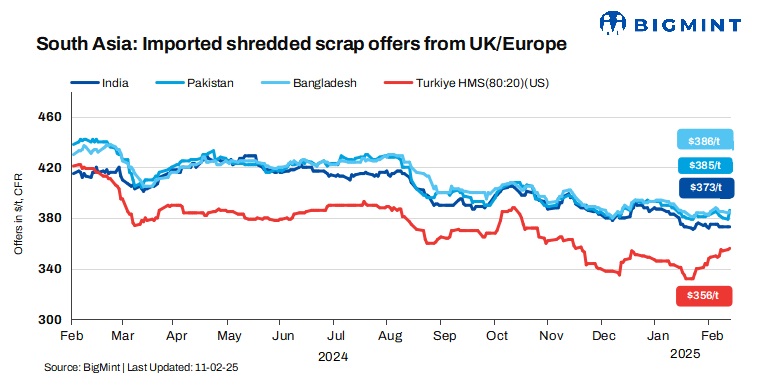
- India buyers cautious, Pak sees pre-Ramadan restocking
- Turkiye monitors US steel, aluminium tariff impact
South Asia’s imported scrap market exhibited a cautious note, with India witnessing subdued activity due to weak buying interest and a depreciating rupee (INR), making imports less attractive. Pakistan saw comparatively better procurement levels as some buyers restocked ahead of Ramadan, though overall sentiment remained watchful amid price fluctuations. In Bangladesh, sluggish construction activity and a lack of new government projects kept mills hesitant in securing large volumes despite local scrap shortages. Meanwhile, Turkiye’s market stayed steady, with mills assessing the impact of new US tariffs while deep-sea scrap prices hovered within a narrow range.
Overview
India: Indian buyers stayed largely inactive in the imported scrap market due to weak buying interest and the INR’s depreciation to 87 against the US dollar (USD), making imports costlier. Market participants highlighted that domestic scrap remains cheaper by INR 1,500-2,000/t compared to imported material. Shredded scrap offers from the UK/Europe remained steady at $370-375/t CFR Nhava Sheva, while bids were heard at $360-365/t CFR. HMS (80:20) was assessed at $350-355/t CFR Nhava Sheva.
The landed price of HMS, including port clearances and inland freight, stood at INR 33,000-34,000/t, while prices in Jalna were at INR 31,500-31,700/t. With domestic scrap offering a price advantage of INR 1,500-1,700/t, buyers continued to favour local material over imports.
Pakistan: Pakistan’s imported scrap market saw better procurement than India’s as some buyers restocked ahead of Ramadan, though sentiment remained cautious due to price volatility. Shredded scrap offers from the UK/Europe were at $385-390/t CFR Qasim, amid ongoing negotiations, while deals were heard at $378-381/t CFR.
A market participant informed, “In Karachi, out of eight factories, three operated at 10-20% capacity utilisation, two at 50-60%, while the rest remained quiet, though no supply shortages were reported.”
Local demand stayed stable, with rebar prices at PKR 245,000-255,000/t and local scrap at PKR 140,000-145,000/t, keeping market activity routine.
Bangladesh: Bangladesh’s imported scrap market remained cautious as weak steel demand persisted due to sluggish construction activity and a lack of new government projects. Despite local scrap shortages, mills refrained from booking large volumes, closely monitoring global price trends.
Australian shredded offers stood at $370-375/t CFR Chattogram, US shredded at $365-370/t CFR, and Hong Kong PNS at $378-380/t CFR.
Turkiye: Turkiye’s imported scrap market remained steady as buyers assessed the impact of new US tariffs on steel and aluminum. Deep-sea scrap prices were range-bound, with US and Baltic-origin HMS (80:20) assessed at $356/t CFR, though indicative tradable values ranged between $350-360/t CFR.
Turkish mills stayed in “watch-and-wait” mode, limiting activity due to uncertainty, while US recyclers held firm on offers at $360/t CFR. Buyers pushed for lower prices, citing weak finished steel demand.
Despite the market slowdown, Turkish exported rebar edged up to $562.50/t FOB, gaining $2.50/t d-o-d.
Price assessments
India: UK-origin shredded indicatives were assessed stable at $373/t CFR Nhava Sheva.
Pakistan: UK-origin shredded indicatives were at $386/t CFR Qasim, up $7/t d-o-d.
Bangladesh: UK-origin shredded was assessed at $385/t CFR Chattogram, up by $1/t d-o-d.
Turkiye: US-origin HMS (80:20) bulk scrap edged up by $1/t d-o-d to $356/t CFR Turkiye.
Leave a Reply