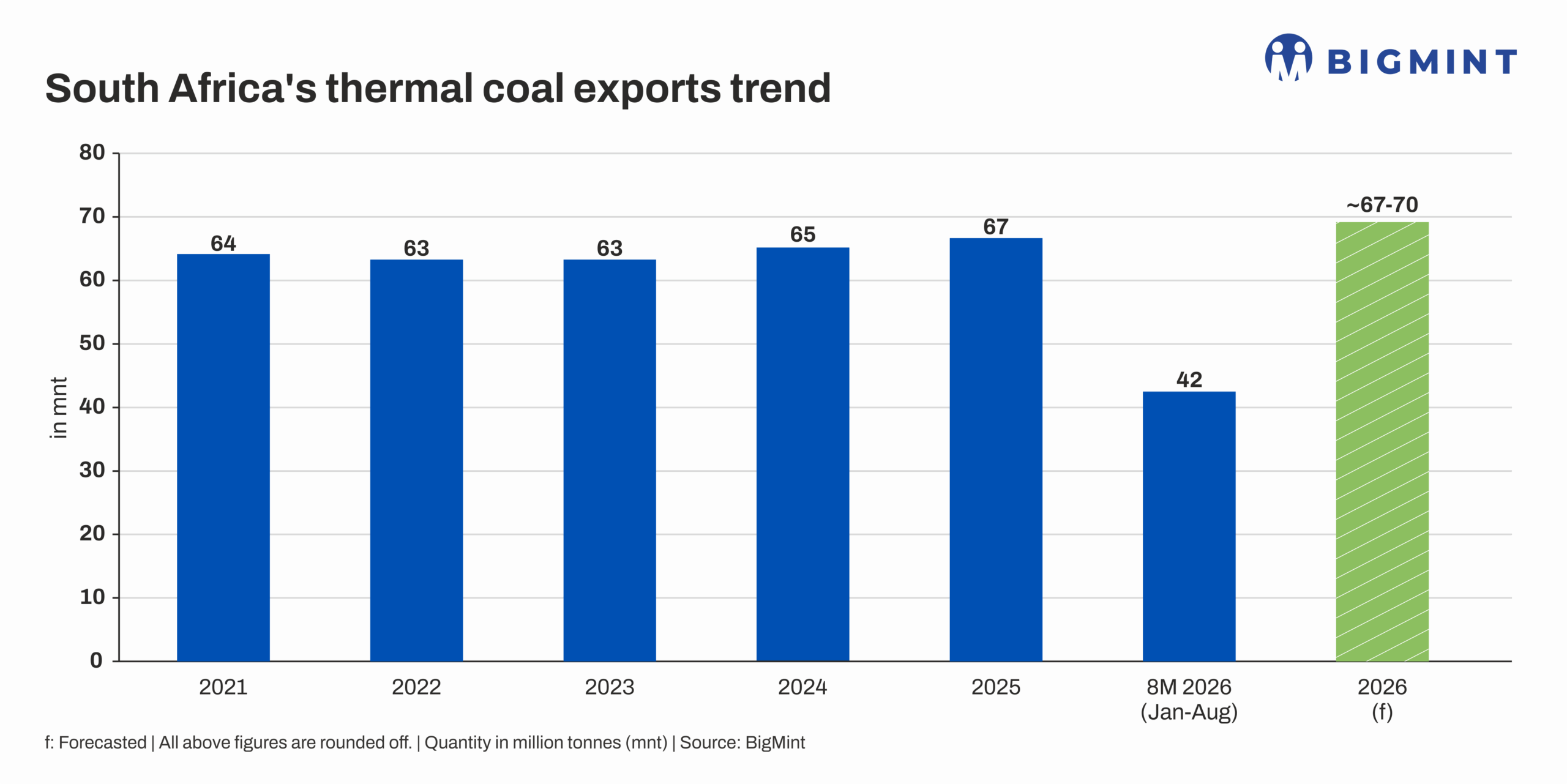
- Bulk coal exports remain largely stable in Jan-Aug’26 at 43 mnt
- Jul-Aug sees 16% rise y-o-y, indicating stronger run-rate in H2
- Rail recovery to lift exports despite subdued Indian buying
Morning Brief: South Africa’s non-coking coal exports are on track to reach 67-70 million tonnes (mnt) in CY’26, up from 66 mnt in CY’25, according to BigMint’s projections. Improving rail performance and gas-to-coal switching have enabled exporters to boost shipments to a wider group of Asian buyers even as Indian demand remained weak.
As per BigMint’s bulk vessel line-up data, exports reached 5.49 mnt in August 2026, up 8.1% y-o-y and 2.4% m-o-m, taking January-August shipments to 42.50 mnt, broadly unchanged y-o-y. However, exports in July-August increased 16% y-o-y to 10.85 mnt, pointing to a stronger shipment run rate entering H2.
Maintaining the July-August average of around 5.43 mnt/month through September-December would take CY’26 exports to around 64.2 mnt. A further improvement in monthly shipments is possible as rail availability strengthens; this could push exports to 67 mnt.

Rail recovery enables export growth
South Africa’s coal export corridor is showing a sustained improvement in operating performance, with better maintenance execution, higher locomotive availability, and faster recovery from disruptions supporting higher rail deliveries.
Transnet is targeting 65 mnt of coal throughput in FY’27 (year ended 31 March 2027), compared with 58.5 mnt in FY’26. This outlook provides support for higher terminal throughput in H2. Notably, Transnet has approved ZAR 6.77 billion ($419 million) to restore the Coal North Corridor, while all 102 new Alstom locomotives ordered for the coal corridor have been deployed.
The Richards Bay Coal Terminal (RBCT) also plans to raise exports by around 10% in CY’26. According to a report by Miningmx, CEO Alan Waller said that RBCT exported just over 30 mnt in H1CY’26, broadly consistent with its full-year target of around 60 mnt. Exports could reach around 62 mnt this year if Transnet can sustain the annualised railage rate of 64 mnt achieved during the four weeks before a scheduled 12-day maintenance shutdown.
Asian destination mix shifts
The growth in exports has been accompanied by a notable change in the destination mix. While India remained the largest market during January-August, bulk shipments to the country declined by 16% y-o-y to 17.02 mnt. India’s share of total exports declined to 40% from 48% in the year-ago period as shipments to other Asian markets increased.
Higher freight costs following the Middle East conflict, a weaker rupee, and stronger demand from competing markets have weighed on Indian buying. With import economics remaining unfavourable, buyers have largely preferred domestic coal. For example, South African RB2 averaged around INR 11,438/t ex-Vizag in August, up 37% y-o-y, while ex-Paradip material averaged INR 11,625/t, up 41% y-o-y.
Sponge iron production, a key end-use segment for South African coal in India, continues to expand despite stable coal imports. BigMint data shows that Indian sponge iron production grew 5% y-o-y to 41 mnt in January-August 2026.

Conversely, South African shipments to Pakistan rose sharply by 102% to 6.13 mnt in January-August 2026 from 3.04 mnt in the corresponding period of CY’25. South Korea also emerged as a stronger outlet, with shipments increasing around 97% y-o-y to 3.15 mnt from 1.60 mnt.
The increase in shipments to Pakistan and South Korea is significant for South Africa’s H2 export outlook. Pakistan has increased coal use amid higher gas and LNG costs, while South Korea’s demand has received support from gas-to-coal switching.
Notably, the IEA expects Korean coal demand to increase 6% y-o-y to 119 mnt in 2026, reversing its earlier forecast for a decline. Higher gas prices and low nuclear availability have supported coal-fired generation, while Korean coal imports are expected to increase by more than 10%.
Meanwhile, China’s imports increased to 1.30 mnt. Higher electricity requirements, expensive LNG, and temporary domestic coal constraints boosted imported coal demand. The IEA expects Chinese coal demand to rise around 1% this year, partly reflecting stronger power demand, weak wind generation, and higher LNG prices.
Outlook
BigMint expects South African non-coking coal exports to increase moderately in H2CY’26, with improving rail performance providing the logistics capacity needed to sustain higher shipments.
The destination mix will be increasingly important. Shipments to India fell by 3.25 mnt y-o-y during January-August, but some improvement in restocking could emerge in H2 as sponge iron producers face tighter domestic coal availability, with the government prioritising dispatches to the power sector. India’s sponge iron sector should, therefore, continue to provide a demand floor, but elevated delivered costs are likely to limit a sharp growth in imports.
Pakistan is likely to remain the main source of incremental demand, while higher South Korean coal consumption and rising Chinese purchases should provide additional outlets for South African volumes.
Leave a Reply