- Limited offers and strong demand lift replacement costs
- Higher domestic coal prices support import interest
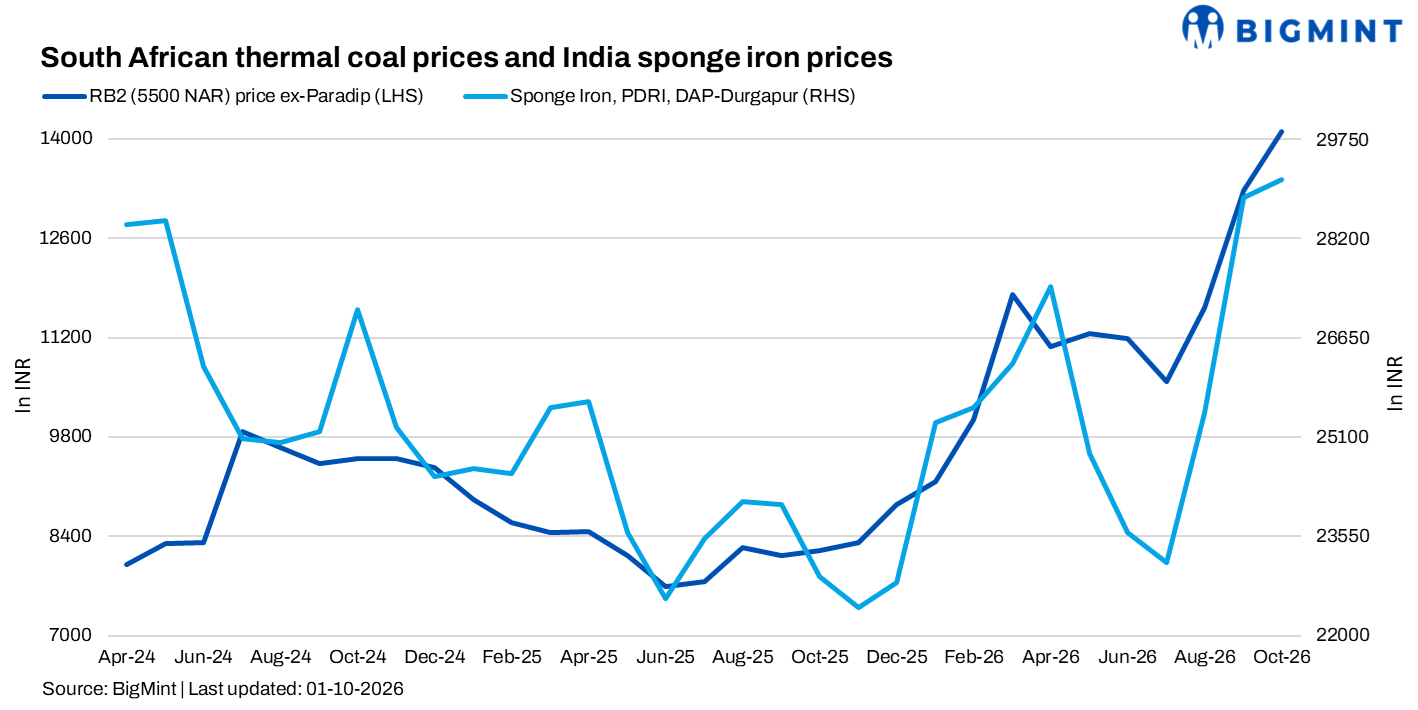
South African thermal coal prices at Indian ports strengthened sharply as of 1 October 2026, supported by tight availability, higher international replacement costs and strong demand from sponge iron and other industrial consumers. Ex-Paradip RB2 (5,500 NAR) increased INR 600/t w-o-w to INR 14,100/t, while RB3 (4,800 NAR) rose INR 600/t to INR 12,100/t. Ex-Vizag, RB2 increased INR 600/t to INR 14,000/t, while RB3 rose INR 500/t to INR 12,000/t.
Higher replacement costs push portside prices
International replacement costs increased sharply during the week, with the South African index rising around $5.5/t, prompting suppliers to raise portside offers. Limited availability at key Indian ports also kept seller offers firm.
At Vizag, RB2 offers were around INR 14,000/t, with some market indications moving towards INR 14,200/t, while RB3 offers were around INR 12,300/t. Around 45,000 t of 5,500 NAR coal was reportedly sold at an average INR 14,000/t.
Another transaction of around 10,000 t of RB2 was concluded at INR 13,800/t. A Raipur-based trader was also reported to have concluded around 20,000 t of RB2 at INR 14,000/t ex-works.
At Gangavaram, RB2 offers were indicated around INR 14,100–14,400/t, while Paradip offers were around INR 14,000/t. South African coal was heard around INR 13,800–14,000/t on the east coast, although much of the available material was reportedly already sold.
The limited number of offers, despite strong enquiries, reflected a tight prompt market and encouraged suppliers to maintain elevated offers.
Port stocks remain uneven
Coal stocks at major Indian ports covered by BigMint’s Week 39 assessment stood at 18.35 mnt on 26 September, down from 18.72 mnt a week earlier. Coking coal stocks declined 12.4% to 5.30 mnt, while non-coking coal inventories increased 3% to 13.05 mnt.
Vizag, Mundra and Paradip recorded the largest stock reductions, together drawing down around 0.93 mnt. The reduction at Vizag was particularly relevant as market participants reported limited South African coal availability there, contributing to higher replacement offers.
Domestic coal prices rise sharply
Domestic coal prices also strengthened significantly, partly encouraging consumers facing expensive imports to rely more on domestic material. Ex-Bilaspur 4,500 GCV coal increased INR 500/t w-o-w to INR 7,000/t, while 5,000 GCV coal rose INR 700/t to INR 9,000/t as of 1 October.
Recent SECL e-auction results also showed strong premiums for selected mine-grade combinations, with G8 premiums exceeding 200% at Beherabandh, Jhilmili and Rajnagar. Such high auction premiums increased domestic replacement costs.
At the same time, some consumers that traditionally used imported coal had increased interest in domestic coal because imported replacement costs had risen sharply. Domestic coal from ECL was also being used by some consumers.
Sponge iron and steel demand support market
Sponge iron prices strengthened during the week, with PDRI ex-Raipur rising INR 1,800/t w-o-w to INR 29,550/t and PDRI ex-Durgapur increasing INR 1,600/t to INR 29,150/t as of 1 October.
Market sentiment improved as finished steel prices also strengthened, supporting sponge iron prices and coal demand. However, enquiries for sponge iron remained selective, with buyers still avoiding excessive inventory building.
Higher coal costs were also supporting sponge iron prices, while the combination of stronger steel prices and limited coal availability increased demand for South African material from some consumers.
Buyers face higher replacement costs
Market sentiment for South African coal turned bullish as suppliers had limited prompt material and buyers faced sharply higher replacement costs. Enquiries remained strong at some ports, but the availability of executable offers was limited.
With domestic coal prices also rising, imported coal continued to attract interest despite elevated prices. However, buyers remained cautious about chasing further increases, particularly as downstream demand was still uneven.
The near-term market was therefore expected to remain supported by tight prompt availability, higher international benchmarks, firm domestic coal prices and stronger replacement costs, while actual buying would depend on buyers’ ability to absorb the higher price levels.
Leave a Reply