- Improved vessel supply pressures freights on Europe, US East Coast routes
- Rates on Trans-Pacific, Mediterranean routes rise on resilient demand
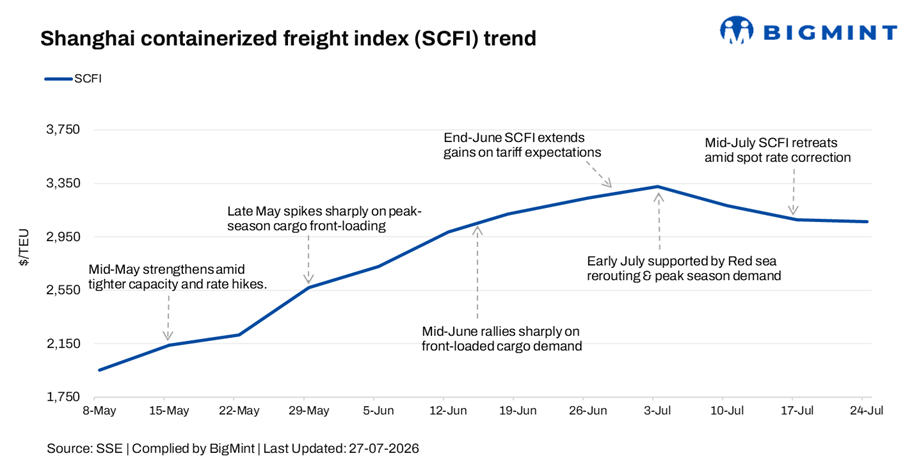
The Shanghai Containerized Freight Index (SCFI) declined 0.6% w-o-w to 3,062.95 on 24 July from 3,080.31 a week earlier, indicating that the recent peak-season rally is beginning to lose momentum. However, freight performance remained mixed across major trade lanes as demand gradually returned to normal levels, while improved vessel availability and ongoing capacity additions eased pressure on several routes.
Asia-Europe freights softened as weaker booking activity and improving vessel availability outweighed support from continued Red Sea disruptions. Meanwhile, the Asia-US East Coast route declined slightly, though balanced supply-demand fundamentals and adequate vessel capacity limited the drop.

In contrast, the Asia-US West Coast route continued to strengthen, supported by resilient peak-season cargo demand, front-loaded shipments, and relatively tight vessel space despite fresh capacity entering the market. Similarly, Asia-Mediterranean rates moved higher as robust import demand, Cape of Good Hope rerouting, and persistent port congestion constrained effective capacity.
Despite the w-o-w decline, freight levels remain well above historical averages, supported by disciplined carrier capacity management, blank sailings, and ongoing geopolitical disruptions that continue to limit downside risks.
Outlook
The SCFI is expected to remain largely stable in the near term as the peak shipping season begins to moderate and additional vessel capacity gradually enters the market. While freight rates on major east-west routes may witness further corrections amid softer booking activity, carriers are likely to continue blank sailings and disciplined capacity management to prevent a sharp decline in spot rates.
At the same time, persistent geopolitical disruptions, including continued Red Sea diversions and congestion at key ports, are expected to keep effective vessel capacity constrained, providing underlying support to freight levels. Market direction will largely depend on cargo demand during the remainder of the peak season, carrier capacity deployment, and the pace of inventory replenishment across major importing regions.

Leave a Reply