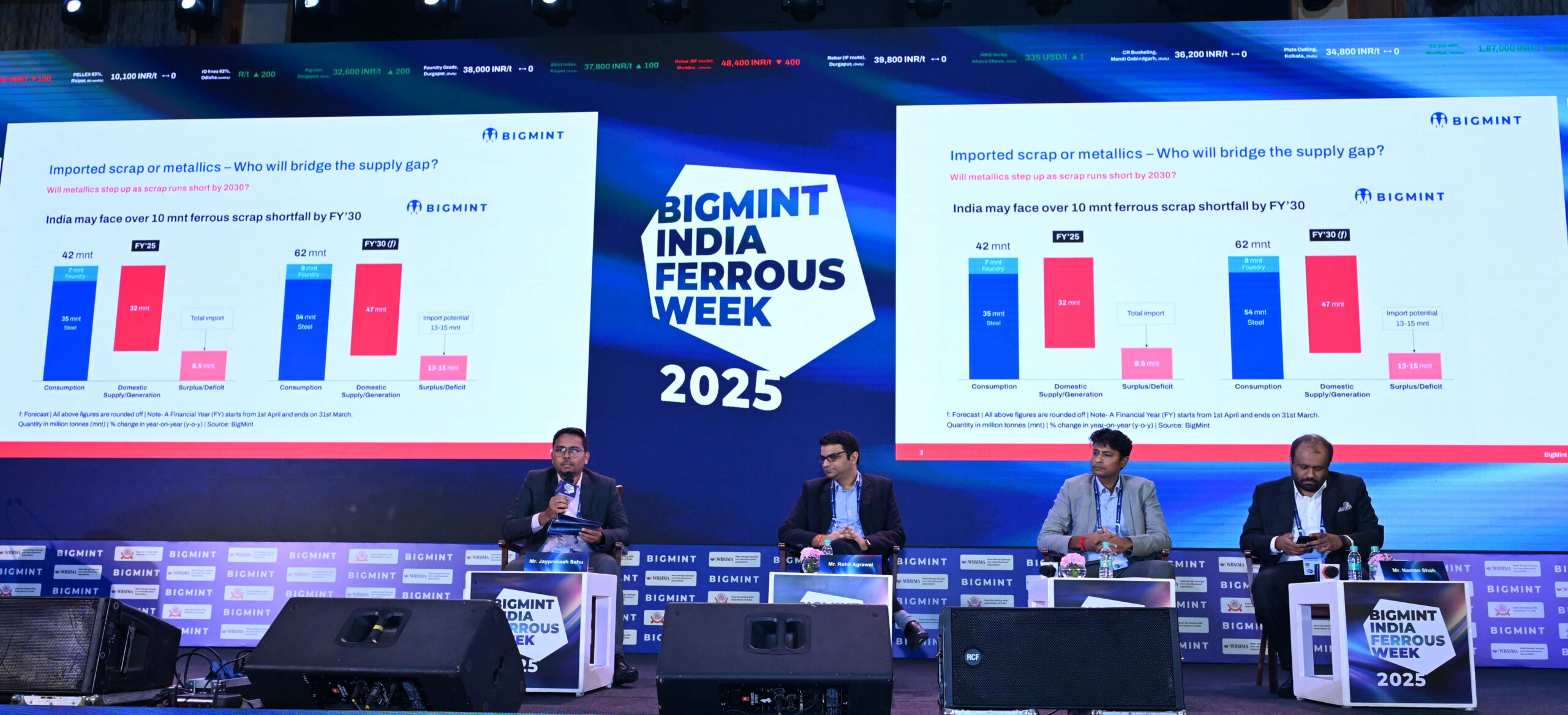
- Imports to help close India’s widening scrap supply gap
- Scaling recycling infra, tech adoption key for sustainability
India’s steel demand is set to surge nearly 50% in the next five years, placing scrap and recycling at the forefront of bridging the looming raw material gap.
At the BigMint India Ferrous Week 2025, industry leaders gathered for a panel discussion to chart the course for India’s ferrous ecosystem. The conversation, moderated by Jayprakash Sahu, BigMint, brought together Rohit Agrawal (JSW Steel), Vivek Prasad (Tata Steel Recycling Business), and Naman Shah (NowPurchase), who shared perspectives on challenges, opportunities, and the path forward.
Scrap’s growing role in steelmaking
Setting the tone, Jayprakash Sahu highlighted the upcoming challenges in India’s raw material security, specifically scrap, during his context-setting presentation.
“India is already the world’s second-largest steel producer, and with production set to reach 220-225 million tonnes (mnt) within five years, scrap demand may reach 55-56 mnt for steelmaking. At the current rate of scrap generation, we may have a shortage of 12-15 mnt of scrap by 2030.”
Rohit Agrawal stressed that India’s domestic scrap ecosystem still lags behind global benchmarks. Unlike in developed economies, structured recycling channels are limited, leaving dependence on imports. However, with demand for quality scrap expected to rise sharply, he emphasised the urgency for scalable collection and processing infrastructure.
“India’s scrap processing infrastructure is still at a very nascent stage. Setting up a standard 0.5 mnt shredding unit requires nearly INR 200 crore and about two years. Additionally, India has fewer than 10-15 active shredders, while the US operates close to 200-250. With most equipment being imported, costs remain high, and domestic R&D has not kept pace,” said Agrawal.
Organised recycling gains ground
Vivek Prasad of Tata Steel Recycling Business expanded on the shift towards organised recycling: “The National Scrap Policy has laid the foundation, but execution is what matters. At Tata Steel Recycling, our efforts are directed towards building scientific collection centres, integrating dismantling facilities, and working with OEMs on end-of-life vehicle recycling. This is not just about supplying scrap — it is about formalising a sector that has historically been unorganised.”
Prasad noted that organised recyclers can ensure both quality and traceability, which will become increasingly important as Indian mills push for greener steelmaking. He also highlighted how ELV recycling, supported by automakers such as Tata Motors and Mahindra, is expected to emerge as a major source of domestic scrap over the coming decade.
Since 2019, the government has pushed several measures — Steel Recycling Policy, Vehicle Scrappage Policy, GST rationalisation, Green Steel Taxonomy, and now the extended producer responsibility (EPR) mandate in 2025. Each step is positive, but execution on the ground is the real challenge.

Technological efficiency in procurement
Adding a supply chain perspective, Naman Shah of NowPurchase underlined the importance of technology and data-driven procurement: “Indian mills, especially secondary producers, face a dual challenge — volatile scrap prices and fragmented supply. Technology platforms can bridge this by providing price transparency, reliable sourcing options, and better planning tools. The shift from phone-based negotiations to data-backed procurement will be critical in making India’s scrap market more efficient.”
Shah also emphasised that digital platforms can help scrapyards and smaller processors integrate into the mainstream market, reducing information asymmetry and improving liquidity in the system.
Addressing quality, policy challenges
A recurring theme across the discussion was quality control. Contamination and inconsistent processing standards continue to limit the utility of domestic scrap. Agrawal pressed for stricter guidelines and testing infrastructure, noting that mills must often pay a premium for imported material to maintain consistency.
Prasad, however, expressed optimism that formalised recycling centres could address these gaps: “If we invest in better segregation and cutting technology at the source, the quality issue can be resolved. Policy incentives must encourage recyclers to modernise and buyers to trust structured players rather than the informal supply chain.”
The panel also discussed the role of government policies. While the introduction of the Reverse Charge Mechanism (RCM) under GST has added compliance complexity for small scrap dealers, Prasad and Shah agreed that, in the long term, such policies may help weed out malpractice and improve traceability. Still, support measures for smaller traders were recommended to avoid disruption in supply.
India’s position in global context
The conversation further touched upon India’s standing in the global scrap market. Agrawal observed that as Europe and the US increasingly divert quality scrap towards their domestic green steel programmes, India must be prepared for tighter import availability. Shah added that this makes domestic recycling even more critical, with technology-led aggregation models offering one viable solution.
Path ahead — need for collaboration, scale
The discussion concluded with a consensus that collaboration across stakeholders — steelmakers, recyclers, technology platforms, and policymakers — will be key. India’s scrap demand is expected to reach 55-60 mnt by 2030, and meeting this requirement will demand both organised recycling growth and an import strategy.
Converging themes: Imports, infrastructure, policy
Across the panel, three themes resonated strongly. First, India will remain an importer of ferrous scrap in the medium term, as domestic generation lags demand growth. Secondly, recycling infrastructure must scale up — from shredders to organised yards — if India is to reduce dependency on overseas markets. Thirdly, policy alignment is critical. Whether in taxation, compliance, or logistics, clarity and incentives will determine the pace of formalisation.
“The world is looking at India as a bright spot in steel demand. But if we fail to secure raw materials sustainably, this growth will come at a higher cost,” Prasad said.
Summarising the panel’s insights, Jayprakash Sahu stressed, “We are not just talking about raw material substitution. This is about shaping a sustainable industry. India has the opportunity to leapfrog by formalising recycling, embracing technology, and creating a transparent market. The momentum is there — we must scale it responsibly.”
Key takeaways
- Scrap demand is set to surge as India’s steel production targets 220-225 mnt in the next five years.
- Domestic scrap collection remains fragmented, necessitating structured recycling centres and ELV dismantling hubs.
- Quality and contamination issues are a persistent challenge, requiring better segregation, processing, and standards.
- Technology platforms can enhance price transparency, sourcing reliability, and procurement efficiency.
- Policy measures such as GST-RCM may improve traceability but need balancing support for smaller players.
- Global supply pressures will push India to rely more on domestic scrap generation and recycling.
- Collaboration across the ecosystem — from steelmakers to recyclers and tech platforms — is essential to scale sustainably.
At BigMint India Ferrous Week 2025, the message was clear: scrap is not merely a raw material but a strategic lever for India’s steel future.
Leave a Reply