- Monthly rebound masks sharp annual decline in farmgate prices
- Import Policies Cushion Market, Limited Relief for Farmers
The largest importer of rice from Vietnam, the Philippines, has stopped importing rice following the extension of an import ban on the staple grain that was introduced in September to protect local farmers from cheaper imports. Palay farmgate prices (mandi selling prices) in the Philippines rose modestly in November following the government’s temporary rice import freeze, but the recovery has offered limited relief to farmers as prices remain well below year-ago levels and most of the harvest has already moved into traders’ hands.
Data released by the Philippine Statistics Authority showed the national average farmgate price of dry palay increased 6.5% month on month to PHP 16.92 per kilogram in November, reflecting a short-term tightening in supply after import inflows were halted. However, prices were still down 16.6% from a year earlier, underscoring the depth of the price correction faced by producers during the peak harvest period.
Regional disparities highlight uneven market conditions
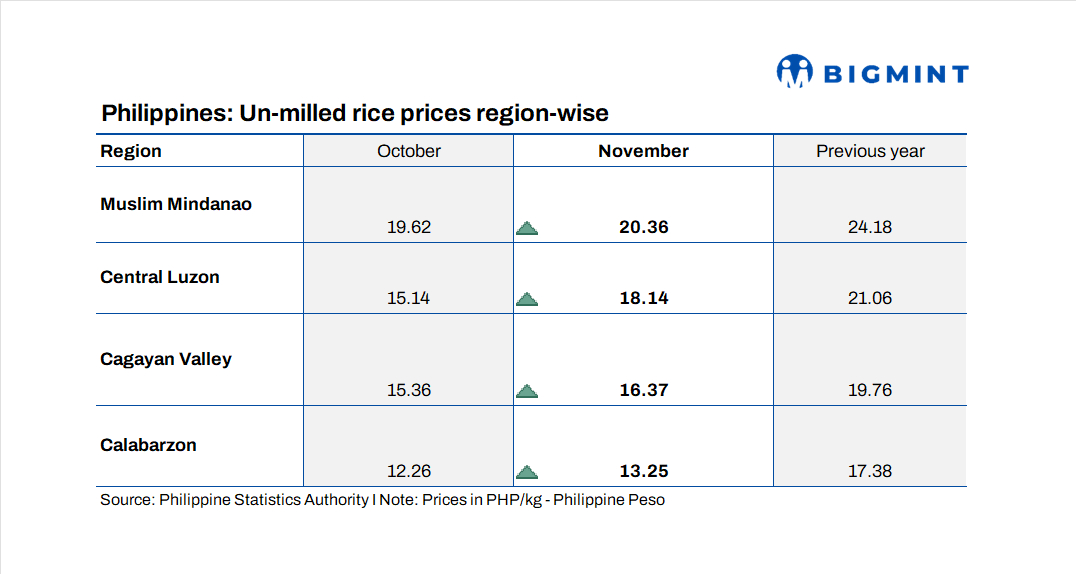
Price movements of un-milled rice diverged sharply across key producing regions, underscoring uneven supply conditions and differences in market access. The Bangsamoro Autonomous Region in Muslim Mindanao recorded the highest average farmgate palay price in November at PHP 20.36/kg, recovering from PHP 19.62 in October but still well below the PHP 24.18 level recorded a year earlier. It was the only region where prices remained above the PHP 20 threshold.
At the lower end, Calabarzon posted the weakest average farmgate price at PHP 13.25 per kilogram, up modestly from PHP 12.26 in October but sharply below PHP 17.38 a year earlier, reflecting sustained oversupply and weaker procurement support.
In Central Luzon, the country’s largest rice-producing region, palay prices rebounded to PHP 18.14 per kilogram in November from PHP 15.14 in October, though they remained significantly below the PHP 21.06 recorded in the same period last year. Cagayan Valley showed a similar pattern, with prices edging up month on month to PHP 16.37 per kilogram from PHP 15.36, but still trailing the year-ago level of PHP 19.76.
Philippine Well-Milled Rice Prices Fall

The national average retail price of well-milled rice in November 2025 fell compared to November 2024 due to higher domestic supply from an above-average harvest and substantial imports earlier in the year, along with softer global rice prices.
Government measures also supported this decline. Import tariffs were cut from 35% to 15% under Executive Order No. 62, making imported rice cheaper, while a temporary import ban protected local farmers during the harvest, helping stabilize prices.
Outlook
Government price guidance via the National Food Authority (NFA) floor may provide limited support, hinging on procurement scale and timing. Rice imports are set to resume in January 2026, stabilising consumer prices but potentially weighing on farmgate values despite higher 20% tariffs. Meanwhile, palay output is forecast near a record 20.3 million tonnes in 2026, though weather risks persist.
Leave a Reply