- Restocking after festive season supports trade
- Sponge iron prices rise INR 100-500/t m-o-m in Nov’25
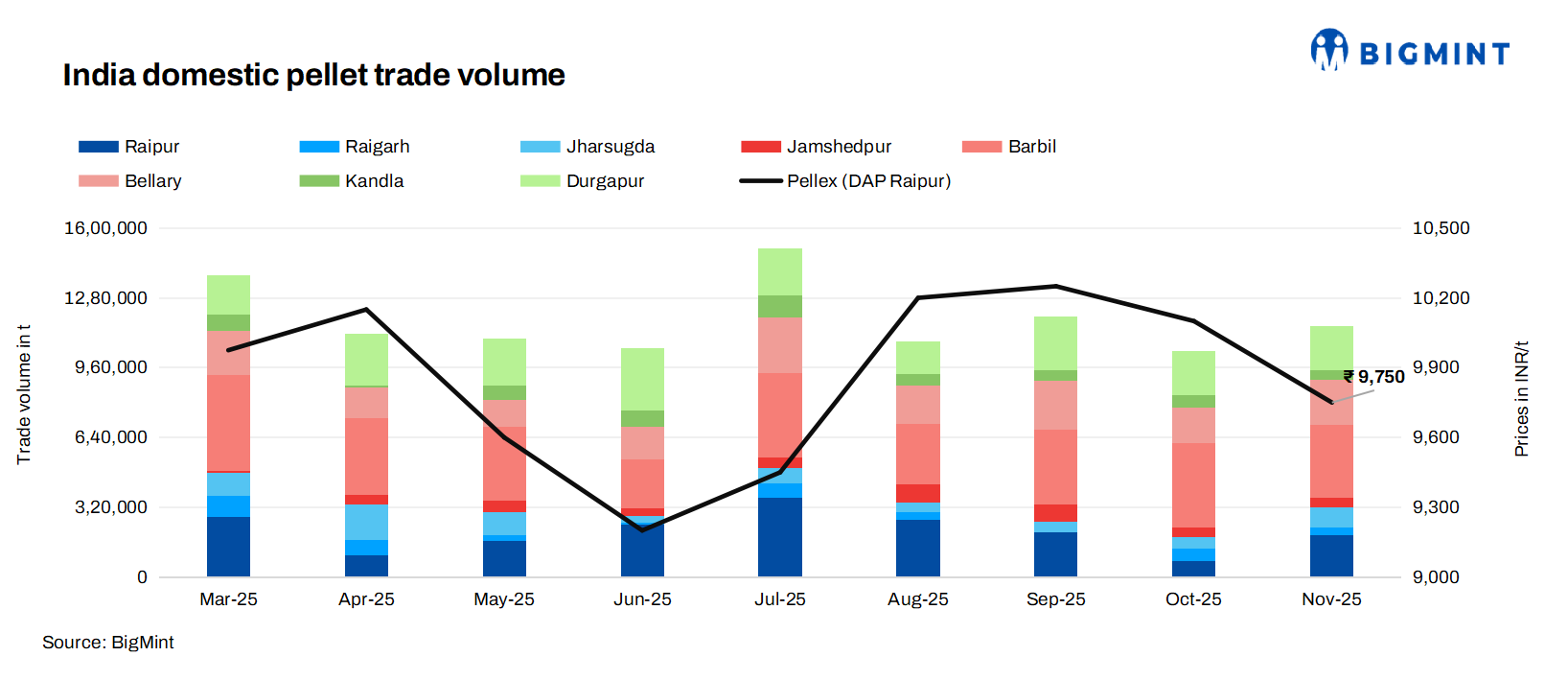
Pellet trade volumes in the pan-India market saw a marginal m-o-m growth of around 11% in November 2025 compared to October, driven by improved buying activity in select regions.
Total volumes recorded reached approximately 1.39 million tonnes (mnt), a notable rise from 1.26 mnt in October. Trades were primarily concluded as spot deals recorded by BigMint.
Sharp growth was recorded in Bellary, Jharsuguda, and Raipur, where active bookings were concluded during the month. In contrast, Barbil and Kandla reported a decline of nearly 14-18% in trades, indicating uneven regional demand trends.
Market updates
Market participants attributed the rise in domestic trade volumes mainly to price corrections by pellet producers and restocking activities by steelmakers following the festive season. A market participant said, “After the festive slowdown, mills were running with low inventories. Once pellet prices softened, buyers re-entered the market to cover short-term requirements.”
The Raipur market also received a boost as GPIL resumed sales after a shutdown of nearly one month, which supported regional volumes. Additionally, some producers diverted cargoes to the domestic market through the coastal route, instead of exporting, further aiding domestic trade momentum. A producer informed BigMint, “Export realisations were not viable, so we preferred domestic bulk deals to maintain plant utilisation.”
Another steelmaker mentioned, “The buyers were cautious in the second half of November, which kept pellet trades tight. Steel prices declined sharply during this period. However, buyers had already secured raw material inventory in the first half.”
However, trade activity slowed notably in the second half of November due to a sharp decline in sponge iron and downstream steel prices, which tightened market liquidity. A sponge iron manufacturer noted, “Falling steel prices have reduced our margins, making it difficult to procure pellets at earlier levels.”
Meanwhile, India’s pellet import volumes declined sharply to around 0.07 mnt in November, compared to 0.14 mnt in October. Imports were largely booked by Kandla-based buyers, while most consumers relied on domestic supply due to weak overseas competitiveness.
Factors driving pellet market
- Bids firm up in OMC’s Nov auction: In OMC’s iron ore fines auction for 1.939 mnt (Fe 51-62%) on 19 November around 1.929 mnt (99%) was booked at INR 2,500-5,900/t. The fines lots received a premium of INR 50-1,000/t over base prices. Bids (weighted average) rose marginally by INR 200/t m-o-m. Limited availability of fines and lack of offers from private miners led to a positive response in the auction.
- PELLEX decreases m-o-m: The monthly average domestic pellet index, PELLEX, dropped by INR 400/t m-o-m in November to INR 9,750/t DAP Raipur. Pellet offers declined in the second half of the month, following a reduction in iron ore prices. Competitive pellet offers from Odisha also put pressure on Raipur’s local prices. In November, pellet prices in other regions decreased by INR 100-200/t m-o-m.
- Sponge PDRI up m-o-m: Sponge PDRI prices rose by INR 500/t m-o-m to INR 23,400/t exw in Raipur in November. Indian sponge iron prices increased by INR 100-500/t m-o-m in several key regions, as market sentiment gradually improved. While there was a modest recovery in downstream steel segments, demand fluctuated across regions.
- NMDC rake movements drop m-o-m: NMDC dispatched 538 rakes from its Chhattisgarh mines in November, equivalent to 2.07 million tonnes (mnt) of iron ore. This was down 2.4% compared to 551 rakes (2.12 mnt) in October, as per BigMint data. On a y-o-y basis, November dispatches remained largely stable compared with 539 rakes in November 2024.

Outlook
Pellet trade volumes in December are expected to remain stable, but may face pressure as steelmakers increasingly switch to iron ore lumps to optimise raw material costs. This trend could keep pellet demand constrained in the near term.
Leave a Reply