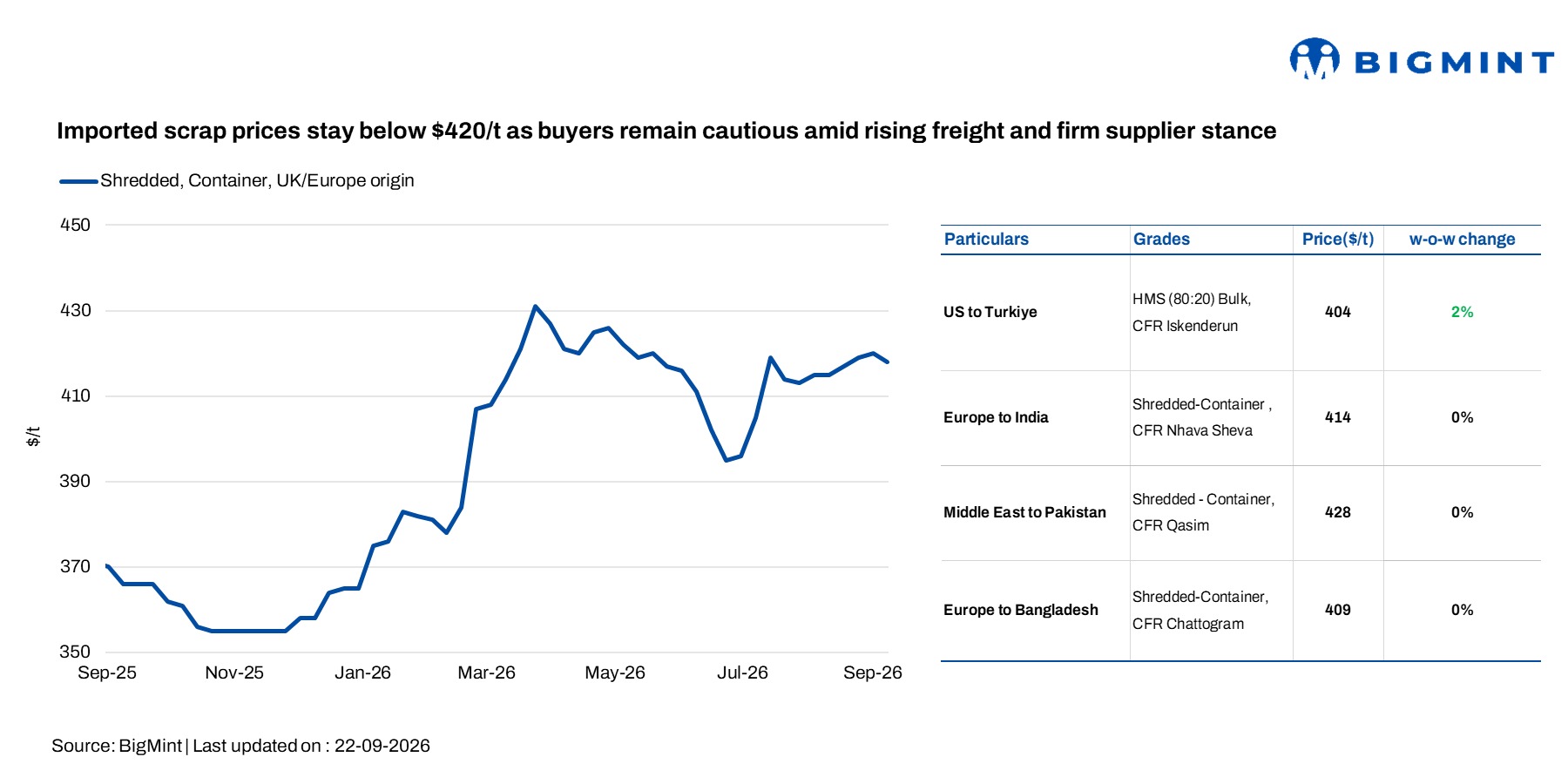
- Firm supplier offers and higher freight support import scrap prices
- Selective steel demand and low mill utilisation limit procurement
Pakistan’s ferrous scrap market remained largely stable during the week ended 22 September, as weak finished steel demand, transport strikes, flooding, energy shortages and the new energy tax continued to constrain mill operations and purchasing activity.
BigMint assessed Europe-origin shredded scrap at $418/t CFR Qasim, down $2/t w-o-w.
The imported scrap market remained uncertain, with domestic purchases staying selective. Market participants reported that demand was present, but a gap between buyer expectations and supplier offers continued to limit procurement.
Market scenario
Around 5,000 t of UK-origin shredded scrap was booked at $417-418/t CFR Qasim, while offers were heard above $422/t. Higher freight costs and firm international offers, however, continued to support imported scrap prices.
A Karachi-based trader said, “The imported market is quite uncertain here in Pakistan. Domestic purchases are selective. Demand is there, but prices are not matching buyers’ expectations. We heard some trades at $418/t, but suppliers are quoting higher at $422-424/t.”
UK/EU-origin shredded scrap was offered at $420-425/t CFR Qasim, while buyers were targeting around $417-420/t. UK-origin nut and bolt scrap was offered at around $430/t, while Brazilian HMS was available at $390-395/t CFR Qasim. Malaysian HMS bundles were heard at around $375/t.
An international trader said freight rates have increased by around $10/t, reducing the availability of competitive offers and potentially pushing replacement costs higher.
Domestic market
Local scrap prices remained at around PKR 134,000-138,000/t ($484-498/t), while billet was quoted at PKR 214,000-218,000/t ($772-787/t). Rebar prices stood at PKR 235,000-240,000/t ($848-866/t) exw.
Mill utilisation remained low at around 35%, with sales estimated at 30-35%. Domestic scrap purchases remained selective as mills faced weak sales, cash-flow constraints, and elevated energy costs. Flooding and power-supply disruptions further weighed on operating rates, limiting procurement requirements despite some underlying demand.
 Ship recycling: Gadani remained the strongest South Asian ship recycling market this week, despite no fresh vessel sales amid limited candidate availability. Recent activity included deliveries of Spring (2,449 LDT), BR Glory (5,000 LDT) and Larus (2,632 LDT), while Yue (11,060 LDT) arrived on 16 September.
Local plate prices eased to PKR 195,000/t ($703/t) from PKR 200,000/t ($721/t), putting some pressure on recycling margins. Despite limited tonnage and strong freight earnings, buyer interest remained healthy, although softer steel prices could lead to more cautious bidding for suitable conventional vessels.
Outlook
Imported scrap prices are expected to hold around $425-430/t CFR Qasim through September, with higher freight costs and firm international scrap markets potentially pushing supplier offers higher and raising replacement costs for Pakistani mills. Mills are likely to continue buying selectively, with buyers remaining focused on price competitiveness.
Buying activity could improve in October if domestic steel demand strengthens and mill operating rates recover. A sustained improvement in rebar sales would support higher scrap procurement and improve mills’ ability to absorb firmer import offers.

Leave a Reply