- Sellers hold back, awaiting better price acceptance from buyers
- Summer season may boost renovation and small-scale infra demand
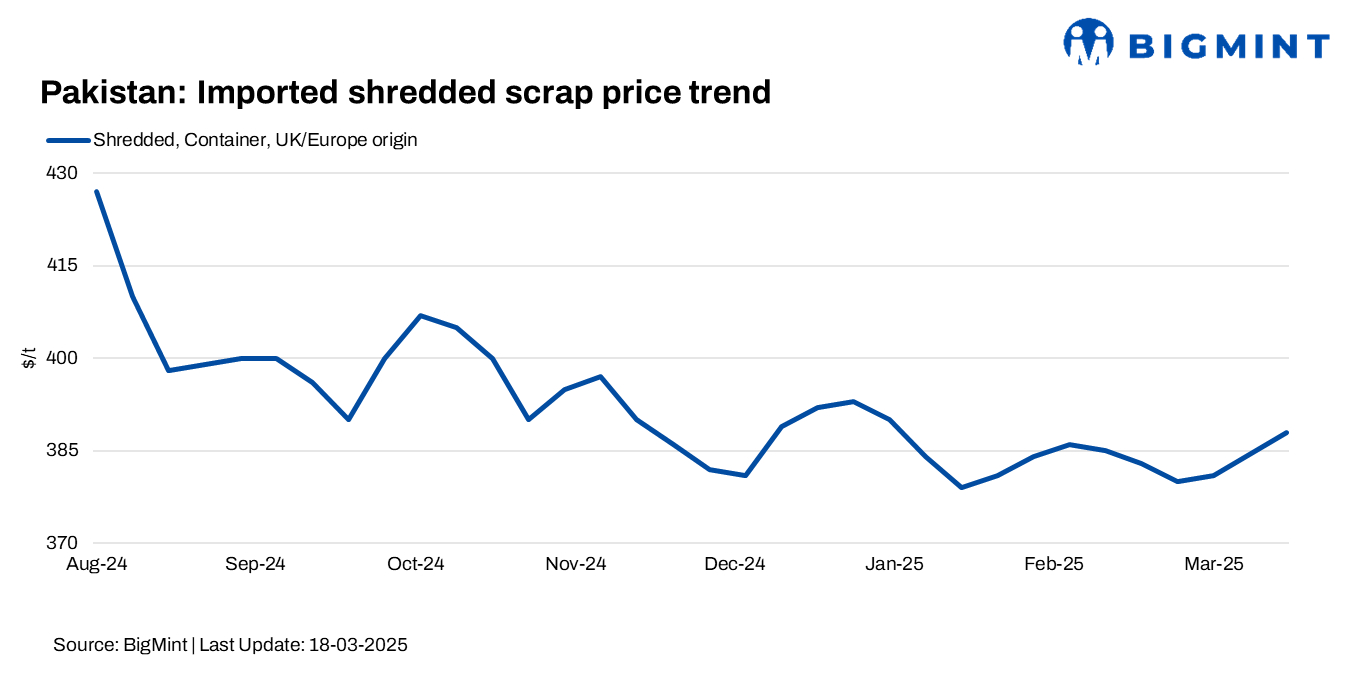
Pakistan’s imported scrap offers rose to $388-392/t, with some deals heard concluded at $385-387/t in the last seven days.
BigMint’s assessment for European/UK-origin shredded scrap stood at $388/tonne (t) CFR Qasim, up by $7/t w-o-w.
As per recent market updates, buyers remain reluctant to accept higher levels amid weak finished steel sales. Sellers are holding back, waiting for better price acceptance from Pakistani buyers. The market saw a slight improvement as offers dried up, but overall realisations remain slow.
Market comments
As per a UK-based market participant, “Construction activity picks up during Ramadan as contractors rush to complete projects before labourers go on holiday. Mid-Ramadan typically sees some steel demand, but overall, the market is now gradually improving. Local scrap remains short due to slow and delayed imports caused by shipping line disruptions. Shredded offers stand at $385/t CFR, but Pakistan’s imported market sentiment is weak with no major buying. Billet is workable for buyers at PKR 205,000-208,000/t ($732-743/t).”
Billet and rebar prices stayed flat, while pre-Eid utility bill payments may keep the pressure on, limiting active trading to just a week. UAE-based sellers are offloading materials at distressed rates due to liquidity challenges faced by buyers.
As per a Gujranwala-based mill official, “Imported deals are limited, but the overall market is improving with the summer season approaching. Renovation and small-scale infrastructure projects might support material sales. UAE shredded is at $392-394/t CFR (bids at $386/t), while UK/EU shredded stands at $390/t CFR (bids at $385/t). Dubai fabrication is at $385/t and HMS at $363/t, with shipments expected by 10 April. Locally, scrap is at PKR 142,000-144,000/t exw ($507-514/t), rebar at PKR 240,000-243,000/t exw ($857-868/t), and billet at PKR 210,000-211,000/t exw ($750-754/t).”

As per a domestic scrap trader, “The scrap and steel market remains very weak, especially during Ramadan, with cash shortages and sluggish demand. There are no major infrastructure developments or new government projects driving activity. Local scrap is at PKR 140/kg exw, rebar at PKR 240,000/t exw ($857/t), and billet at PKR 210,000/t exw ($750/t). Imported shredded offers stand at $390/t CFR UAE and $388/t CFR UK/EU.”
As per a Karachi-based mill, “EU-origin shredded offers are at $385-390/t, but suppliers are aiming for $395-398/t. South Asia’s slow buying is holding back further price hikes. Post Ramadan, market activity in Pakistan is expected to improve, though falling rebar and billet prices will continue to pressure mill margins.”
Pakistan’s economy is projected to grow by 2.5-3.5% in FY’25, barely outpacing population growth (2.44%). The SBP’s pause on monetary easing aims to curb rising imports, driven by a stable currency and lower global commodity prices. However, with stagnant local production, the economy relies heavily on imports. While big corporates benefit from relaxed lending under the ADR regime, smaller industries remain credit-starved. Without structural reforms, Pakistan faces mounting debt servicing costs and declining competitiveness, leaving Islamabad with no option but to push through real, productivity-driven reforms or remain stuck in low growth.
Outlook: Pakistan’s imported scrap market is likely to remain sluggish due to weak steel sales. After Ramadan, activity may improve slightly as contractors resume projects, but liquidity issues and pre-Eid bill payments will keep mills under pressure.

Leave a Reply