- Local scrap, billet, rebar prices remain stable
- War risk surcharges, vessels detours, delays likely
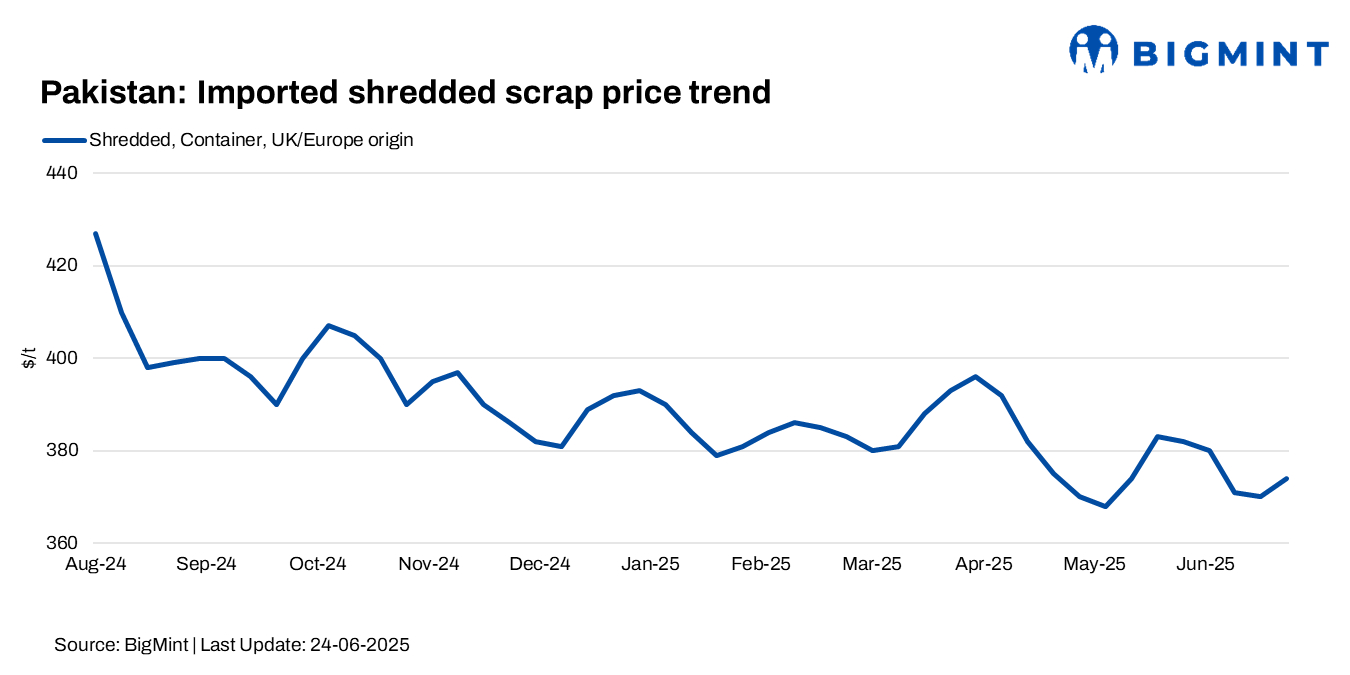
Pakistan’s imported shredded scrap offers for material from the UK/EU are currently quoted at $374-377/t CFR Qasim, marking a slight uptick from last week’s levels.
BigMint‘s assessment for European/UK-origin shredded scrap stood at $374/t CFR Qasim, inching up by $4/t w-o-w.
Market commentary
“UK shredded scrap offers are now at around $377/t CFR Qasim, reflecting the Middle East tensions and rising oil price concerns. Very few suppliers are quoting below $375/t,” said a Karachi-based mill source. “Billet and rebar prices are hovering around PKR 205,000-235,000/t ($722-828/t), with premium grades commanding an additional PKR 3,000-4,000/t ($11-14/t).”
“Local scrap is at PKR 142,000/t ($500/t), billet at PKR 210,000/t ($739/t), and rebar at PKR 235,000-238,000/t ($827-838/t), all ex-works. This week, UAE-based sellers are actively offering 1000 tonnes of HMS at $357/t CFR Qasim with 21 free days and prompt shipment. Around 500 t of GI bundles are being offered at $366/t CFR under similar terms. Shredded offers remain firm– 1,000 t (2-day arrival) at $390/t and $388/t for 500 t (prompt), both with 21 free days. Buyers are evaluating if the market can absorb these levels.”

“Freight is definitely set to rise, though no one’s certain by how much yet. Shipping lines will surely add extra charges–just like they did during the India-Pakistan tensions,” a trader remarked.
Tensions surrounding the possible closure of the Strait of Hormuz–critical for 20-30% of Gulf oil and gas flows–are creating unease among Pakistani scrap importers. With no alternative sea route from origins like Oman, UAE, Kuwait, Saudi Arabia, Qatar, and Bahrain, any disruption could stall arrivals. Even though shipments from the UK, Europe, and North America bypass the strait, global carriers may still impose war risk surcharges, reroute vessels, and delay cargoes by 2–4 weeks, potentially inflating freight by 50-200%.
On a broader level, the conflict could rattle global steel trade. Exports from Iran, the UAE, and Turkiye to the US and EU may fall by 30-40%, pushing up prices at destinations. Higher oil could lift steelmaking costs, while financial sanctions may block cross-border payments. Traders are being advised to diversify sourcing, secure freight terms early, and avoid overstocking amid war prospects.
Dost Steels to raise PKR 4.45 bn via rights issue for billet production
Pakistan’s Dost Steels Ltd will raise PKR 4.45 billion ($15.6 million) through a 100% rights issue to fund a melting furnace installation and meet working capital needs, the company disclosed to PSX. The furnace will enable in-house billet production, lowering raw material costs and boosting margins.
PSRMA urges rollback of 5% duty on re-rollable scrap
The Pakistan Steel Re-Rolling Mills Association (PSRMA) has strongly opposed the proposed 5% customs duty on re-rollable scrap in the FY’26 budget, calling it discriminatory toward SMEs. The duty hike, from 0% to 5%, contrasts with the reduction of duty on melting scrap to 0% and billets to 5%, favouring larger players.
PSRMA warns the move could lead to mass closures of small mills and urges Prime Minister Shehbaz Sharif to intervene, citing risks of market monopolisation and tariff imbalance.
Outlook: In the near term, buyers are expected to remain cautious by monitoring freight trends and awaiting policy clarity before taking further decisions.

Leave a Reply