- Heavy rains hit construction; Bala makers face deeper stress
- UAE shredded quoted higher, limits mills’ buying appetite
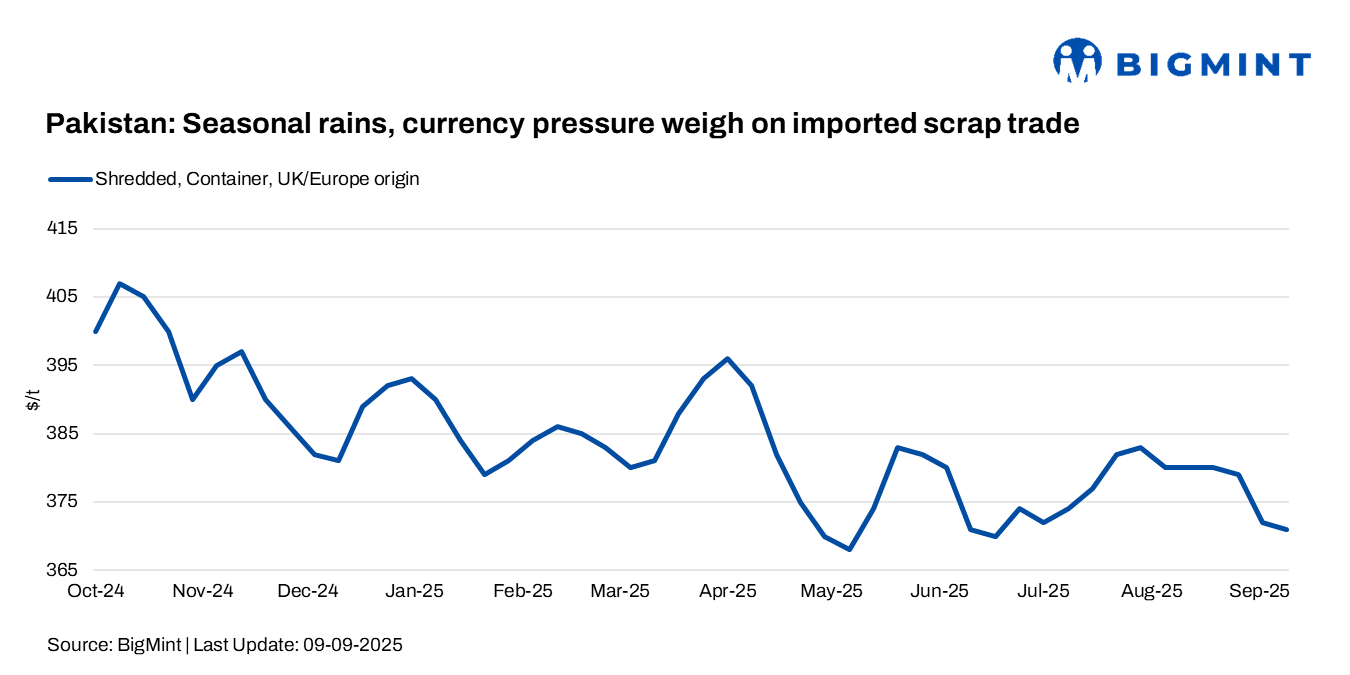
Pakistan’s imported scrap market edged lower w-o-w, weighed down by weak GBP-USD conversion, heavy rainfall, and prevailing bearish steel market sentiment.
BigMint assessed European/UK-origin shredded at $371/tonne (t) CFR Qasim, inching down by $1/t w-o-w.
As per a market insider, around 5-6 deals were concluded at $368-372/t CFR Qasim over the past week.
As per market insiders, heavy rains and flooding have slowed sales sharply, with Bala makers (furnaces) more vulnerable than bar mills, keeping Bala levels low and unsettled this week. Shredded was offered at $372-375/t CFR with bids at $366-368/t, while UAE material was quoted higher, at $388-390/t against bids of $382-383/t, which limited buying activity.
As per a major trader based in the UAE, shredded asking levels were around $390/t, with bids at $380-382/t CFR Qasim. HMS-PNS mix was discussed at $372-375/t CFR, while UAE-origin HMS was offered at $365/t CFR. Sheared HMS was last sold at $372/t, and 1,000 t of UK shredded were booked last weekend at $370/t CFR Qasim. However, starting this week, no major deals were heard, with shredded offers hovering at $372-375/t.

A Karachi-based steel mill source said local scrap was at PKR 141,000/t ($497/t), billets at PKR 200,000/t ($705/t), bars at PKR 230,000/t ($811/t), and bala at PKR 184,000-186,000/t ($648-655/t). Rebar grade 60 stood at PKR 235,000/t ($828/t). He added that heavy rains in Punjab, now moving towards Sindh, dampened demand, while 1,000 t of UK shredded were booked at $370/t CFR Qasim.
A weak GBP-USD conversion rate, bearish sentiment, and seasonal rains, which further slowed construction activity, kept mills operating at 30-40% of their capacity. With margins squeezed by competitive pricing, industry players warn some mills may scale back or suspend operations if demand fails to recover.
Outlook
Pakistan’s scrap market is likely to stay weak in the near term, with a poor exchange rate and flooding in key regions keeping demand weaker. Prices may see further downside until the post-monsoon construction resumption revives steel consumption.
Leave a Reply