- Imported scrap prices firm on tight supply, demand weak
- Mills cautious amid taxes, margins, and liquidity pressure
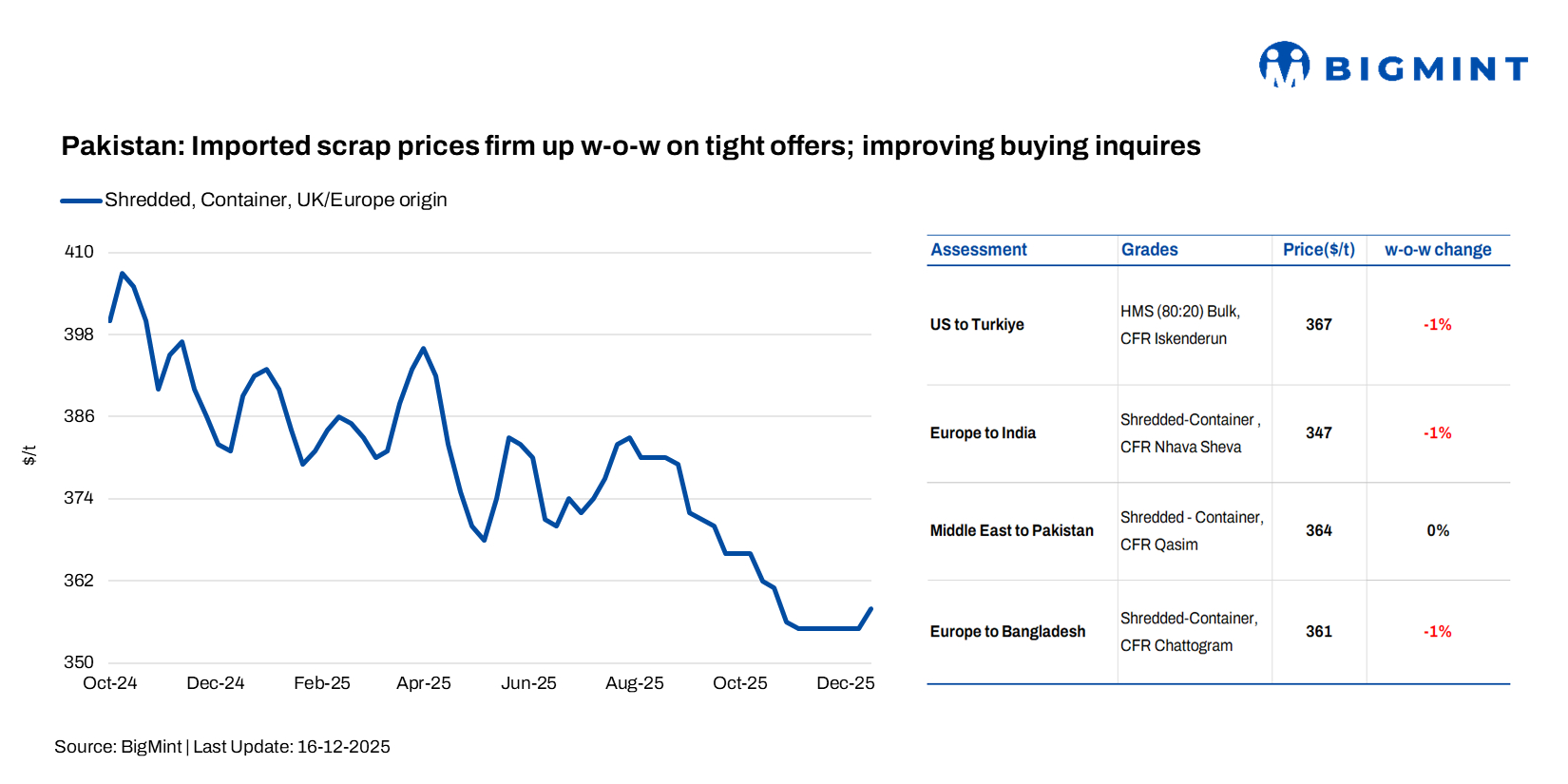
Pakistan’s imported shredded scrap price inched up by $3/t w-o-w at $358-360/t CFR for the week ended 16 December. Imported scrap market activity remained subdued, with overall sentiment quiet and momentum limited. However, offers edged higher amid fewer cargoes available in the market, prompting some buyers to turn slightly more active ahead of the holiday period.
Buying interest remained selective and price-sensitive, with most enquiries concentrated around lower, workable levels rather than chasing rising offers.
The IMF’s $1.2 billion disbursement has lifted SBP reserves and marginally improved market confidence. However, a major transport strike disrupted logistics, tightened cashflows, and slowed spot activity. As operations normalise, rebar demand is expected to see a modest pickup, offering some near-term support.
Scrap prices remained firm, driven more by limited availability than by liquidity. Recent transactions for Europe/UK shredded were heard at $354-359/t CFR Qasim. In the Middle East, market conditions stayed balanced, with sellers holding firm while buyers faced limited availability for January shipments.
Despite this, overall sentiment softened as domestic demand remained weak. Mills continued to buy cautiously, focusing only on lower workable levels amid margin pressure and uncertainty in downstream steel consumption.

The Pakistan FBR has revised the minimum values on which sales tax must be calculated for locally produced steel. Even if mills invoice at a lower price, tax will be charged based on these benchmark rates.
- Steel bars: Based on the average national retail price published by PBS, minus PKR 1,500/t.
- Billets: Taxed at 85% of the steel-bar benchmark.
- Ingots/bala: Taxed at 80% of the steel-bar benchmark.
- Ship plates: Taxed at 75% of the steel-bar benchmark.
Purpose is to prevent under-invoicing and standardize tax valuation across the steel industry.
Gadani activity remains subdued despite Prime Green Recyclers becoming Pakistan’s first HKC-certified yard. Limited HKC capacity, DASR compliance hurdles, and uncompetitive pricing have kept most vessels away, leaving the waterfront largely inactive, with only a small LDT unit arriving due to weaker regional alternatives.
Steel plate prices have slipped toward $575/t under pressure from cheaper Iranian imports, weighing on sentiment. Despite easing inflation and a stable PKR, limited HKC compliance is likely to keep Pakistan’s recycling market weak into 2026.
Outlook: We expect the market to remain cautious in December, with scrap prices holding firm on limited availability rather than a recovery in demand. Buying is likely to stay selective as mills manage tight margins, weak downstream consumption, and the impact of higher tax benchmarks on cashflows.

Leave a Reply