- Recovery expected post-monsoon with construction revival
- Prolonged losses could push some mills to cut or halt operations
Pakistan’s imported scrap market fell sharply w-o-w, pressured by a weak UK pound-to-dollar conversion and bearish sentiment. Seasonal rains further slowed construction, keeping mill demand muted, with most plants still operating at 30-40% of their capacity, as seen since early this year.
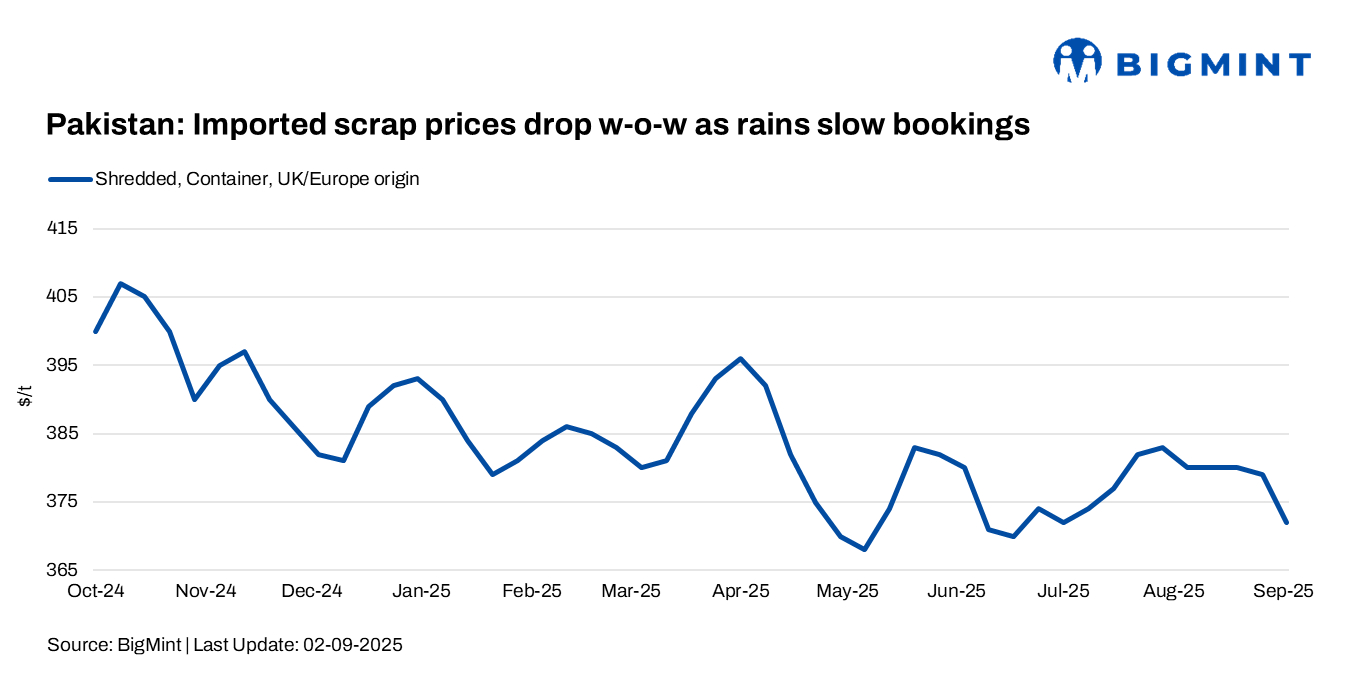
BigMint assessed European/UK-origin shredded at $372/tonne (t) CFR Qasim, down $7/t w-o-w.
As per a market insider, around 5-6 deals were concluded at $370-379/t CFR Qasim over the past week.
Shredded prices witnessed a gradual slide, trading at $370-372/t CFR depending on quality, against $377-378/t two weeks ago. The decline followed sluggish market activity, with no major buyers stepping in.
As per insiders, the market remained saturated, with competitive pricing squeezing margins. Industry participants noted that if losses persist, some mills may be forced to scale back or shut operations until demand shows signs of recovery.
As per market insiders, some Chinese hot-rolled coils (HRCs) were heard to have been booked at $490-495/t CFR Karachi (late October shipment), while German Busheling was offered at $390-395/t CFR with only one deal heard.
As per a major trader based in the UAE, Middle-Eastern HMS-PNS was heard at $365-370/t CFR, but imported scrap trades in Pakistan remained mostly inactive amid weak buying. Heavy rains and flooding further slowed activity, while finished steel demand showed no signs of recovery. Panic sales also continued to weigh on prices. Until recently, Pakistan was the only active buyer in South Asia, mainly for UK/EU shredded.

A Karachi-based steel mill source said domestic scrap prices remained range-bound w-o-w at PKR 138,000-141,000/t ($488-498/t), while rebar traded at PKR 237,000-238,000/t ($837-841/t). He noted that rebar demand was moderate, but overall sentiment stayed weak, with offers sliding.
Outlook
A sustained rebound will depend on liquidity flows and PKR stability. Imported scrap may stay more attractive than domestic material due to cost and tax advantages, but a notable pick-up in trade volumes is more likely by mid- to late-September, following the monsoon, if rebar sales improve with a recovery in construction activity.
Leave a Reply